

1 Quantitative Phase Imaging: Principles and Applications
15
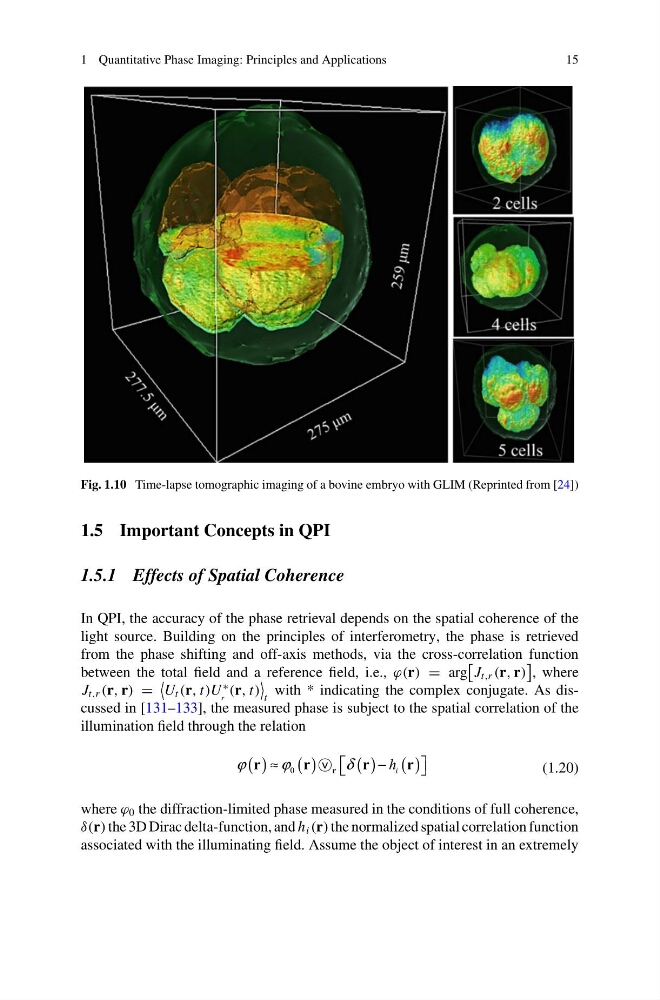
Fig. 1.10 Time-lapse tomographic imaging of a bovine embryo with GLIM (Reprinted from [24])
1.5 Important Concepts in QPI
1.5.1 Effects of Spatial Coherence
In QPI, the accuracy of the phase retrieval depends on the spatial coherence of the
light source. Building on the principles of interferometry, the phase is retrieved
from the phase shifting and off-axis methods, via the cross-correlation function
between the total field and a reference field, i.e., ϕ(r) = arg
J t,r (r, r)
, where
J t,r (r, r) =
U t (r, t)U
∗
r
(r, t)
t
with * indicating the complex conjugate. As discussed in [131–133], the measured phase is subject to the spatial correlation of the
illumination field through the relation
( )
( )
( ) ( )
0
i
h
ϕ
ϕ
δ
≈
−
⎡
⎤
⎣
⎦
r
r
r
r
r
ⓥ
(1.20)
where ϕ 0 the diffraction-limited phase measured in the conditions of full coherence,
δ(r) the 3D Dirac delta-function, and h i (r) the normalized spatial correlation function
associated with the illuminating field. Assume the object of interest in an extremely
15
Fig. 1.10 Time-lapse tomographic imaging of a bovine embryo with GLIM (Reprinted from [24])
1.5 Important Concepts in QPI
1.5.1 Effects of Spatial Coherence
In QPI, the accuracy of the phase retrieval depends on the spatial coherence of the
light source. Building on the principles of interferometry, the phase is retrieved
from the phase shifting and off-axis methods, via the cross-correlation function
between the total field and a reference field, i.e., ϕ(r) = arg
J t,r (r, r)
, where
J t,r (r, r) =
U t (r, t)U
∗
r
(r, t)
t
with * indicating the complex conjugate. As discussed in [131–133], the measured phase is subject to the spatial correlation of the
illumination field through the relation
( )
( )
( ) ( )
0
i
h
ϕ
ϕ
δ
≈
−
⎡
⎤
⎣
⎦
r
r
r
r
r
ⓥ
(1.20)
where ϕ 0 the diffraction-limited phase measured in the conditions of full coherence,
δ(r) the 3D Dirac delta-function, and h i (r) the normalized spatial correlation function
associated with the illuminating field. Assume the object of interest in an extremely