

316
I. I. Smolyaninov and V. N. Smolyaninova
developed by Narimanov’s group [10] an optical metamaterial made of a concentric
arrangement of metal and dielectric cylinders may be characterized by a strongly
anisotropic dielectric permittivity tensor in which the tangential ε θ and the radial ε r
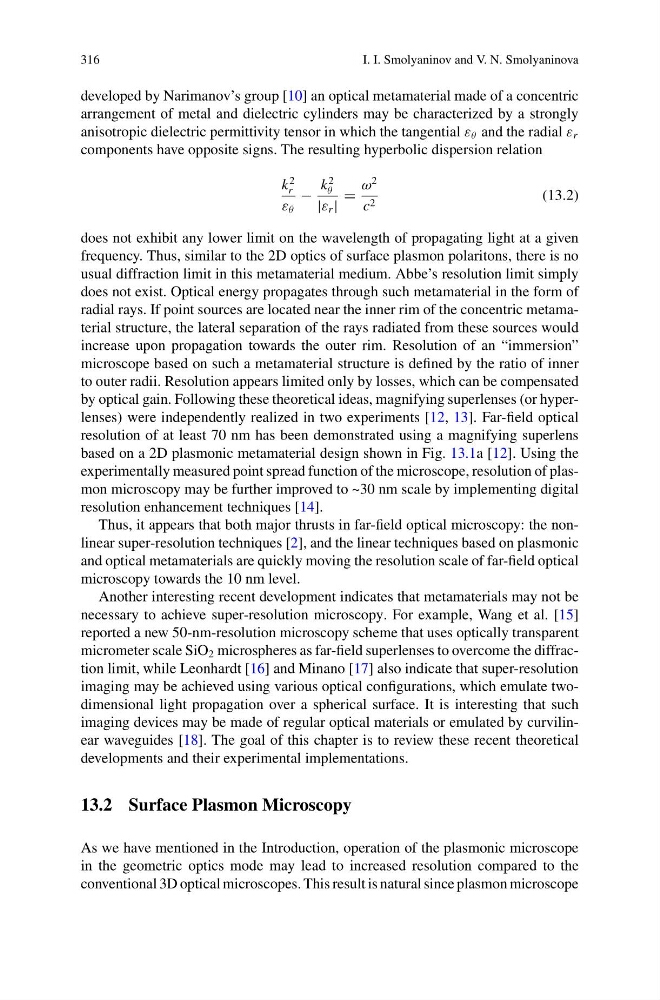
components have opposite signs. The resulting hyperbolic dispersion relation
k
2
r
ε θ
−
k
2
θ
|ε r |
=
ω
2
c 2
(13.2)
does not exhibit any lower limit on the wavelength of propagating light at a given
frequency. Thus, similar to the 2D optics of surface plasmon polaritons, there is no
usual diffraction limit in this metamaterial medium. Abbe’s resolution limit simply
does not exist. Optical energy propagates through such metamaterial in the form of
radial rays. If point sources are located near the inner rim of the concentric metamaterial structure, the lateral separation of the rays radiated from these sources would
increase upon propagation towards the outer rim. Resolution of an “immersion”
microscope based on such a metamaterial structure is defined by the ratio of inner
to outer radii. Resolution appears limited only by losses, which can be compensated
by optical gain. Following these theoretical ideas, magnifying superlenses (or hyperlenses) were independently realized in two experiments [12, 13]. Far-field optical
resolution of at least 70 nm has been demonstrated using a magnifying superlens
based on a 2D plasmonic metamaterial design shown in Fig. 13.1a [12]. Using the
experimentally measured point spread function of the microscope, resolution of plasmon microscopy may be further improved to ~30 nm scale by implementing digital
resolution enhancement techniques [14].
Thus, it appears that both major thrusts in far-field optical microscopy: the nonlinear super-resolution techniques [2], and the linear techniques based on plasmonic
and optical metamaterials are quickly moving the resolution scale of far-field optical
microscopy towards the 10 nm level.
Another interesting recent development indicates that metamaterials may not be
necessary to achieve super-resolution microscopy. For example, Wang et al. [15]
reported a new 50-nm-resolution microscopy scheme that uses optically transparent
micrometer scale SiO 2 microspheres as far-field superlenses to overcome the diffraction limit, while Leonhardt [16] and Minano [17] also indicate that super-resolution
imaging may be achieved using various optical configurations, which emulate twodimensional light propagation over a spherical surface. It is interesting that such
imaging devices may be made of regular optical materials or emulated by curvilinear waveguides [18]. The goal of this chapter is to review these recent theoretical
developments and their experimental implementations.
13.2 Surface Plasmon Microscopy
As we have mentioned in the Introduction, operation of the plasmonic microscope
in the geometric optics mode may lead to increased resolution compared to the
conventional 3D optical microscopes. This result is natural since plasmon microscope
I. I. Smolyaninov and V. N. Smolyaninova
developed by Narimanov’s group [10] an optical metamaterial made of a concentric
arrangement of metal and dielectric cylinders may be characterized by a strongly
anisotropic dielectric permittivity tensor in which the tangential ε θ and the radial ε r
components have opposite signs. The resulting hyperbolic dispersion relation
k
2
r
ε θ
−
k
2
θ
|ε r |
=
ω
2
c 2
(13.2)
does not exhibit any lower limit on the wavelength of propagating light at a given
frequency. Thus, similar to the 2D optics of surface plasmon polaritons, there is no
usual diffraction limit in this metamaterial medium. Abbe’s resolution limit simply
does not exist. Optical energy propagates through such metamaterial in the form of
radial rays. If point sources are located near the inner rim of the concentric metamaterial structure, the lateral separation of the rays radiated from these sources would
increase upon propagation towards the outer rim. Resolution of an “immersion”
microscope based on such a metamaterial structure is defined by the ratio of inner
to outer radii. Resolution appears limited only by losses, which can be compensated
by optical gain. Following these theoretical ideas, magnifying superlenses (or hyperlenses) were independently realized in two experiments [12, 13]. Far-field optical
resolution of at least 70 nm has been demonstrated using a magnifying superlens
based on a 2D plasmonic metamaterial design shown in Fig. 13.1a [12]. Using the
experimentally measured point spread function of the microscope, resolution of plasmon microscopy may be further improved to ~30 nm scale by implementing digital
resolution enhancement techniques [14].
Thus, it appears that both major thrusts in far-field optical microscopy: the nonlinear super-resolution techniques [2], and the linear techniques based on plasmonic
and optical metamaterials are quickly moving the resolution scale of far-field optical
microscopy towards the 10 nm level.
Another interesting recent development indicates that metamaterials may not be
necessary to achieve super-resolution microscopy. For example, Wang et al. [15]
reported a new 50-nm-resolution microscopy scheme that uses optically transparent
micrometer scale SiO 2 microspheres as far-field superlenses to overcome the diffraction limit, while Leonhardt [16] and Minano [17] also indicate that super-resolution
imaging may be achieved using various optical configurations, which emulate twodimensional light propagation over a spherical surface. It is interesting that such
imaging devices may be made of regular optical materials or emulated by curvilinear waveguides [18]. The goal of this chapter is to review these recent theoretical
developments and their experimental implementations.
13.2 Surface Plasmon Microscopy
As we have mentioned in the Introduction, operation of the plasmonic microscope
in the geometric optics mode may lead to increased resolution compared to the
conventional 3D optical microscopes. This result is natural since plasmon microscope