

11 Label-Free Super-Resolution Microscopy by Nonlinear …
267
exhibits complex dynamics which determine the various coefficients of R. We
assume that in the short times (ps-scale), the instantaneous distribution of charge
carriers or phonons mimics the 3D absorption profile of the pump, and induces
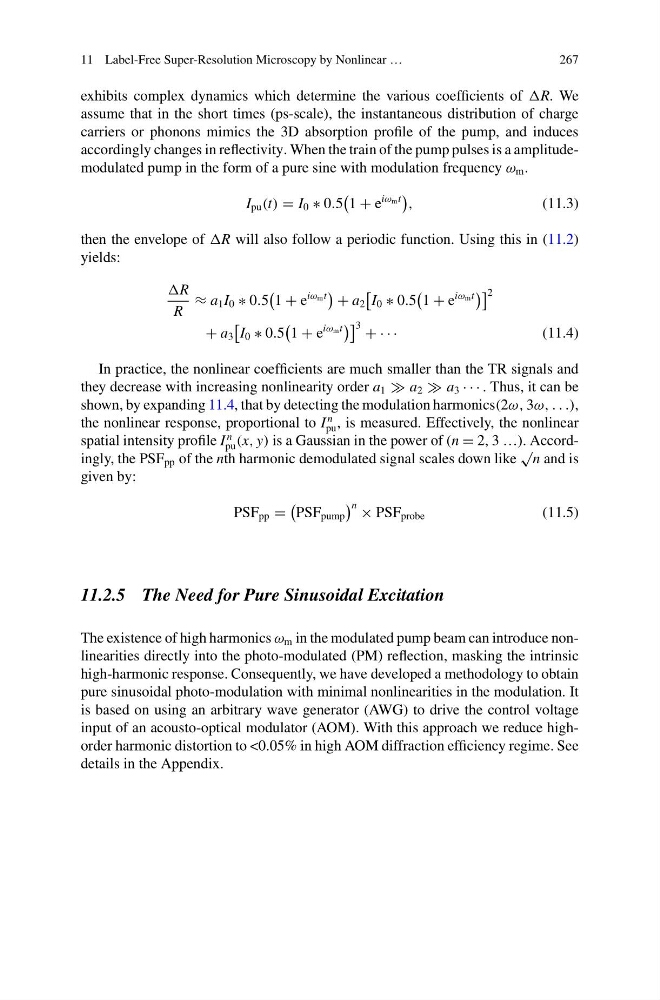
accordingly changes in reflectivity. When the train of the pump pulses is a amplitudemodulated pump in the form of a pure sine with modulation frequency ω m .
I pu (t) = I 0 ∗ 0.5
1 + e
iω m t
,
(11.3)
then the envelope of R will also follow a periodic function. Using this in (11.2)
yields:
R
R
≈ a 1 I 0 ∗ 0.5
1 + e
iω m t
+ a 2
I 0 ∗ 0.5
1 + e
iω m t
2
+ a 3
I 0 ∗ 0.5
1 + e
iω m t
3 + · · ·
(11.4)
In practice, the nonlinear coefficients are much smaller than the TR signals and
they decrease with increasing nonlinearity order a 1 a 2 a 3 · · · . Thus, it can be
shown, by expanding 11.4, that by detecting the modulation harmonics(2ω, 3ω, . . .),
the nonlinear response, proportional to I
n
pu , is measured. Effectively, the nonlinear
spatial intensity profile I
n
pu (x, y) is a Gaussian in the power of (n = 2, 3 …). Accordingly, the PSF pp of the nth harmonic demodulated signal scales down like
√
n and is
given by:
PSF pp =
PSF pump
n × PSF probe
(11.5)
11.2.5 The Need for Pure Sinusoidal Excitation
The existence of high harmonics ω m in the modulated pump beam can introduce nonlinearities directly into the photo-modulated (PM) reflection, masking the intrinsic
high-harmonic response. Consequently, we have developed a methodology to obtain
pure sinusoidal photo-modulation with minimal nonlinearities in the modulation. It
is based on using an arbitrary wave generator (AWG) to drive the control voltage
input of an acousto-optical modulator (AOM). With this approach we reduce highorder harmonic distortion to <0.05% in high AOM diffraction efficiency regime. See
details in the Appendix.
267
exhibits complex dynamics which determine the various coefficients of R. We
assume that in the short times (ps-scale), the instantaneous distribution of charge
carriers or phonons mimics the 3D absorption profile of the pump, and induces
accordingly changes in reflectivity. When the train of the pump pulses is a amplitudemodulated pump in the form of a pure sine with modulation frequency ω m .
I pu (t) = I 0 ∗ 0.5
1 + e
iω m t
,
(11.3)
then the envelope of R will also follow a periodic function. Using this in (11.2)
yields:
R
R
≈ a 1 I 0 ∗ 0.5
1 + e
iω m t
+ a 2
I 0 ∗ 0.5
1 + e
iω m t
2
+ a 3
I 0 ∗ 0.5
1 + e
iω m t
3 + · · ·
(11.4)
In practice, the nonlinear coefficients are much smaller than the TR signals and
they decrease with increasing nonlinearity order a 1 a 2 a 3 · · · . Thus, it can be
shown, by expanding 11.4, that by detecting the modulation harmonics(2ω, 3ω, . . .),
the nonlinear response, proportional to I
n
pu , is measured. Effectively, the nonlinear
spatial intensity profile I
n
pu (x, y) is a Gaussian in the power of (n = 2, 3 …). Accordingly, the PSF pp of the nth harmonic demodulated signal scales down like
√
n and is
given by:
PSF pp =
PSF pump
n × PSF probe
(11.5)
11.2.5 The Need for Pure Sinusoidal Excitation
The existence of high harmonics ω m in the modulated pump beam can introduce nonlinearities directly into the photo-modulated (PM) reflection, masking the intrinsic
high-harmonic response. Consequently, we have developed a methodology to obtain
pure sinusoidal photo-modulation with minimal nonlinearities in the modulation. It
is based on using an arbitrary wave generator (AWG) to drive the control voltage
input of an acousto-optical modulator (AOM). With this approach we reduce highorder harmonic distortion to <0.05% in high AOM diffraction efficiency regime. See
details in the Appendix.