

11 Label-Free Super-Resolution Microscopy by Nonlinear …
265
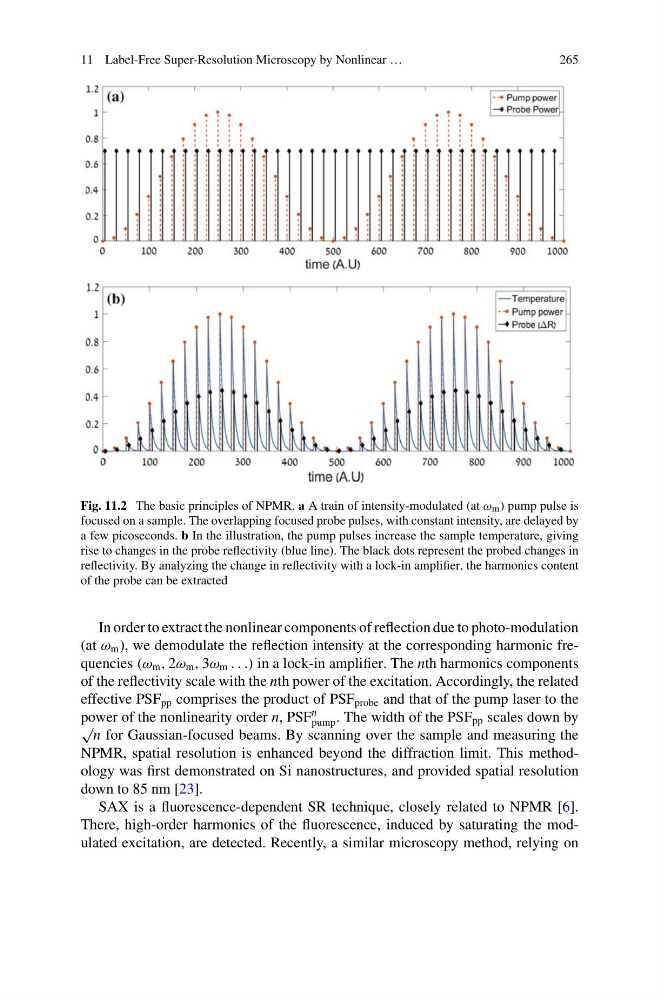
Fig. 11.2 The basic principles of NPMR. a A train of intensity-modulated (at ω m ) pump pulse is
focused on a sample. The overlapping focused probe pulses, with constant intensity, are delayed by
a few picoseconds. b In the illustration, the pump pulses increase the sample temperature, giving
rise to changes in the probe reflectivity (blue line). The black dots represent the probed changes in
reflectivity. By analyzing the change in reflectivity with a lock-in amplifier, the harmonics content
of the probe can be extracted
In order to extract the nonlinear components of reflection due to photo-modulation
(at ω m ), we demodulate the reflection intensity at the corresponding harmonic frequencies (ω m , 2ω m , 3ω m . . .) in a lock-in amplifier. The nth harmonics components
of the reflectivity scale with the nth power of the excitation. Accordingly, the related
effective PSF pp comprises the product of PSF probe and that of the pump laser to the
power of the nonlinearity order n, PSF
n
pump . The width of the PSF pp scales down by
√
n for Gaussian-focused beams. By scanning over the sample and measuring the
NPMR, spatial resolution is enhanced beyond the diffraction limit. This methodology was first demonstrated on Si nanostructures, and provided spatial resolution
down to 85 nm [23].
SAX is a fluorescence-dependent SR technique, closely related to NPMR [6].
There, high-order harmonics of the fluorescence, induced by saturating the modulated excitation, are detected. Recently, a similar microscopy method, relying on
265
Fig. 11.2 The basic principles of NPMR. a A train of intensity-modulated (at ω m ) pump pulse is
focused on a sample. The overlapping focused probe pulses, with constant intensity, are delayed by
a few picoseconds. b In the illustration, the pump pulses increase the sample temperature, giving
rise to changes in the probe reflectivity (blue line). The black dots represent the probed changes in
reflectivity. By analyzing the change in reflectivity with a lock-in amplifier, the harmonics content
of the probe can be extracted
In order to extract the nonlinear components of reflection due to photo-modulation
(at ω m ), we demodulate the reflection intensity at the corresponding harmonic frequencies (ω m , 2ω m , 3ω m . . .) in a lock-in amplifier. The nth harmonics components
of the reflectivity scale with the nth power of the excitation. Accordingly, the related
effective PSF pp comprises the product of PSF probe and that of the pump laser to the
power of the nonlinearity order n, PSF
n
pump . The width of the PSF pp scales down by
√
n for Gaussian-focused beams. By scanning over the sample and measuring the
NPMR, spatial resolution is enhanced beyond the diffraction limit. This methodology was first demonstrated on Si nanostructures, and provided spatial resolution
down to 85 nm [23].
SAX is a fluorescence-dependent SR technique, closely related to NPMR [6].
There, high-order harmonics of the fluorescence, induced by saturating the modulated excitation, are detected. Recently, a similar microscopy method, relying on