

10 Super-Resolution Imaging Based on Nonlinear Plasmonic Scattering
257
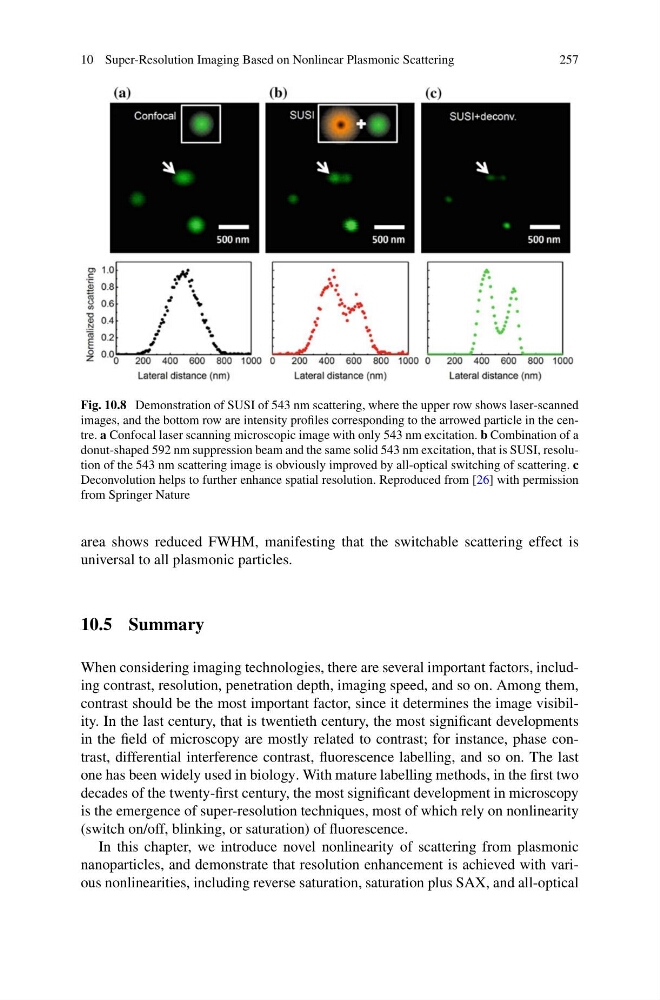
Fig. 10.8 Demonstration of SUSI of 543 nm scattering, where the upper row shows laser-scanned
images, and the bottom row are intensity profiles corresponding to the arrowed particle in the centre. a Confocal laser scanning microscopic image with only 543 nm excitation. b Combination of a
donut-shaped 592 nm suppression beam and the same solid 543 nm excitation, that is SUSI, resolution of the 543 nm scattering image is obviously improved by all-optical switching of scattering. c
Deconvolution helps to further enhance spatial resolution. Reproduced from [26] with permission
from Springer Nature
area shows reduced FWHM, manifesting that the switchable scattering effect is
universal to all plasmonic particles.
10.5 Summary
When considering imaging technologies, there are several important factors, including contrast, resolution, penetration depth, imaging speed, and so on. Among them,
contrast should be the most important factor, since it determines the image visibility. In the last century, that is twentieth century, the most significant developments
in the field of microscopy are mostly related to contrast; for instance, phase contrast, differential interference contrast, fluorescence labelling, and so on. The last
one has been widely used in biology. With mature labelling methods, in the first two
decades of the twenty-first century, the most significant development in microscopy
is the emergence of super-resolution techniques, most of which rely on nonlinearity
(switch on/off, blinking, or saturation) of fluorescence.
In this chapter, we introduce novel nonlinearity of scattering from plasmonic
nanoparticles, and demonstrate that resolution enhancement is achieved with various nonlinearities, including reverse saturation, saturation plus SAX, and all-optical
257
Fig. 10.8 Demonstration of SUSI of 543 nm scattering, where the upper row shows laser-scanned
images, and the bottom row are intensity profiles corresponding to the arrowed particle in the centre. a Confocal laser scanning microscopic image with only 543 nm excitation. b Combination of a
donut-shaped 592 nm suppression beam and the same solid 543 nm excitation, that is SUSI, resolution of the 543 nm scattering image is obviously improved by all-optical switching of scattering. c
Deconvolution helps to further enhance spatial resolution. Reproduced from [26] with permission
from Springer Nature
area shows reduced FWHM, manifesting that the switchable scattering effect is
universal to all plasmonic particles.
10.5 Summary
When considering imaging technologies, there are several important factors, including contrast, resolution, penetration depth, imaging speed, and so on. Among them,
contrast should be the most important factor, since it determines the image visibility. In the last century, that is twentieth century, the most significant developments
in the field of microscopy are mostly related to contrast; for instance, phase contrast, differential interference contrast, fluorescence labelling, and so on. The last
one has been widely used in biology. With mature labelling methods, in the first two
decades of the twenty-first century, the most significant development in microscopy
is the emergence of super-resolution techniques, most of which rely on nonlinearity
(switch on/off, blinking, or saturation) of fluorescence.
In this chapter, we introduce novel nonlinearity of scattering from plasmonic
nanoparticles, and demonstrate that resolution enhancement is achieved with various nonlinearities, including reverse saturation, saturation plus SAX, and all-optical