

10 Super-Resolution Imaging Based on Nonlinear Plasmonic Scattering
255
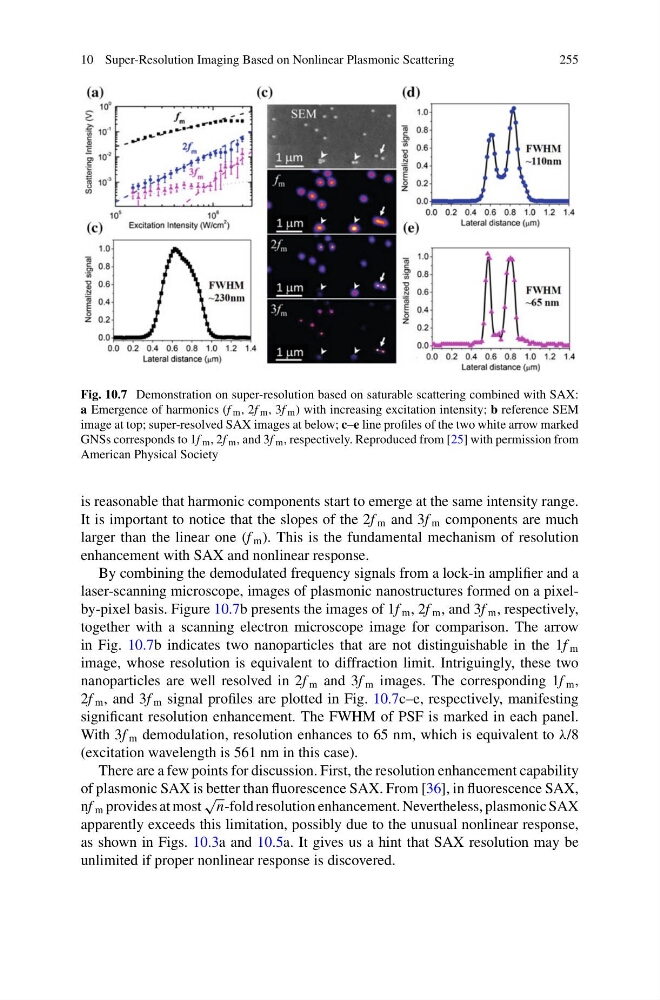
Fig. 10.7 Demonstration on super-resolution based on saturable scattering combined with SAX:
a Emergence of harmonics (f m , 2f m , 3f m ) with increasing excitation intensity; b reference SEM
image at top; super-resolved SAX images at below; c–e line profiles of the two white arrow marked
GNSs corresponds to 1f m , 2f m , and 3f m , respectively. Reproduced from [25] with permission from
American Physical Society
is reasonable that harmonic components start to emerge at the same intensity range.
It is important to notice that the slopes of the 2f m and 3f m components are much
larger than the linear one (f m ). This is the fundamental mechanism of resolution
enhancement with SAX and nonlinear response.
By combining the demodulated frequency signals from a lock-in amplifier and a
laser-scanning microscope, images of plasmonic nanostructures formed on a pixelby-pixel basis. Figure 10.7b presents the images of 1f m , 2f m , and 3f m , respectively,
together with a scanning electron microscope image for comparison. The arrow
in Fig. 10.7b indicates two nanoparticles that are not distinguishable in the 1f m
image, whose resolution is equivalent to diffraction limit. Intriguingly, these two
nanoparticles are well resolved in 2f m and 3f m images. The corresponding 1f m ,
2f m , and 3f m signal profiles are plotted in Fig. 10.7c–e, respectively, manifesting
significant resolution enhancement. The FWHM of PSF is marked in each panel.
With 3f m demodulation, resolution enhances to 65 nm, which is equivalent to λ/8
(excitation wavelength is 561 nm in this case).
There are a few points for discussion. First, the resolution enhancement capability
of plasmonic SAX is better than fluorescence SAX. From [36], in fluorescence SAX,
nf m provides at most
√
n-fold resolution enhancement. Nevertheless, plasmonic SAX
apparently exceeds this limitation, possibly due to the unusual nonlinear response,
as shown in Figs. 10.3a and 10.5a. It gives us a hint that SAX resolution may be
unlimited if proper nonlinear response is discovered.
255
Fig. 10.7 Demonstration on super-resolution based on saturable scattering combined with SAX:
a Emergence of harmonics (f m , 2f m , 3f m ) with increasing excitation intensity; b reference SEM
image at top; super-resolved SAX images at below; c–e line profiles of the two white arrow marked
GNSs corresponds to 1f m , 2f m , and 3f m , respectively. Reproduced from [25] with permission from
American Physical Society
is reasonable that harmonic components start to emerge at the same intensity range.
It is important to notice that the slopes of the 2f m and 3f m components are much
larger than the linear one (f m ). This is the fundamental mechanism of resolution
enhancement with SAX and nonlinear response.
By combining the demodulated frequency signals from a lock-in amplifier and a
laser-scanning microscope, images of plasmonic nanostructures formed on a pixelby-pixel basis. Figure 10.7b presents the images of 1f m , 2f m , and 3f m , respectively,
together with a scanning electron microscope image for comparison. The arrow
in Fig. 10.7b indicates two nanoparticles that are not distinguishable in the 1f m
image, whose resolution is equivalent to diffraction limit. Intriguingly, these two
nanoparticles are well resolved in 2f m and 3f m images. The corresponding 1f m ,
2f m , and 3f m signal profiles are plotted in Fig. 10.7c–e, respectively, manifesting
significant resolution enhancement. The FWHM of PSF is marked in each panel.
With 3f m demodulation, resolution enhances to 65 nm, which is equivalent to λ/8
(excitation wavelength is 561 nm in this case).
There are a few points for discussion. First, the resolution enhancement capability
of plasmonic SAX is better than fluorescence SAX. From [36], in fluorescence SAX,
nf m provides at most
√
n-fold resolution enhancement. Nevertheless, plasmonic SAX
apparently exceeds this limitation, possibly due to the unusual nonlinear response,
as shown in Figs. 10.3a and 10.5a. It gives us a hint that SAX resolution may be
unlimited if proper nonlinear response is discovered.