

246
T. C. Jagadale and S.-W. Chu
10.2 Principle of Super-Resolution Based on Nonlinear
Absorption and Emission
As mentioned in the previous section, super-resolution can be achieved by nonlinear absorption or emission. Below we specifically review the principle of two
techniques, SAX and STED. The former relies on saturation of emission, and resolution is enhanced by extracting the saturated part by temporal modulation and
demodulation. The latter is based on all-optical switching and saturation of stimulated emission, which can enhance spatial resolution by adding a spatial modulation
pattern to deplete the emission around the centre of focus.
10.2.1 Saturation of Emission + Temporal Modulation: SAX
It is well known that fluorescence emission intensity saturates at high excitation power
[24]. When a sample is illuminated by a focussed laser light, the saturated excitation
dominates in the centre of focus spot due to Gaussian nature of illumination beam.
Therefore, the extraction of nonlinear signals allows detecting emission signals from
only a small fraction within the emission detection volume, resulting in the spatial
resolution enhancement. This is the underlying concept of SAX.
The key of SAX super-resolution is the extraction of nonlinear signals from the
mixture of linear and nonlinear signals within the excitation spot. One clever idea
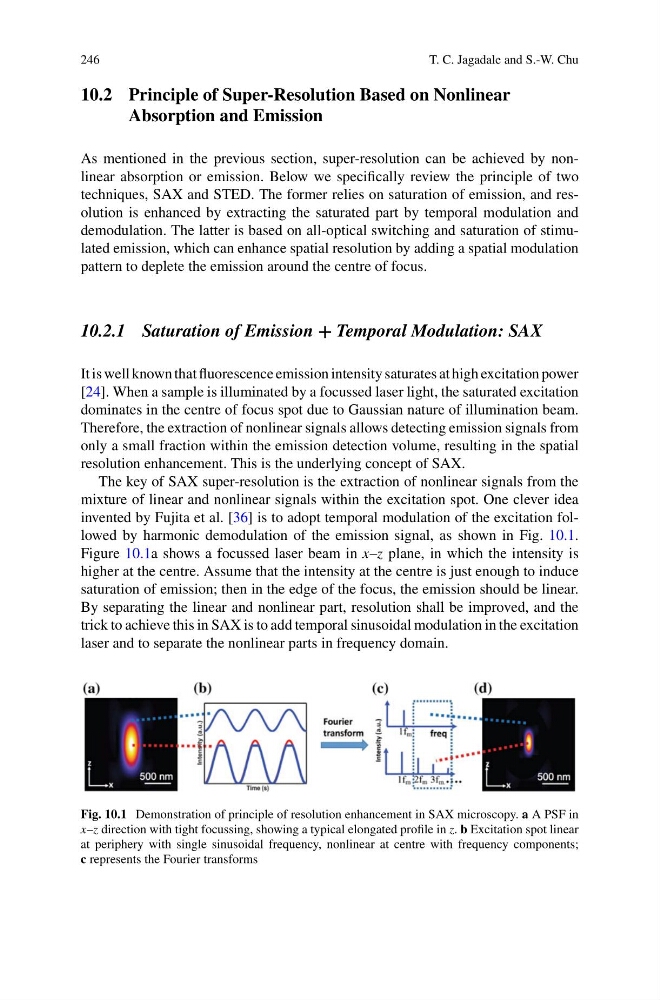
invented by Fujita et al. [36] is to adopt temporal modulation of the excitation followed by harmonic demodulation of the emission signal, as shown in Fig. 10.1.
Figure 10.1a shows a focussed laser beam in x–z plane, in which the intensity is
higher at the centre. Assume that the intensity at the centre is just enough to induce
saturation of emission; then in the edge of the focus, the emission should be linear.
By separating the linear and nonlinear part, resolution shall be improved, and the
trick to achieve this in SAX is to add temporal sinusoidal modulation in the excitation
laser and to separate the nonlinear parts in frequency domain.
Fig. 10.1 Demonstration of principle of resolution enhancement in SAX microscopy. a A PSF in
x–z direction with tight focussing, showing a typical elongated profile in z. b Excitation spot linear
at periphery with single sinusoidal frequency, nonlinear at centre with frequency components;
c represents the Fourier transforms
T. C. Jagadale and S.-W. Chu
10.2 Principle of Super-Resolution Based on Nonlinear
Absorption and Emission
As mentioned in the previous section, super-resolution can be achieved by nonlinear absorption or emission. Below we specifically review the principle of two
techniques, SAX and STED. The former relies on saturation of emission, and resolution is enhanced by extracting the saturated part by temporal modulation and
demodulation. The latter is based on all-optical switching and saturation of stimulated emission, which can enhance spatial resolution by adding a spatial modulation
pattern to deplete the emission around the centre of focus.
10.2.1 Saturation of Emission + Temporal Modulation: SAX
It is well known that fluorescence emission intensity saturates at high excitation power
[24]. When a sample is illuminated by a focussed laser light, the saturated excitation
dominates in the centre of focus spot due to Gaussian nature of illumination beam.
Therefore, the extraction of nonlinear signals allows detecting emission signals from
only a small fraction within the emission detection volume, resulting in the spatial
resolution enhancement. This is the underlying concept of SAX.
The key of SAX super-resolution is the extraction of nonlinear signals from the
mixture of linear and nonlinear signals within the excitation spot. One clever idea
invented by Fujita et al. [36] is to adopt temporal modulation of the excitation followed by harmonic demodulation of the emission signal, as shown in Fig. 10.1.
Figure 10.1a shows a focussed laser beam in x–z plane, in which the intensity is
higher at the centre. Assume that the intensity at the centre is just enough to induce
saturation of emission; then in the edge of the focus, the emission should be linear.
By separating the linear and nonlinear part, resolution shall be improved, and the
trick to achieve this in SAX is to add temporal sinusoidal modulation in the excitation
laser and to separate the nonlinear parts in frequency domain.
Fig. 10.1 Demonstration of principle of resolution enhancement in SAX microscopy. a A PSF in
x–z direction with tight focussing, showing a typical elongated profile in z. b Excitation spot linear
at periphery with single sinusoidal frequency, nonlinear at centre with frequency components;
c represents the Fourier transforms