

224
H. Pinhas et al.
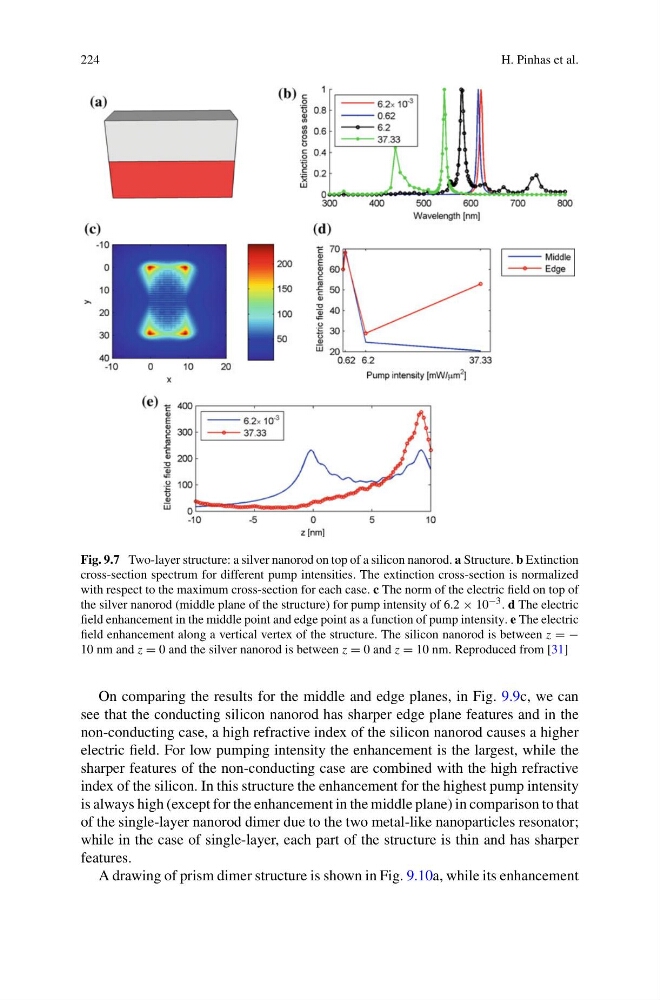
Fig. 9.7 Two-layer structure: a silver nanorod on top of a silicon nanorod. a Structure. b Extinction
cross-section spectrum for different pump intensities. The extinction cross-section is normalized
with respect to the maximum cross-section for each case. c The norm of the electric field on top of
the silver nanorod (middle plane of the structure) for pump intensity of 6.2 × 10 −3 . d The electric
field enhancement in the middle point and edge point as a function of pump intensity. e The electric
field enhancement along a vertical vertex of the structure. The silicon nanorod is between z = −
10 nm and z = 0 and the silver nanorod is between z = 0 and z = 10 nm. Reproduced from [31]
On comparing the results for the middle and edge planes, in Fig. 9.9c, we can
see that the conducting silicon nanorod has sharper edge plane features and in the
non-conducting case, a high refractive index of the silicon nanorod causes a higher
electric field. For low pumping intensity the enhancement is the largest, while the
sharper features of the non-conducting case are combined with the high refractive
index of the silicon. In this structure the enhancement for the highest pump intensity
is always high (except for the enhancement in the middle plane) in comparison to that
of the single-layer nanorod dimer due to the two metal-like nanoparticles resonator;
while in the case of single-layer, each part of the structure is thin and has sharper
features.
A drawing of prism dimer structure is shown in Fig. 9.10a, while its enhancement
H. Pinhas et al.
Fig. 9.7 Two-layer structure: a silver nanorod on top of a silicon nanorod. a Structure. b Extinction
cross-section spectrum for different pump intensities. The extinction cross-section is normalized
with respect to the maximum cross-section for each case. c The norm of the electric field on top of
the silver nanorod (middle plane of the structure) for pump intensity of 6.2 × 10 −3 . d The electric
field enhancement in the middle point and edge point as a function of pump intensity. e The electric
field enhancement along a vertical vertex of the structure. The silicon nanorod is between z = −
10 nm and z = 0 and the silver nanorod is between z = 0 and z = 10 nm. Reproduced from [31]
On comparing the results for the middle and edge planes, in Fig. 9.9c, we can
see that the conducting silicon nanorod has sharper edge plane features and in the
non-conducting case, a high refractive index of the silicon nanorod causes a higher
electric field. For low pumping intensity the enhancement is the largest, while the
sharper features of the non-conducting case are combined with the high refractive
index of the silicon. In this structure the enhancement for the highest pump intensity
is always high (except for the enhancement in the middle plane) in comparison to that
of the single-layer nanorod dimer due to the two metal-like nanoparticles resonator;
while in the case of single-layer, each part of the structure is thin and has sharper
features.
A drawing of prism dimer structure is shown in Fig. 9.10a, while its enhancement