

200
K. Fujita
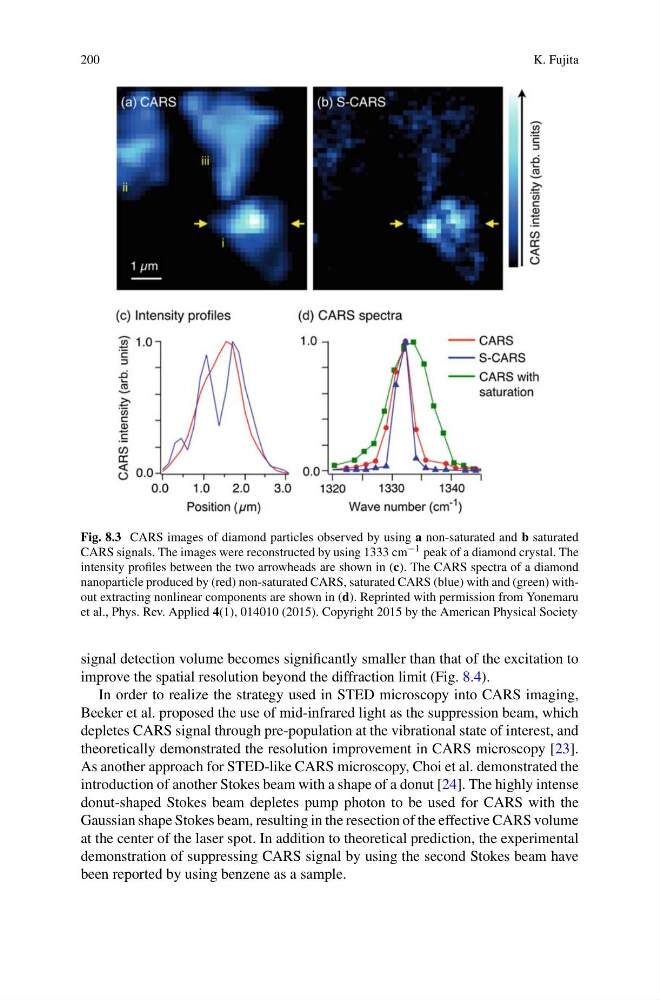
Fig. 8.3 CARS images of diamond particles observed by using a non-saturated and b saturated
CARS signals. The images were reconstructed by using 1333 cm −1 peak of a diamond crystal. The
intensity profiles between the two arrowheads are shown in (c). The CARS spectra of a diamond
nanoparticle produced by (red) non-saturated CARS, saturated CARS (blue) with and (green) without extracting nonlinear components are shown in (d). Reprinted with permission from Yonemaru
et al., Phys. Rev. Applied 4(1), 014010 (2015). Copyright 2015 by the American Physical Society
signal detection volume becomes significantly smaller than that of the excitation to
improve the spatial resolution beyond the diffraction limit (Fig. 8.4).
In order to realize the strategy used in STED microscopy into CARS imaging,
Beeker et al. proposed the use of mid-infrared light as the suppression beam, which
depletes CARS signal through pre-population at the vibrational state of interest, and
theoretically demonstrated the resolution improvement in CARS microscopy [23].
As another approach for STED-like CARS microscopy, Choi et al. demonstrated the
introduction of another Stokes beam with a shape of a donut [24]. The highly intense
donut-shaped Stokes beam depletes pump photon to be used for CARS with the
Gaussian shape Stokes beam, resulting in the resection of the effective CARS volume
at the center of the laser spot. In addition to theoretical prediction, the experimental
demonstration of suppressing CARS signal by using the second Stokes beam have
been reported by using benzene as a sample.
K. Fujita
Fig. 8.3 CARS images of diamond particles observed by using a non-saturated and b saturated
CARS signals. The images were reconstructed by using 1333 cm −1 peak of a diamond crystal. The
intensity profiles between the two arrowheads are shown in (c). The CARS spectra of a diamond
nanoparticle produced by (red) non-saturated CARS, saturated CARS (blue) with and (green) without extracting nonlinear components are shown in (d). Reprinted with permission from Yonemaru
et al., Phys. Rev. Applied 4(1), 014010 (2015). Copyright 2015 by the American Physical Society
signal detection volume becomes significantly smaller than that of the excitation to
improve the spatial resolution beyond the diffraction limit (Fig. 8.4).
In order to realize the strategy used in STED microscopy into CARS imaging,
Beeker et al. proposed the use of mid-infrared light as the suppression beam, which
depletes CARS signal through pre-population at the vibrational state of interest, and
theoretically demonstrated the resolution improvement in CARS microscopy [23].
As another approach for STED-like CARS microscopy, Choi et al. demonstrated the
introduction of another Stokes beam with a shape of a donut [24]. The highly intense
donut-shaped Stokes beam depletes pump photon to be used for CARS with the
Gaussian shape Stokes beam, resulting in the resection of the effective CARS volume
at the center of the laser spot. In addition to theoretical prediction, the experimental
demonstration of suppressing CARS signal by using the second Stokes beam have
been reported by using benzene as a sample.