

184
P. Bianchini et al.
is realized using a beam with a spatially controlled intensity distribution featuring
a “zero” (doughnut shape). In this way, the signal of interest is switched off at the
periphery of the focal spot, and it can be detected only from an arbitrarily small volume at the very center of the depletion beam by saturating the depletion transition. By
collinearly scanning the beams, super-resolved images can be directly acquired. The
signal suppression due to the depletion beam depends exponentially on the depletion
intensity [92], and this nonlinear behavior is essential for breaking the diffraction
barrier. The obtained resolution d is inversely proportional to the intensity of the
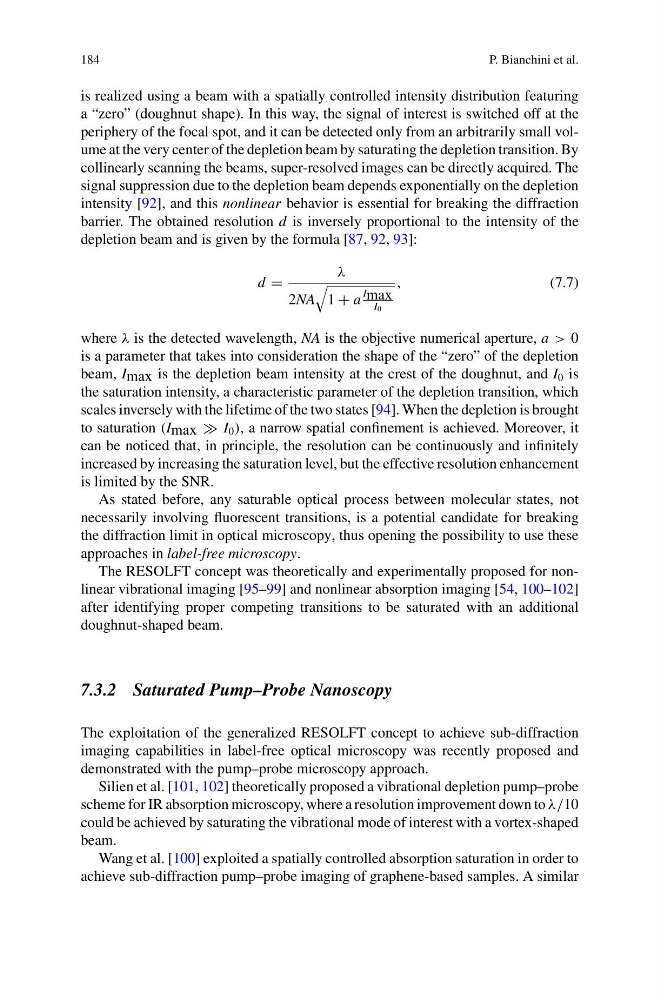
depletion beam and is given by the formula [87, 92, 93]:
d =
λ
2NA
1 + a
I max
I 0
,
(7.7)
where λ is the detected wavelength, NA is the objective numerical aperture, a > 0
is a parameter that takes into consideration the shape of the “zero” of the depletion
beam, I max is the depletion beam intensity at the crest of the doughnut, and I 0 is
the saturation intensity, a characteristic parameter of the depletion transition, which
scales inversely with the lifetime of the two states [94]. When the depletion is brought
to saturation (I max I 0 ), a narrow spatial confinement is achieved. Moreover, it
can be noticed that, in principle, the resolution can be continuously and infinitely
increased by increasing the saturation level, but the effective resolution enhancement
is limited by the SNR.
As stated before, any saturable optical process between molecular states, not
necessarily involving fluorescent transitions, is a potential candidate for breaking
the diffraction limit in optical microscopy, thus opening the possibility to use these
approaches in label-free microscopy.
The RESOLFT concept was theoretically and experimentally proposed for nonlinear vibrational imaging [95–99] and nonlinear absorption imaging [54, 100–102]
after identifying proper competing transitions to be saturated with an additional
doughnut-shaped beam.
7.3.2 Saturated Pump–Probe Nanoscopy
The exploitation of the generalized RESOLFT concept to achieve sub-diffraction
imaging capabilities in label-free optical microscopy was recently proposed and
demonstrated with the pump–probe microscopy approach.
Silien et al. [101, 102] theoretically proposed a vibrational depletion pump–probe
scheme for IR absorption microscopy, where a resolution improvement down to λ/10
could be achieved by saturating the vibrational mode of interest with a vortex-shaped
beam.
Wang et al. [100] exploited a spatially controlled absorption saturation in order to
achieve sub-diffraction pump–probe imaging of graphene-based samples. A similar
P. Bianchini et al.
is realized using a beam with a spatially controlled intensity distribution featuring
a “zero” (doughnut shape). In this way, the signal of interest is switched off at the
periphery of the focal spot, and it can be detected only from an arbitrarily small volume at the very center of the depletion beam by saturating the depletion transition. By
collinearly scanning the beams, super-resolved images can be directly acquired. The
signal suppression due to the depletion beam depends exponentially on the depletion
intensity [92], and this nonlinear behavior is essential for breaking the diffraction
barrier. The obtained resolution d is inversely proportional to the intensity of the
depletion beam and is given by the formula [87, 92, 93]:
d =
λ
2NA
1 + a
I max
I 0
,
(7.7)
where λ is the detected wavelength, NA is the objective numerical aperture, a > 0
is a parameter that takes into consideration the shape of the “zero” of the depletion
beam, I max is the depletion beam intensity at the crest of the doughnut, and I 0 is
the saturation intensity, a characteristic parameter of the depletion transition, which
scales inversely with the lifetime of the two states [94]. When the depletion is brought
to saturation (I max I 0 ), a narrow spatial confinement is achieved. Moreover, it
can be noticed that, in principle, the resolution can be continuously and infinitely
increased by increasing the saturation level, but the effective resolution enhancement
is limited by the SNR.
As stated before, any saturable optical process between molecular states, not
necessarily involving fluorescent transitions, is a potential candidate for breaking
the diffraction limit in optical microscopy, thus opening the possibility to use these
approaches in label-free microscopy.
The RESOLFT concept was theoretically and experimentally proposed for nonlinear vibrational imaging [95–99] and nonlinear absorption imaging [54, 100–102]
after identifying proper competing transitions to be saturated with an additional
doughnut-shaped beam.
7.3.2 Saturated Pump–Probe Nanoscopy
The exploitation of the generalized RESOLFT concept to achieve sub-diffraction
imaging capabilities in label-free optical microscopy was recently proposed and
demonstrated with the pump–probe microscopy approach.
Silien et al. [101, 102] theoretically proposed a vibrational depletion pump–probe
scheme for IR absorption microscopy, where a resolution improvement down to λ/10
could be achieved by saturating the vibrational mode of interest with a vortex-shaped
beam.
Wang et al. [100] exploited a spatially controlled absorption saturation in order to
achieve sub-diffraction pump–probe imaging of graphene-based samples. A similar