

174
P. Bianchini et al.
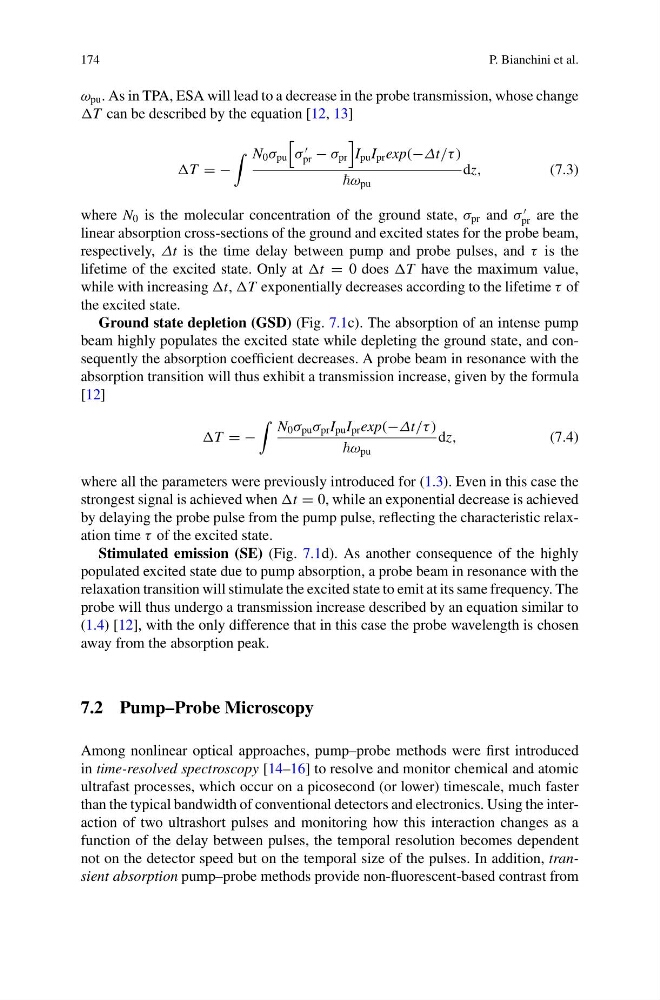
ω pu . As in TPA, ESA will lead to a decrease in the probe transmission, whose change
T can be described by the equation [12, 13]
T = −
N 0 σ pu
σ
pr − σ pr
I pu I pr exp(−Δt/τ )
ω pu
dz,
(7.3)
where N 0 is the molecular concentration of the ground state, σ pr and σ
pr are the
linear absorption cross-sections of the ground and excited states for the probe beam,
respectively, Δt is the time delay between pump and probe pulses, and τ is the
lifetime of the excited state. Only at t = 0 does T have the maximum value,
while with increasing t, T exponentially decreases according to the lifetime τ of
the excited state.
Ground state depletion (GSD) (Fig. 7.1c). The absorption of an intense pump
beam highly populates the excited state while depleting the ground state, and consequently the absorption coefficient decreases. A probe beam in resonance with the
absorption transition will thus exhibit a transmission increase, given by the formula
[12]
T = −
N 0 σ pu σ pr I pu I pr exp(−Δt/τ )
ω pu
dz,
(7.4)
where all the parameters were previously introduced for (1.3). Even in this case the
strongest signal is achieved when t = 0, while an exponential decrease is achieved
by delaying the probe pulse from the pump pulse, reflecting the characteristic relaxation time τ of the excited state.
Stimulated emission (SE) (Fig. 7.1d). As another consequence of the highly
populated excited state due to pump absorption, a probe beam in resonance with the
relaxation transition will stimulate the excited state to emit at its same frequency. The
probe will thus undergo a transmission increase described by an equation similar to
(1.4) [12], with the only difference that in this case the probe wavelength is chosen
away from the absorption peak.
7.2 Pump–Probe Microscopy
Among nonlinear optical approaches, pump–probe methods were first introduced
in time-resolved spectroscopy [14–16] to resolve and monitor chemical and atomic
ultrafast processes, which occur on a picosecond (or lower) timescale, much faster
than the typical bandwidth of conventional detectors and electronics. Using the interaction of two ultrashort pulses and monitoring how this interaction changes as a
function of the delay between pulses, the temporal resolution becomes dependent
not on the detector speed but on the temporal size of the pulses. In addition, transient absorption pump–probe methods provide non-fluorescent-based contrast from
P. Bianchini et al.
ω pu . As in TPA, ESA will lead to a decrease in the probe transmission, whose change
T can be described by the equation [12, 13]
T = −
N 0 σ pu
σ
pr − σ pr
I pu I pr exp(−Δt/τ )
ω pu
dz,
(7.3)
where N 0 is the molecular concentration of the ground state, σ pr and σ
pr are the
linear absorption cross-sections of the ground and excited states for the probe beam,
respectively, Δt is the time delay between pump and probe pulses, and τ is the
lifetime of the excited state. Only at t = 0 does T have the maximum value,
while with increasing t, T exponentially decreases according to the lifetime τ of
the excited state.
Ground state depletion (GSD) (Fig. 7.1c). The absorption of an intense pump
beam highly populates the excited state while depleting the ground state, and consequently the absorption coefficient decreases. A probe beam in resonance with the
absorption transition will thus exhibit a transmission increase, given by the formula
[12]
T = −
N 0 σ pu σ pr I pu I pr exp(−Δt/τ )
ω pu
dz,
(7.4)
where all the parameters were previously introduced for (1.3). Even in this case the
strongest signal is achieved when t = 0, while an exponential decrease is achieved
by delaying the probe pulse from the pump pulse, reflecting the characteristic relaxation time τ of the excited state.
Stimulated emission (SE) (Fig. 7.1d). As another consequence of the highly
populated excited state due to pump absorption, a probe beam in resonance with the
relaxation transition will stimulate the excited state to emit at its same frequency. The
probe will thus undergo a transmission increase described by an equation similar to
(1.4) [12], with the only difference that in this case the probe wavelength is chosen
away from the absorption peak.
7.2 Pump–Probe Microscopy
Among nonlinear optical approaches, pump–probe methods were first introduced
in time-resolved spectroscopy [14–16] to resolve and monitor chemical and atomic
ultrafast processes, which occur on a picosecond (or lower) timescale, much faster
than the typical bandwidth of conventional detectors and electronics. Using the interaction of two ultrashort pulses and monitoring how this interaction changes as a
function of the delay between pulses, the temporal resolution becomes dependent
not on the detector speed but on the temporal size of the pulses. In addition, transient absorption pump–probe methods provide non-fluorescent-based contrast from