

172
P. Bianchini et al.
The macroscopic electric polarizability P(t) of the material is the main parameter
that characterizes the interaction, and it can be expanded in powers of the incident
light electric field E(t) as [1]
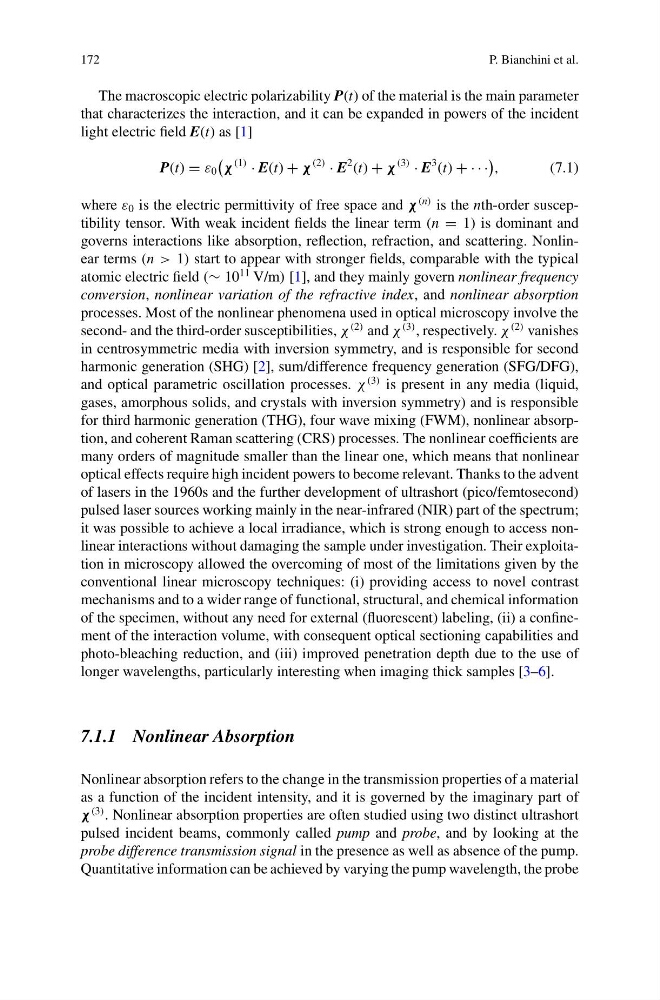
P(t) = ε 0
χ
(1)
· E(t) + χ
(2)
· E
2 (t) + χ
(3)
· E
3 (t) + · · ·
,
(7.1)
where ε 0 is the electric permittivity of free space and χ
(n) is the nth-order susceptibility tensor. With weak incident fields the linear term (n = 1) is dominant and
governs interactions like absorption, reflection, refraction, and scattering. Nonlinear terms (n > 1) start to appear with stronger fields, comparable with the typical
atomic electric field (∼ 10
11 V/m) [1], and they mainly govern nonlinear frequency
conversion, nonlinear variation of the refractive index, and nonlinear absorption
processes. Most of the nonlinear phenomena used in optical microscopy involve the
second- and the third-order susceptibilities, χ
(2) and χ
(3) , respectively. χ
(2) vanishes
in centrosymmetric media with inversion symmetry, and is responsible for second
harmonic generation (SHG) [2], sum/difference frequency generation (SFG/DFG),
and optical parametric oscillation processes. χ
(3) is present in any media (liquid,
gases, amorphous solids, and crystals with inversion symmetry) and is responsible
for third harmonic generation (THG), four wave mixing (FWM), nonlinear absorption, and coherent Raman scattering (CRS) processes. The nonlinear coefficients are
many orders of magnitude smaller than the linear one, which means that nonlinear
optical effects require high incident powers to become relevant. Thanks to the advent
of lasers in the 1960s and the further development of ultrashort (pico/femtosecond)
pulsed laser sources working mainly in the near-infrared (NIR) part of the spectrum;
it was possible to achieve a local irradiance, which is strong enough to access nonlinear interactions without damaging the sample under investigation. Their exploitation in microscopy allowed the overcoming of most of the limitations given by the
conventional linear microscopy techniques: (i) providing access to novel contrast
mechanisms and to a wider range of functional, structural, and chemical information
of the specimen, without any need for external (fluorescent) labeling, (ii) a confinement of the interaction volume, with consequent optical sectioning capabilities and
photo-bleaching reduction, and (iii) improved penetration depth due to the use of
longer wavelengths, particularly interesting when imaging thick samples [3–6].
7.1.1 Nonlinear Absorption
Nonlinear absorption refers to the change in the transmission properties of a material
as a function of the incident intensity, and it is governed by the imaginary part of
χ
(3) . Nonlinear absorption properties are often studied using two distinct ultrashort
pulsed incident beams, commonly called pump and probe, and by looking at the
probe difference transmission signal in the presence as well as absence of the pump.
Quantitative information can be achieved by varying the pump wavelength, the probe
P. Bianchini et al.
The macroscopic electric polarizability P(t) of the material is the main parameter
that characterizes the interaction, and it can be expanded in powers of the incident
light electric field E(t) as [1]
P(t) = ε 0
χ
(1)
· E(t) + χ
(2)
· E
2 (t) + χ
(3)
· E
3 (t) + · · ·
,
(7.1)
where ε 0 is the electric permittivity of free space and χ
(n) is the nth-order susceptibility tensor. With weak incident fields the linear term (n = 1) is dominant and
governs interactions like absorption, reflection, refraction, and scattering. Nonlinear terms (n > 1) start to appear with stronger fields, comparable with the typical
atomic electric field (∼ 10
11 V/m) [1], and they mainly govern nonlinear frequency
conversion, nonlinear variation of the refractive index, and nonlinear absorption
processes. Most of the nonlinear phenomena used in optical microscopy involve the
second- and the third-order susceptibilities, χ
(2) and χ
(3) , respectively. χ
(2) vanishes
in centrosymmetric media with inversion symmetry, and is responsible for second
harmonic generation (SHG) [2], sum/difference frequency generation (SFG/DFG),
and optical parametric oscillation processes. χ
(3) is present in any media (liquid,
gases, amorphous solids, and crystals with inversion symmetry) and is responsible
for third harmonic generation (THG), four wave mixing (FWM), nonlinear absorption, and coherent Raman scattering (CRS) processes. The nonlinear coefficients are
many orders of magnitude smaller than the linear one, which means that nonlinear
optical effects require high incident powers to become relevant. Thanks to the advent
of lasers in the 1960s and the further development of ultrashort (pico/femtosecond)
pulsed laser sources working mainly in the near-infrared (NIR) part of the spectrum;
it was possible to achieve a local irradiance, which is strong enough to access nonlinear interactions without damaging the sample under investigation. Their exploitation in microscopy allowed the overcoming of most of the limitations given by the
conventional linear microscopy techniques: (i) providing access to novel contrast
mechanisms and to a wider range of functional, structural, and chemical information
of the specimen, without any need for external (fluorescent) labeling, (ii) a confinement of the interaction volume, with consequent optical sectioning capabilities and
photo-bleaching reduction, and (iii) improved penetration depth due to the use of
longer wavelengths, particularly interesting when imaging thick samples [3–6].
7.1.1 Nonlinear Absorption
Nonlinear absorption refers to the change in the transmission properties of a material
as a function of the incident intensity, and it is governed by the imaginary part of
χ
(3) . Nonlinear absorption properties are often studied using two distinct ultrashort
pulsed incident beams, commonly called pump and probe, and by looking at the
probe difference transmission signal in the presence as well as absence of the pump.
Quantitative information can be achieved by varying the pump wavelength, the probe