

144
C. Li and J.-X. Cheng
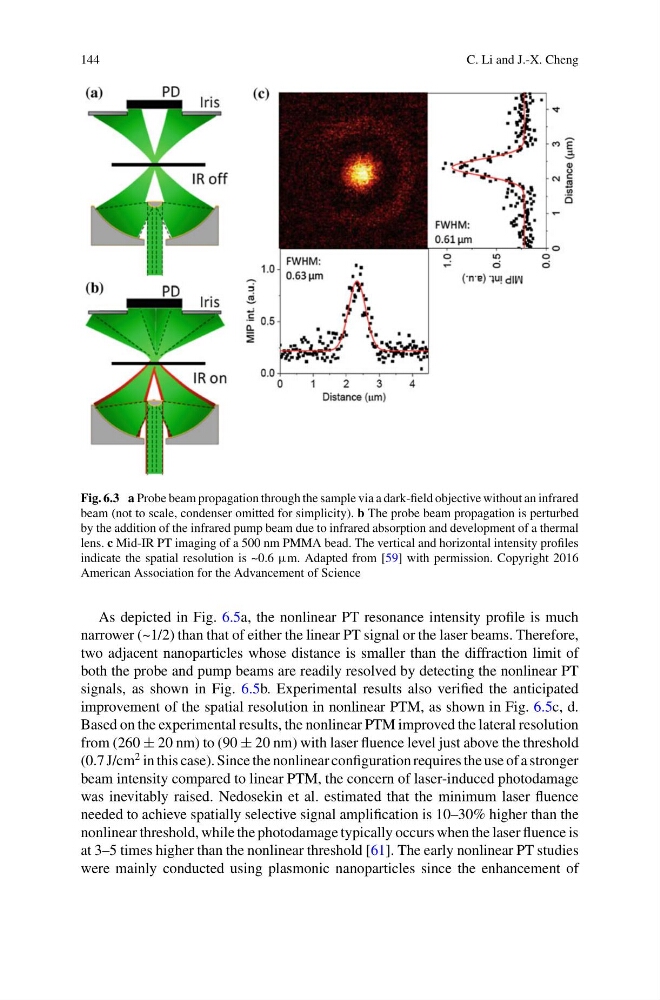
Fig. 6.3 a Probe beam propagation through the sample via a dark-field objective without an infrared
beam (not to scale, condenser omitted for simplicity). b The probe beam propagation is perturbed
by the addition of the infrared pump beam due to infrared absorption and development of a thermal
lens. c Mid-IR PT imaging of a 500 nm PMMA bead. The vertical and horizontal intensity profiles
indicate the spatial resolution is ~0.6 µm. Adapted from [59] with permission. Copyright 2016
American Association for the Advancement of Science
As depicted in Fig. 6.5a, the nonlinear PT resonance intensity profile is much
narrower (~1/2) than that of either the linear PT signal or the laser beams. Therefore,
two adjacent nanoparticles whose distance is smaller than the diffraction limit of
both the probe and pump beams are readily resolved by detecting the nonlinear PT
signals, as shown in Fig. 6.5b. Experimental results also verified the anticipated
improvement of the spatial resolution in nonlinear PTM, as shown in Fig. 6.5c, d.
Based on the experimental results, the nonlinear PTM improved the lateral resolution
from (260 ± 20 nm) to (90 ± 20 nm) with laser fluence level just above the threshold
(0.7 J/cm
2 in this case). Since the nonlinear configuration requires the use of a stronger
beam intensity compared to linear PTM, the concern of laser-induced photodamage
was inevitably raised. Nedosekin et al. estimated that the minimum laser fluence
needed to achieve spatially selective signal amplification is 10–30% higher than the
nonlinear threshold, while the photodamage typically occurs when the laser fluence is
at 3–5 times higher than the nonlinear threshold [61]. The early nonlinear PT studies
were mainly conducted using plasmonic nanoparticles since the enhancement of
C. Li and J.-X. Cheng
Fig. 6.3 a Probe beam propagation through the sample via a dark-field objective without an infrared
beam (not to scale, condenser omitted for simplicity). b The probe beam propagation is perturbed
by the addition of the infrared pump beam due to infrared absorption and development of a thermal
lens. c Mid-IR PT imaging of a 500 nm PMMA bead. The vertical and horizontal intensity profiles
indicate the spatial resolution is ~0.6 µm. Adapted from [59] with permission. Copyright 2016
American Association for the Advancement of Science
As depicted in Fig. 6.5a, the nonlinear PT resonance intensity profile is much
narrower (~1/2) than that of either the linear PT signal or the laser beams. Therefore,
two adjacent nanoparticles whose distance is smaller than the diffraction limit of
both the probe and pump beams are readily resolved by detecting the nonlinear PT
signals, as shown in Fig. 6.5b. Experimental results also verified the anticipated
improvement of the spatial resolution in nonlinear PTM, as shown in Fig. 6.5c, d.
Based on the experimental results, the nonlinear PTM improved the lateral resolution
from (260 ± 20 nm) to (90 ± 20 nm) with laser fluence level just above the threshold
(0.7 J/cm
2 in this case). Since the nonlinear configuration requires the use of a stronger
beam intensity compared to linear PTM, the concern of laser-induced photodamage
was inevitably raised. Nedosekin et al. estimated that the minimum laser fluence
needed to achieve spatially selective signal amplification is 10–30% higher than the
nonlinear threshold, while the photodamage typically occurs when the laser fluence is
at 3–5 times higher than the nonlinear threshold [61]. The early nonlinear PT studies
were mainly conducted using plasmonic nanoparticles since the enhancement of