

6 Absorption-Based Far-Field Label-Free Super-Resolution …
141
the periodic distortion induced by the PT process and deduced the sample absorptivity
with high sensitivity [73]. It is also suggested that heat dissipation from the hot spot,
located at the center of the beam, to the surrounding medium will affect the detected
PT lens profile. Therefore, liquids with lower heat conductivity tend to produce larger
thermal gradient in smaller space, which leads to higher detection sensitivity [74].
Note that all those attempts deployed the single-beam apparatus in which only one
laser was used to both excite and probe the PT lens effect. And the best sensitivity
for absorptivity measurements reported was limited to ~10
−6 cm
−1 [75].
The breakthrough was not realized until the deployment of the dual-beam apparatus along with the synchronous detection which achieved an ultimate sensitivity
of less than 10
−11 cm
−1 for absorptivity determination [58]. Unlike its single-beam
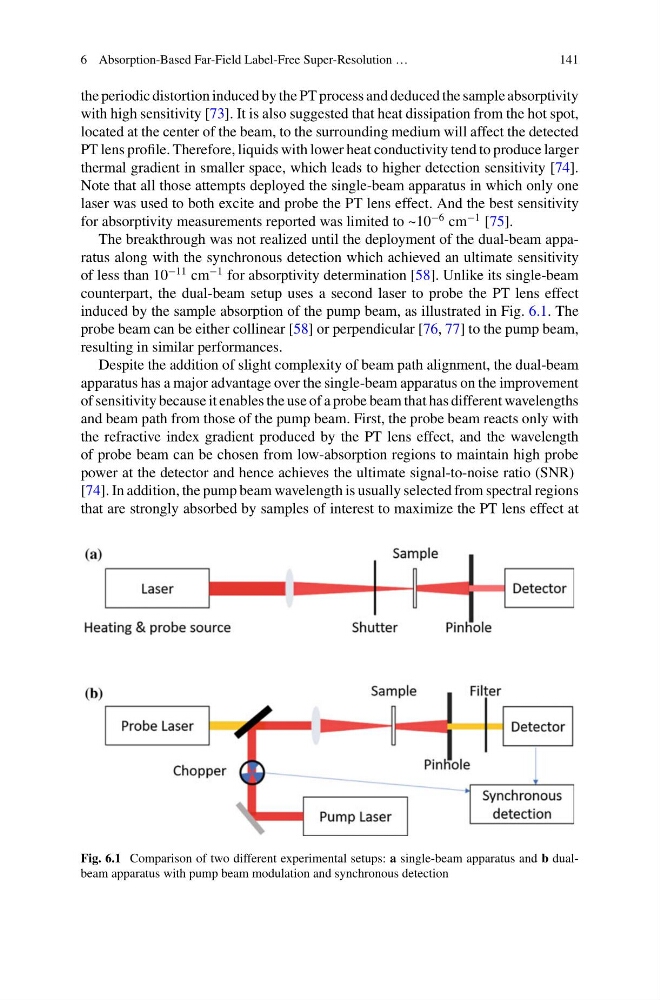
counterpart, the dual-beam setup uses a second laser to probe the PT lens effect
induced by the sample absorption of the pump beam, as illustrated in Fig. 6.1. The
probe beam can be either collinear [58] or perpendicular [76, 77] to the pump beam,
resulting in similar performances.
Despite the addition of slight complexity of beam path alignment, the dual-beam
apparatus has a major advantage over the single-beam apparatus on the improvement
of sensitivity because it enables the use of a probe beam that has different wavelengths
and beam path from those of the pump beam. First, the probe beam reacts only with
the refractive index gradient produced by the PT lens effect, and the wavelength
of probe beam can be chosen from low-absorption regions to maintain high probe
power at the detector and hence achieves the ultimate signal-to-noise ratio (SNR)
[74]. In addition, the pump beam wavelength is usually selected from spectral regions
that are strongly absorbed by samples of interest to maximize the PT lens effect at
Fig. 6.1 Comparison of two different experimental setups: a single-beam apparatus and b dualbeam apparatus with pump beam modulation and synchronous detection
141
the periodic distortion induced by the PT process and deduced the sample absorptivity
with high sensitivity [73]. It is also suggested that heat dissipation from the hot spot,
located at the center of the beam, to the surrounding medium will affect the detected
PT lens profile. Therefore, liquids with lower heat conductivity tend to produce larger
thermal gradient in smaller space, which leads to higher detection sensitivity [74].
Note that all those attempts deployed the single-beam apparatus in which only one
laser was used to both excite and probe the PT lens effect. And the best sensitivity
for absorptivity measurements reported was limited to ~10
−6 cm
−1 [75].
The breakthrough was not realized until the deployment of the dual-beam apparatus along with the synchronous detection which achieved an ultimate sensitivity
of less than 10
−11 cm
−1 for absorptivity determination [58]. Unlike its single-beam
counterpart, the dual-beam setup uses a second laser to probe the PT lens effect
induced by the sample absorption of the pump beam, as illustrated in Fig. 6.1. The
probe beam can be either collinear [58] or perpendicular [76, 77] to the pump beam,
resulting in similar performances.
Despite the addition of slight complexity of beam path alignment, the dual-beam
apparatus has a major advantage over the single-beam apparatus on the improvement
of sensitivity because it enables the use of a probe beam that has different wavelengths
and beam path from those of the pump beam. First, the probe beam reacts only with
the refractive index gradient produced by the PT lens effect, and the wavelength
of probe beam can be chosen from low-absorption regions to maintain high probe
power at the detector and hence achieves the ultimate signal-to-noise ratio (SNR)
[74]. In addition, the pump beam wavelength is usually selected from spectral regions
that are strongly absorbed by samples of interest to maximize the PT lens effect at
Fig. 6.1 Comparison of two different experimental setups: a single-beam apparatus and b dualbeam apparatus with pump beam modulation and synchronous detection