

5 Near-Field Scanning Optical Microscope Combined with Digital …
121
in contact with a plasmonic metallic sample, leaky surface plasmons are observed
at a supercritical emission angle. We also perform Finite-Difference Time-Domain
(FDTD) simulations that support a model of the NSOM tip as a superposition of
electric and magnetic dipoles.
5.3.1 Experimental Setup
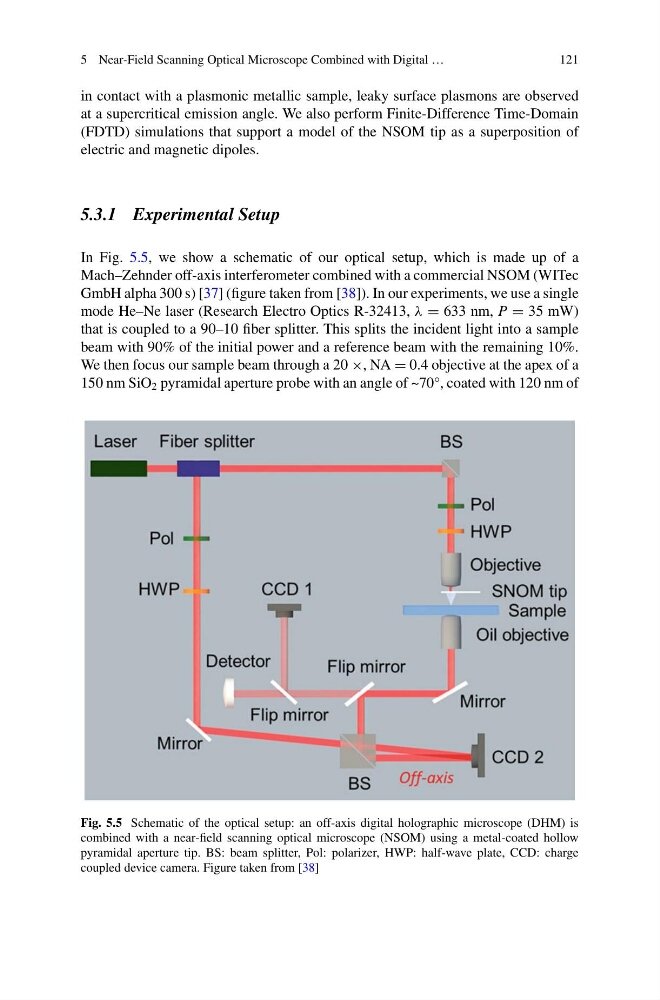
In Fig. 5.5, we show a schematic of our optical setup, which is made up of a
Mach–Zehnder off-axis interferometer combined with a commercial NSOM (WITec
GmbH alpha 300 s) [37] (figure taken from [38]). In our experiments, we use a single
mode He–Ne laser (Research Electro Optics R-32413, λ = 633 nm, P = 35 mW)
that is coupled to a 90–10 fiber splitter. This splits the incident light into a sample
beam with 90% of the initial power and a reference beam with the remaining 10%.
We then focus our sample beam through a 20 ×, NA = 0.4 objective at the apex of a
150 nm SiO 2 pyramidal aperture probe with an angle of ~70°, coated with 120 nm of
Fig. 5.5 Schematic of the optical setup: an off-axis digital holographic microscope (DHM) is
combined with a near-field scanning optical microscope (NSOM) using a metal-coated hollow
pyramidal aperture tip. BS: beam splitter, Pol: polarizer, HWP: half-wave plate, CCD: charge
coupled device camera. Figure taken from [38]
121
in contact with a plasmonic metallic sample, leaky surface plasmons are observed
at a supercritical emission angle. We also perform Finite-Difference Time-Domain
(FDTD) simulations that support a model of the NSOM tip as a superposition of
electric and magnetic dipoles.
5.3.1 Experimental Setup
In Fig. 5.5, we show a schematic of our optical setup, which is made up of a
Mach–Zehnder off-axis interferometer combined with a commercial NSOM (WITec
GmbH alpha 300 s) [37] (figure taken from [38]). In our experiments, we use a single
mode He–Ne laser (Research Electro Optics R-32413, λ = 633 nm, P = 35 mW)
that is coupled to a 90–10 fiber splitter. This splits the incident light into a sample
beam with 90% of the initial power and a reference beam with the remaining 10%.
We then focus our sample beam through a 20 ×, NA = 0.4 objective at the apex of a
150 nm SiO 2 pyramidal aperture probe with an angle of ~70°, coated with 120 nm of
Fig. 5.5 Schematic of the optical setup: an off-axis digital holographic microscope (DHM) is
combined with a near-field scanning optical microscope (NSOM) using a metal-coated hollow
pyramidal aperture tip. BS: beam splitter, Pol: polarizer, HWP: half-wave plate, CCD: charge
coupled device camera. Figure taken from [38]