

118
N. Rahbany et al.
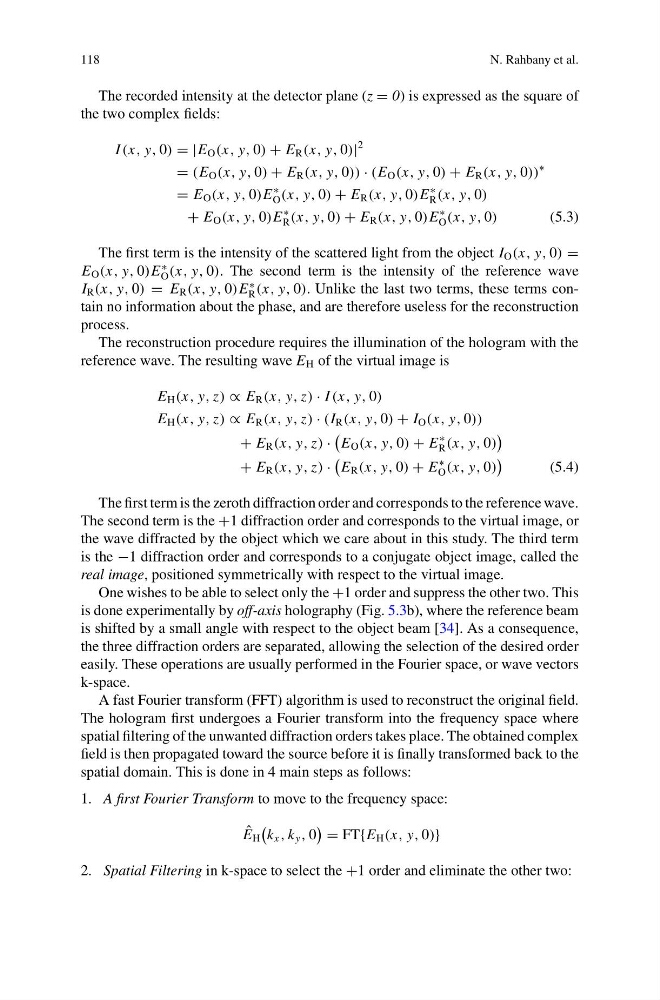
The recorded intensity at the detector plane (z = 0) is expressed as the square of
the two complex fields:
I (x, y, 0) = |E O (x, y, 0) + E R (x, y, 0)|
2
= (E O (x, y, 0) + E R (x, y, 0)) · (E O (x, y, 0) + E R (x, y, 0))
∗
= E O (x, y, 0)E
∗
O (x, y, 0) + E R (x, y, 0)E
∗
R (x, y, 0)
+ E O (x, y, 0)E
∗
R (x, y, 0) + E R (x, y, 0)E
∗
O (x, y, 0)
(5.3)
The first term is the intensity of the scattered light from the object I O (x, y, 0) =
E O (x, y, 0)E
∗
O (x, y, 0). The second term is the intensity of the reference wave
I R (x, y, 0) = E R (x, y, 0)E
∗
R (x, y, 0). Unlike the last two terms, these terms contain no information about the phase, and are therefore useless for the reconstruction
process.
The reconstruction procedure requires the illumination of the hologram with the
reference wave. The resulting wave E H of the virtual image is
E H (x, y, z) ∝ E R (x, y, z) · I (x, y, 0)
E H (x, y, z) ∝ E R (x, y, z) · (I R (x, y, 0) + I O (x, y, 0))
+ E R (x, y, z) ·
E O (x, y, 0) + E
∗
R (x, y, 0)
+ E R (x, y, z) ·
E R (x, y, 0) + E
∗
O (x, y, 0)
(5.4)
The first term is the zeroth diffraction order and corresponds to the reference wave.
The second term is the +1 diffraction order and corresponds to the virtual image, or
the wave diffracted by the object which we care about in this study. The third term
is the −1 diffraction order and corresponds to a conjugate object image, called the
real image, positioned symmetrically with respect to the virtual image.
One wishes to be able to select only the +1 order and suppress the other two. This
is done experimentally by off-axis holography (Fig. 5.3b), where the reference beam
is shifted by a small angle with respect to the object beam [34]. As a consequence,
the three diffraction orders are separated, allowing the selection of the desired order
easily. These operations are usually performed in the Fourier space, or wave vectors
k-space.
A fast Fourier transform (FFT) algorithm is used to reconstruct the original field.
The hologram first undergoes a Fourier transform into the frequency space where
spatial filtering of the unwanted diffraction orders takes place. The obtained complex
field is then propagated toward the source before it is finally transformed back to the
spatial domain. This is done in 4 main steps as follows:
1. A first Fourier Transform to move to the frequency space:
ˆ
E H
k x , k y , 0
= FT{E H (x, y, 0)}
2. Spatial Filtering in k-space to select the +1 order and eliminate the other two:
N. Rahbany et al.
The recorded intensity at the detector plane (z = 0) is expressed as the square of
the two complex fields:
I (x, y, 0) = |E O (x, y, 0) + E R (x, y, 0)|
2
= (E O (x, y, 0) + E R (x, y, 0)) · (E O (x, y, 0) + E R (x, y, 0))
∗
= E O (x, y, 0)E
∗
O (x, y, 0) + E R (x, y, 0)E
∗
R (x, y, 0)
+ E O (x, y, 0)E
∗
R (x, y, 0) + E R (x, y, 0)E
∗
O (x, y, 0)
(5.3)
The first term is the intensity of the scattered light from the object I O (x, y, 0) =
E O (x, y, 0)E
∗
O (x, y, 0). The second term is the intensity of the reference wave
I R (x, y, 0) = E R (x, y, 0)E
∗
R (x, y, 0). Unlike the last two terms, these terms contain no information about the phase, and are therefore useless for the reconstruction
process.
The reconstruction procedure requires the illumination of the hologram with the
reference wave. The resulting wave E H of the virtual image is
E H (x, y, z) ∝ E R (x, y, z) · I (x, y, 0)
E H (x, y, z) ∝ E R (x, y, z) · (I R (x, y, 0) + I O (x, y, 0))
+ E R (x, y, z) ·
E O (x, y, 0) + E
∗
R (x, y, 0)
+ E R (x, y, z) ·
E R (x, y, 0) + E
∗
O (x, y, 0)
(5.4)
The first term is the zeroth diffraction order and corresponds to the reference wave.
The second term is the +1 diffraction order and corresponds to the virtual image, or
the wave diffracted by the object which we care about in this study. The third term
is the −1 diffraction order and corresponds to a conjugate object image, called the
real image, positioned symmetrically with respect to the virtual image.
One wishes to be able to select only the +1 order and suppress the other two. This
is done experimentally by off-axis holography (Fig. 5.3b), where the reference beam
is shifted by a small angle with respect to the object beam [34]. As a consequence,
the three diffraction orders are separated, allowing the selection of the desired order
easily. These operations are usually performed in the Fourier space, or wave vectors
k-space.
A fast Fourier transform (FFT) algorithm is used to reconstruct the original field.
The hologram first undergoes a Fourier transform into the frequency space where
spatial filtering of the unwanted diffraction orders takes place. The obtained complex
field is then propagated toward the source before it is finally transformed back to the
spatial domain. This is done in 4 main steps as follows:
1. A first Fourier Transform to move to the frequency space:
ˆ
E H
k x , k y , 0
= FT{E H (x, y, 0)}
2. Spatial Filtering in k-space to select the +1 order and eliminate the other two: