

5 Near-Field Scanning Optical Microscope Combined with Digital …
117
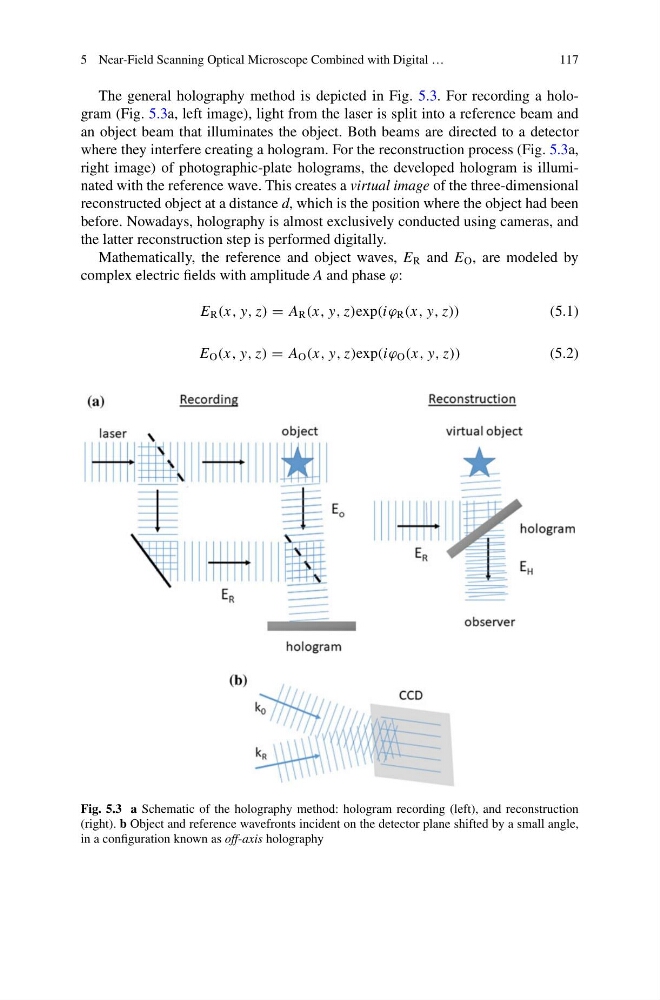
The general holography method is depicted in Fig. 5.3. For recording a hologram (Fig. 5.3a, left image), light from the laser is split into a reference beam and
an object beam that illuminates the object. Both beams are directed to a detector
where they interfere creating a hologram. For the reconstruction process (Fig. 5.3a,
right image) of photographic-plate holograms, the developed hologram is illuminated with the reference wave. This creates a virtual image of the three-dimensional
reconstructed object at a distance d, which is the position where the object had been
before. Nowadays, holography is almost exclusively conducted using cameras, and
the latter reconstruction step is performed digitally.
Mathematically, the reference and object waves, E R and E O , are modeled by
complex electric fields with amplitude A and phase ϕ:
E R (x, y, z) = A R (x, y, z)exp(iϕ R (x, y, z))
(5.1)
E O (x, y, z) = A O (x, y, z)exp(iϕ O (x, y, z))
(5.2)
Fig. 5.3 a Schematic of the holography method: hologram recording (left), and reconstruction
(right). b Object and reference wavefronts incident on the detector plane shifted by a small angle,
in a configuration known as off-axis holography
117
The general holography method is depicted in Fig. 5.3. For recording a hologram (Fig. 5.3a, left image), light from the laser is split into a reference beam and
an object beam that illuminates the object. Both beams are directed to a detector
where they interfere creating a hologram. For the reconstruction process (Fig. 5.3a,
right image) of photographic-plate holograms, the developed hologram is illuminated with the reference wave. This creates a virtual image of the three-dimensional
reconstructed object at a distance d, which is the position where the object had been
before. Nowadays, holography is almost exclusively conducted using cameras, and
the latter reconstruction step is performed digitally.
Mathematically, the reference and object waves, E R and E O , are modeled by
complex electric fields with amplitude A and phase ϕ:
E R (x, y, z) = A R (x, y, z)exp(iϕ R (x, y, z))
(5.1)
E O (x, y, z) = A O (x, y, z)exp(iϕ O (x, y, z))
(5.2)
Fig. 5.3 a Schematic of the holography method: hologram recording (left), and reconstruction
(right). b Object and reference wavefronts incident on the detector plane shifted by a small angle,
in a configuration known as off-axis holography