

5 Near-Field Scanning Optical Microscope Combined with Digital …
115
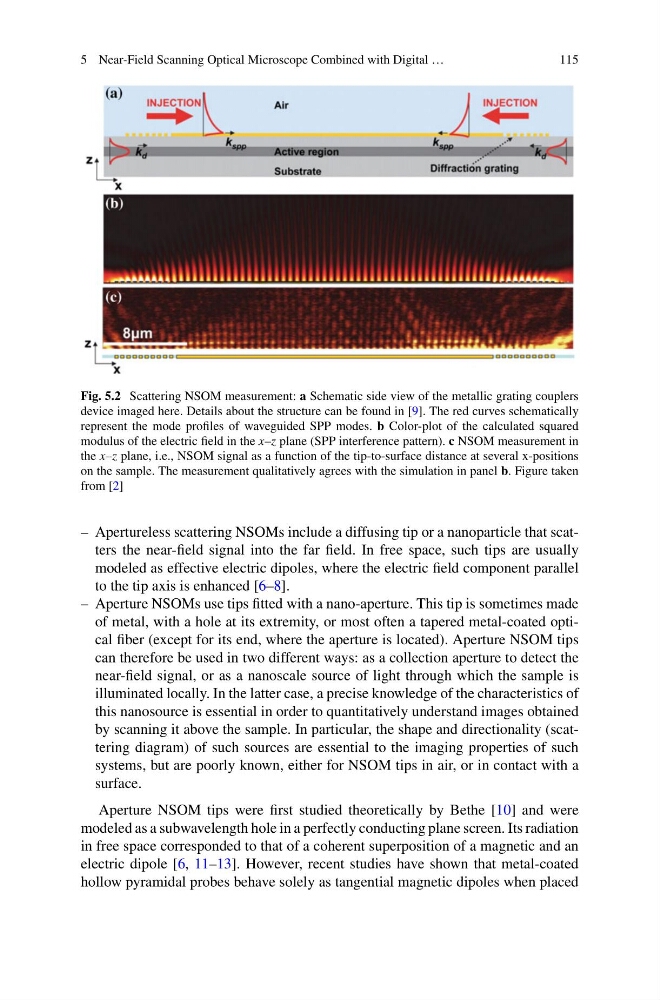
Fig. 5.2 Scattering NSOM measurement: a Schematic side view of the metallic grating couplers
device imaged here. Details about the structure can be found in [9]. The red curves schematically
represent the mode profiles of waveguided SPP modes. b Color-plot of the calculated squared
modulus of the electric field in the x–z plane (SPP interference pattern). c NSOM measurement in
the x–z plane, i.e., NSOM signal as a function of the tip-to-surface distance at several x-positions
on the sample. The measurement qualitatively agrees with the simulation in panel b. Figure taken
from [2]
– Apertureless scattering NSOMs include a diffusing tip or a nanoparticle that scatters the near-field signal into the far field. In free space, such tips are usually
modeled as effective electric dipoles, where the electric field component parallel
to the tip axis is enhanced [6–8].
– Aperture NSOMs use tips fitted with a nano-aperture. This tip is sometimes made
of metal, with a hole at its extremity, or most often a tapered metal-coated optical fiber (except for its end, where the aperture is located). Aperture NSOM tips
can therefore be used in two different ways: as a collection aperture to detect the
near-field signal, or as a nanoscale source of light through which the sample is
illuminated locally. In the latter case, a precise knowledge of the characteristics of
this nanosource is essential in order to quantitatively understand images obtained
by scanning it above the sample. In particular, the shape and directionality (scattering diagram) of such sources are essential to the imaging properties of such
systems, but are poorly known, either for NSOM tips in air, or in contact with a
surface.
Aperture NSOM tips were first studied theoretically by Bethe [10] and were
modeled as a subwavelength hole in a perfectly conducting plane screen. Its radiation
in free space corresponded to that of a coherent superposition of a magnetic and an
electric dipole [6, 11–13]. However, recent studies have shown that metal-coated
hollow pyramidal probes behave solely as tangential magnetic dipoles when placed
115
Fig. 5.2 Scattering NSOM measurement: a Schematic side view of the metallic grating couplers
device imaged here. Details about the structure can be found in [9]. The red curves schematically
represent the mode profiles of waveguided SPP modes. b Color-plot of the calculated squared
modulus of the electric field in the x–z plane (SPP interference pattern). c NSOM measurement in
the x–z plane, i.e., NSOM signal as a function of the tip-to-surface distance at several x-positions
on the sample. The measurement qualitatively agrees with the simulation in panel b. Figure taken
from [2]
– Apertureless scattering NSOMs include a diffusing tip or a nanoparticle that scatters the near-field signal into the far field. In free space, such tips are usually
modeled as effective electric dipoles, where the electric field component parallel
to the tip axis is enhanced [6–8].
– Aperture NSOMs use tips fitted with a nano-aperture. This tip is sometimes made
of metal, with a hole at its extremity, or most often a tapered metal-coated optical fiber (except for its end, where the aperture is located). Aperture NSOM tips
can therefore be used in two different ways: as a collection aperture to detect the
near-field signal, or as a nanoscale source of light through which the sample is
illuminated locally. In the latter case, a precise knowledge of the characteristics of
this nanosource is essential in order to quantitatively understand images obtained
by scanning it above the sample. In particular, the shape and directionality (scattering diagram) of such sources are essential to the imaging properties of such
systems, but are poorly known, either for NSOM tips in air, or in contact with a
surface.
Aperture NSOM tips were first studied theoretically by Bethe [10] and were
modeled as a subwavelength hole in a perfectly conducting plane screen. Its radiation
in free space corresponded to that of a coherent superposition of a magnetic and an
electric dipole [6, 11–13]. However, recent studies have shown that metal-coated
hollow pyramidal probes behave solely as tangential magnetic dipoles when placed