

114
N. Rahbany et al.
5.1 Introduction to Near-Field Scanning Optical
Microscopy (NSOM)
Near-field Scanning Optical Microscopy (NSOM) is an important super-resolution
imaging technique which is used to overcome the diffraction limit and study lightmatter interaction at a subwavelength scale [1].
Since the high-frequency spatial components of the electromagnetic (EM) field are
contained in the near field and decay exponentially with the distance from the sample,
they are entirely lost when using far-field optical microscopy techniques. Therefore,
the idea of near-field microscopy is to collect the information contained in the near
field and make it measurable with traditional far-field detection tools. Scattering-type
NSOM uses a scanning probe, which is typically a tip with a sub-λ sized scatterer
at its extremity, to measure the evanescent waves that are confined in the near field.
The evanescent signal is scattered from the near field and is converted to a far-field
propagating wave which is directed to a detector measuring its intensity. Then, the
sample is scanned with respect to the tip to obtain a complete image of the scanned
area point by point. Probing the near field allows to overcome the diffraction limit,
which is why NSOM has proven to be a powerful “super-resolution” technique. The
method allows one indeed to perform sub-λ imaging, or to detect purely evanescent
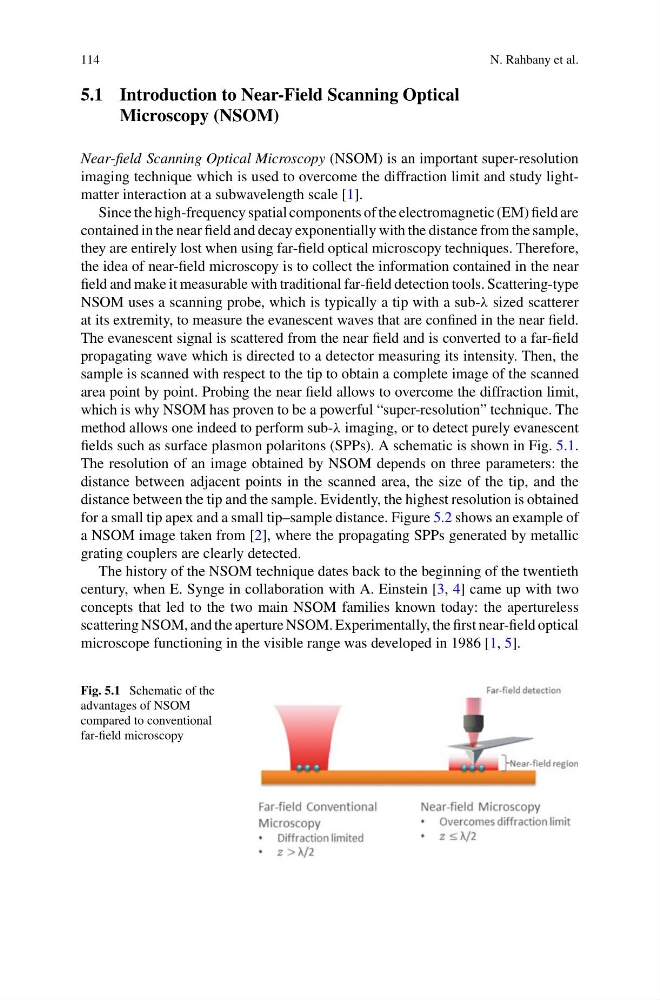
fields such as surface plasmon polaritons (SPPs). A schematic is shown in Fig. 5.1.
The resolution of an image obtained by NSOM depends on three parameters: the
distance between adjacent points in the scanned area, the size of the tip, and the
distance between the tip and the sample. Evidently, the highest resolution is obtained
for a small tip apex and a small tip–sample distance. Figure 5.2 shows an example of
a NSOM image taken from [2], where the propagating SPPs generated by metallic
grating couplers are clearly detected.
The history of the NSOM technique dates back to the beginning of the twentieth
century, when E. Synge in collaboration with A. Einstein [3, 4] came up with two
concepts that led to the two main NSOM families known today: the apertureless
scattering NSOM, and the aperture NSOM. Experimentally, the first near-field optical
microscope functioning in the visible range was developed in 1986 [1, 5].
Fig. 5.1 Schematic of the
advantages of NSOM
compared to conventional
far-field microscopy
N. Rahbany et al.
5.1 Introduction to Near-Field Scanning Optical
Microscopy (NSOM)
Near-field Scanning Optical Microscopy (NSOM) is an important super-resolution
imaging technique which is used to overcome the diffraction limit and study lightmatter interaction at a subwavelength scale [1].
Since the high-frequency spatial components of the electromagnetic (EM) field are
contained in the near field and decay exponentially with the distance from the sample,
they are entirely lost when using far-field optical microscopy techniques. Therefore,
the idea of near-field microscopy is to collect the information contained in the near
field and make it measurable with traditional far-field detection tools. Scattering-type
NSOM uses a scanning probe, which is typically a tip with a sub-λ sized scatterer
at its extremity, to measure the evanescent waves that are confined in the near field.
The evanescent signal is scattered from the near field and is converted to a far-field
propagating wave which is directed to a detector measuring its intensity. Then, the
sample is scanned with respect to the tip to obtain a complete image of the scanned
area point by point. Probing the near field allows to overcome the diffraction limit,
which is why NSOM has proven to be a powerful “super-resolution” technique. The
method allows one indeed to perform sub-λ imaging, or to detect purely evanescent
fields such as surface plasmon polaritons (SPPs). A schematic is shown in Fig. 5.1.
The resolution of an image obtained by NSOM depends on three parameters: the
distance between adjacent points in the scanned area, the size of the tip, and the
distance between the tip and the sample. Evidently, the highest resolution is obtained
for a small tip apex and a small tip–sample distance. Figure 5.2 shows an example of
a NSOM image taken from [2], where the propagating SPPs generated by metallic
grating couplers are clearly detected.
The history of the NSOM technique dates back to the beginning of the twentieth
century, when E. Synge in collaboration with A. Einstein [3, 4] came up with two
concepts that led to the two main NSOM families known today: the apertureless
scattering NSOM, and the aperture NSOM. Experimentally, the first near-field optical
microscope functioning in the visible range was developed in 1986 [1, 5].
Fig. 5.1 Schematic of the
advantages of NSOM
compared to conventional
far-field microscopy