

4 Tomographic Diffractive Microscopy …
97
precision requirements. When neglecting diffraction, this permits easily to obtain
isotropic resolution images. Indeed, in that case, the set of captures frequencies
depicts a disk in Fourier space, which rotates around one of its diameter describing
a filled sphere.
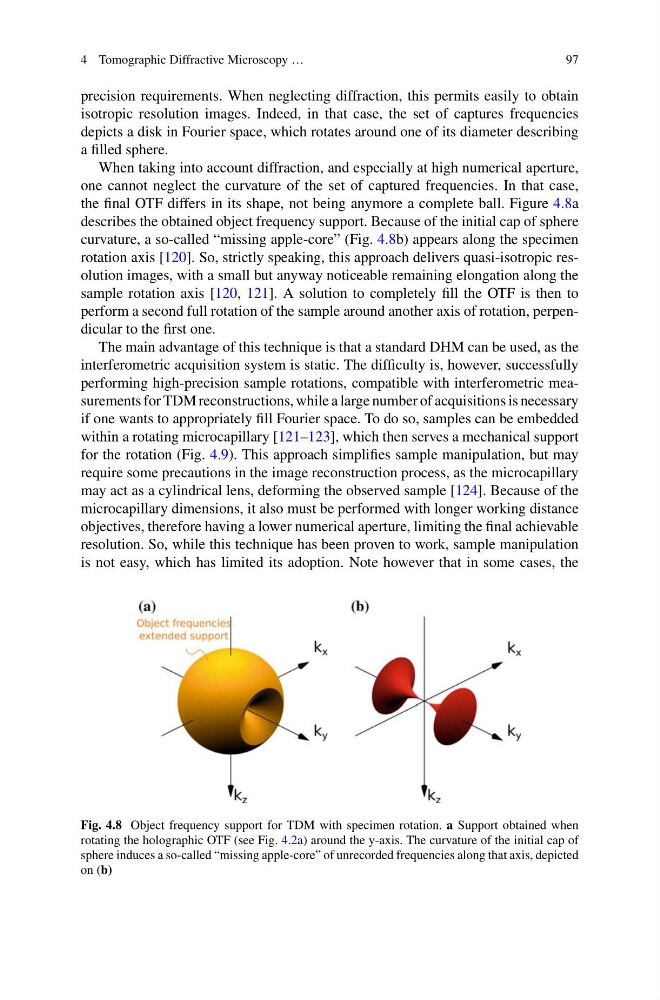
When taking into account diffraction, and especially at high numerical aperture,
one cannot neglect the curvature of the set of captured frequencies. In that case,
the final OTF differs in its shape, not being anymore a complete ball. Figure 4.8a
describes the obtained object frequency support. Because of the initial cap of sphere
curvature, a so-called “missing apple-core” (Fig. 4.8b) appears along the specimen
rotation axis [120]. So, strictly speaking, this approach delivers quasi-isotropic resolution images, with a small but anyway noticeable remaining elongation along the
sample rotation axis [120, 121]. A solution to completely fill the OTF is then to
perform a second full rotation of the sample around another axis of rotation, perpendicular to the first one.
The main advantage of this technique is that a standard DHM can be used, as the
interferometric acquisition system is static. The difficulty is, however, successfully
performing high-precision sample rotations, compatible with interferometric measurements for TDM reconstructions, while a large number of acquisitions is necessary
if one wants to appropriately fill Fourier space. To do so, samples can be embedded
within a rotating microcapillary [121–123], which then serves a mechanical support
for the rotation (Fig. 4.9). This approach simplifies sample manipulation, but may
require some precautions in the image reconstruction process, as the microcapillary
may act as a cylindrical lens, deforming the observed sample [124]. Because of the
microcapillary dimensions, it also must be performed with longer working distance
objectives, therefore having a lower numerical aperture, limiting the final achievable
resolution. So, while this technique has been proven to work, sample manipulation
is not easy, which has limited its adoption. Note however that in some cases, the
Fig. 4.8 Object frequency support for TDM with specimen rotation. a Support obtained when
rotating the holographic OTF (see Fig. 4.2a) around the y-axis. The curvature of the initial cap of
sphere induces a so-called “missing apple-core” of unrecorded frequencies along that axis, depicted
on (b)
97
precision requirements. When neglecting diffraction, this permits easily to obtain
isotropic resolution images. Indeed, in that case, the set of captures frequencies
depicts a disk in Fourier space, which rotates around one of its diameter describing
a filled sphere.
When taking into account diffraction, and especially at high numerical aperture,
one cannot neglect the curvature of the set of captured frequencies. In that case,
the final OTF differs in its shape, not being anymore a complete ball. Figure 4.8a
describes the obtained object frequency support. Because of the initial cap of sphere
curvature, a so-called “missing apple-core” (Fig. 4.8b) appears along the specimen
rotation axis [120]. So, strictly speaking, this approach delivers quasi-isotropic resolution images, with a small but anyway noticeable remaining elongation along the
sample rotation axis [120, 121]. A solution to completely fill the OTF is then to
perform a second full rotation of the sample around another axis of rotation, perpendicular to the first one.
The main advantage of this technique is that a standard DHM can be used, as the
interferometric acquisition system is static. The difficulty is, however, successfully
performing high-precision sample rotations, compatible with interferometric measurements for TDM reconstructions, while a large number of acquisitions is necessary
if one wants to appropriately fill Fourier space. To do so, samples can be embedded
within a rotating microcapillary [121–123], which then serves a mechanical support
for the rotation (Fig. 4.9). This approach simplifies sample manipulation, but may
require some precautions in the image reconstruction process, as the microcapillary
may act as a cylindrical lens, deforming the observed sample [124]. Because of the
microcapillary dimensions, it also must be performed with longer working distance
objectives, therefore having a lower numerical aperture, limiting the final achievable
resolution. So, while this technique has been proven to work, sample manipulation
is not easy, which has limited its adoption. Note however that in some cases, the
Fig. 4.8 Object frequency support for TDM with specimen rotation. a Support obtained when
rotating the holographic OTF (see Fig. 4.2a) around the y-axis. The curvature of the initial cap of
sphere induces a so-called “missing apple-core” of unrecorded frequencies along that axis, depicted
on (b)