

74
L. E. Bilston
10
100
1000
10000
100000
0.0001 0.01
1
100
Strain rate (1/s)
Nicolle et al (2005) 0.0033%
Bilston et al (1997) 0.1%
Shen et al (2006) 1%
Hrapko et al (2006) 1%
Brands et al (1999) 1%
1
10
100
1000
10000
100000
0.0001 0.01
1
100
Strain rate (1/s)
Storage Modulus (Pa)
Loss Modulus (Pa)
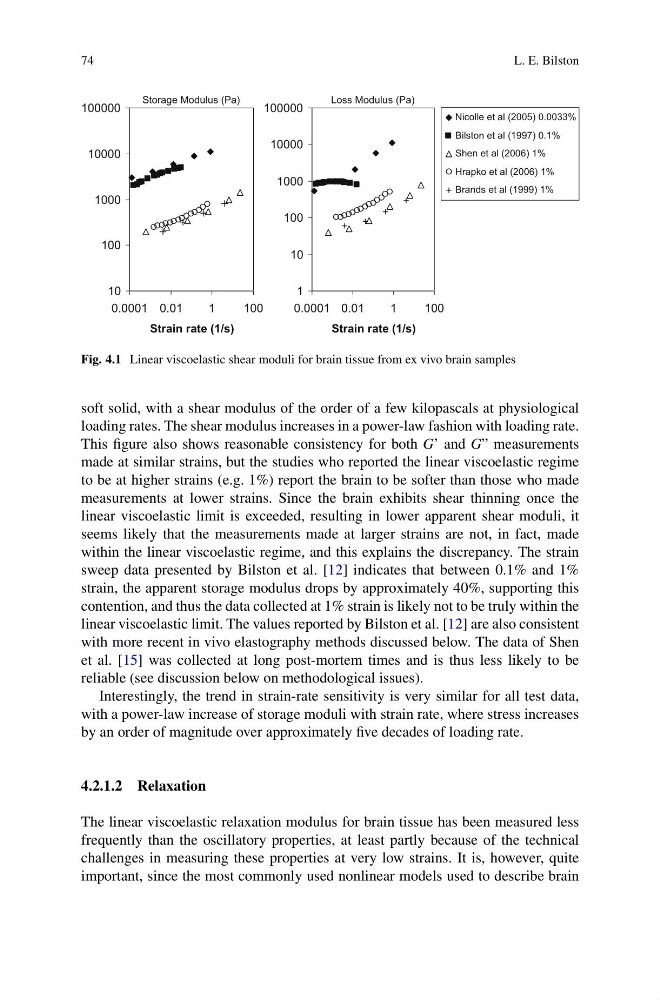
Fig. 4.1 Linear viscoelastic shear moduli for brain tissue from ex vivo brain samples
soft solid, with a shear modulus of the order of a few kilopascals at physiological
loading rates. The shear modulus increases in a power-law fashion with loading rate.
This figure also shows reasonable consistency for both G’ and G” measurements
made at similar strains, but the studies who reported the linear viscoelastic regime
to be at higher strains (e.g. 1%) report the brain to be softer than those who made
measurements at lower strains. Since the brain exhibits shear thinning once the
linear viscoelastic limit is exceeded, resulting in lower apparent shear moduli, it
seems likely that the measurements made at larger strains are not, in fact, made
within the linear viscoelastic regime, and this explains the discrepancy. The strain
sweep data presented by Bilston et al. [12] indicates that between 0.1% and 1%
strain, the apparent storage modulus drops by approximately 40%, supporting this
contention, and thus the data collected at 1% strain is likely not to be truly within the
linear viscoelastic limit. The values reported by Bilston et al. [12] are also consistent
with more recent in vivo elastography methods discussed below. The data of Shen
et al. [15] was collected at long post-mortem times and is thus less likely to be
reliable (see discussion below on methodological issues).
Interestingly, the trend in strain-rate sensitivity is very similar for all test data,
with a power-law increase of storage moduli with strain rate, where stress increases
by an order of magnitude over approximately five decades of loading rate.
4.2.1.2 Relaxation
The linear viscoelastic relaxation modulus for brain tissue has been measured less
frequently than the oscillatory properties, at least partly because of the technical
challenges in measuring these properties at very low strains. It is, however, quite
important, since the most commonly used nonlinear models used to describe brain
L. E. Bilston
10
100
1000
10000
100000
0.0001 0.01
1
100
Strain rate (1/s)
Nicolle et al (2005) 0.0033%
Bilston et al (1997) 0.1%
Shen et al (2006) 1%
Hrapko et al (2006) 1%
Brands et al (1999) 1%
1
10
100
1000
10000
100000
0.0001 0.01
1
100
Strain rate (1/s)
Storage Modulus (Pa)
Loss Modulus (Pa)
Fig. 4.1 Linear viscoelastic shear moduli for brain tissue from ex vivo brain samples
soft solid, with a shear modulus of the order of a few kilopascals at physiological
loading rates. The shear modulus increases in a power-law fashion with loading rate.
This figure also shows reasonable consistency for both G’ and G” measurements
made at similar strains, but the studies who reported the linear viscoelastic regime
to be at higher strains (e.g. 1%) report the brain to be softer than those who made
measurements at lower strains. Since the brain exhibits shear thinning once the
linear viscoelastic limit is exceeded, resulting in lower apparent shear moduli, it
seems likely that the measurements made at larger strains are not, in fact, made
within the linear viscoelastic regime, and this explains the discrepancy. The strain
sweep data presented by Bilston et al. [12] indicates that between 0.1% and 1%
strain, the apparent storage modulus drops by approximately 40%, supporting this
contention, and thus the data collected at 1% strain is likely not to be truly within the
linear viscoelastic limit. The values reported by Bilston et al. [12] are also consistent
with more recent in vivo elastography methods discussed below. The data of Shen
et al. [15] was collected at long post-mortem times and is thus less likely to be
reliable (see discussion below on methodological issues).
Interestingly, the trend in strain-rate sensitivity is very similar for all test data,
with a power-law increase of storage moduli with strain rate, where stress increases
by an order of magnitude over approximately five decades of loading rate.
4.2.1.2 Relaxation
The linear viscoelastic relaxation modulus for brain tissue has been measured less
frequently than the oscillatory properties, at least partly because of the technical
challenges in measuring these properties at very low strains. It is, however, quite
important, since the most commonly used nonlinear models used to describe brain