

336
H. Courtecuisse et al.
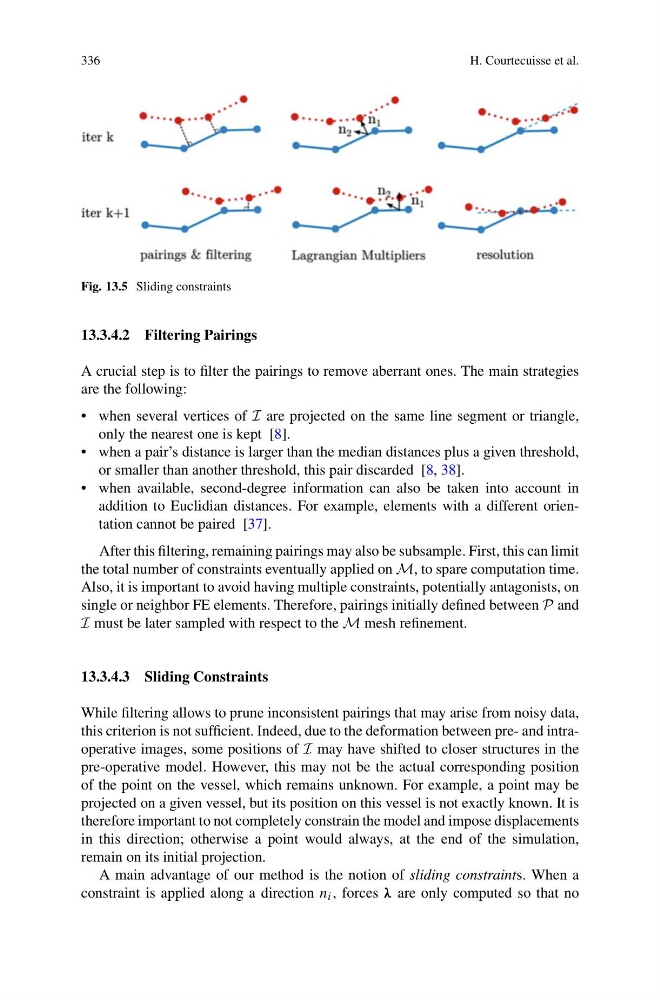
Fig. 13.5 Sliding constraints
13.3.4.2 Filtering Pairings
A crucial step is to filter the pairings to remove aberrant ones. The main strategies
are the following:
• when several vertices of I are projected on the same line segment or triangle,
only the nearest one is kept [8].
• when a pair’s distance is larger than the median distances plus a given threshold,
or smaller than another threshold, this pair discarded [8, 38].
• when available, second-degree information can also be taken into account in
addition to Euclidian distances. For example, elements with a different orientation cannot be paired [37].
After this filtering, remaining pairings may also be subsample. First, this can limit
the total number of constraints eventually applied on M, to spare computation time.
Also, it is important to avoid having multiple constraints, potentially antagonists, on
single or neighbor FE elements. Therefore, pairings initially defined between P and
I must be later sampled with respect to the M mesh refinement.
13.3.4.3 Sliding Constraints
While filtering allows to prune inconsistent pairings that may arise from noisy data,
this criterion is not sufficient. Indeed, due to the deformation between pre- and intraoperative images, some positions of I may have shifted to closer structures in the
pre-operative model. However, this may not be the actual corresponding position
of the point on the vessel, which remains unknown. For example, a point may be
projected on a given vessel, but its position on this vessel is not exactly known. It is
therefore important to not completely constrain the model and impose displacements
in this direction; otherwise a point would always, at the end of the simulation,
remain on its initial projection.
A main advantage of our method is the notion of sliding constraints. When a
constraint is applied along a direction n i , forces λ are only computed so that no
H. Courtecuisse et al.
Fig. 13.5 Sliding constraints
13.3.4.2 Filtering Pairings
A crucial step is to filter the pairings to remove aberrant ones. The main strategies
are the following:
• when several vertices of I are projected on the same line segment or triangle,
only the nearest one is kept [8].
• when a pair’s distance is larger than the median distances plus a given threshold,
or smaller than another threshold, this pair discarded [8, 38].
• when available, second-degree information can also be taken into account in
addition to Euclidian distances. For example, elements with a different orientation cannot be paired [37].
After this filtering, remaining pairings may also be subsample. First, this can limit
the total number of constraints eventually applied on M, to spare computation time.
Also, it is important to avoid having multiple constraints, potentially antagonists, on
single or neighbor FE elements. Therefore, pairings initially defined between P and
I must be later sampled with respect to the M mesh refinement.
13.3.4.3 Sliding Constraints
While filtering allows to prune inconsistent pairings that may arise from noisy data,
this criterion is not sufficient. Indeed, due to the deformation between pre- and intraoperative images, some positions of I may have shifted to closer structures in the
pre-operative model. However, this may not be the actual corresponding position
of the point on the vessel, which remains unknown. For example, a point may be
projected on a given vessel, but its position on this vessel is not exactly known. It is
therefore important to not completely constrain the model and impose displacements
in this direction; otherwise a point would always, at the end of the simulation,
remain on its initial projection.
A main advantage of our method is the notion of sliding constraints. When a
constraint is applied along a direction n i , forces λ are only computed so that no