

294
A. Wittek et al.
10 cm
4 cm
Displacement:
3 cm
a)
b)
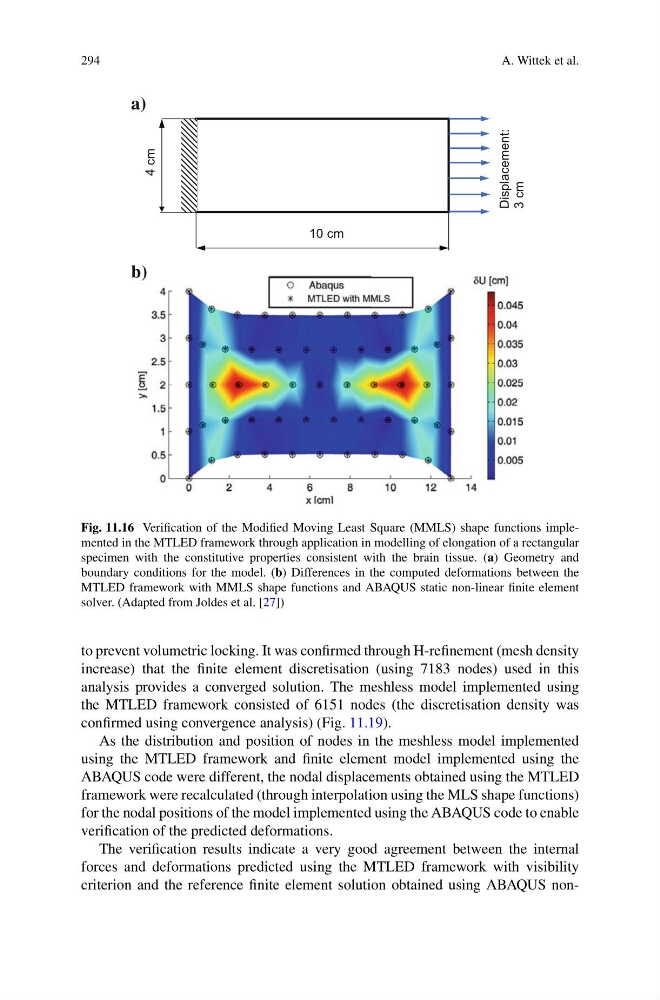
Fig. 11.16 Verification of the Modified Moving Least Square (MMLS) shape functions implemented in the MTLED framework through application in modelling of elongation of a rectangular
specimen with the constitutive properties consistent with the brain tissue. (a) Geometry and
boundary conditions for the model. (b) Differences in the computed deformations between the
MTLED framework with MMLS shape functions and ABAQUS static non-linear finite element
solver. (Adapted from Joldes et al. [27])
to prevent volumetric locking. It was confirmed through H-refinement (mesh density
increase) that the finite element discretisation (using 7183 nodes) used in this
analysis provides a converged solution. The meshless model implemented using
the MTLED framework consisted of 6151 nodes (the discretisation density was
confirmed using convergence analysis) (Fig. 11.19).
As the distribution and position of nodes in the meshless model implemented
using the MTLED framework and finite element model implemented using the
ABAQUS code were different, the nodal displacements obtained using the MTLED
framework were recalculated (through interpolation using the MLS shape functions)
for the nodal positions of the model implemented using the ABAQUS code to enable
verification of the predicted deformations.
The verification results indicate a very good agreement between the internal
forces and deformations predicted using the MTLED framework with visibility
criterion and the reference finite element solution obtained using ABAQUS non-
A. Wittek et al.
10 cm
4 cm
Displacement:
3 cm
a)
b)
Fig. 11.16 Verification of the Modified Moving Least Square (MMLS) shape functions implemented in the MTLED framework through application in modelling of elongation of a rectangular
specimen with the constitutive properties consistent with the brain tissue. (a) Geometry and
boundary conditions for the model. (b) Differences in the computed deformations between the
MTLED framework with MMLS shape functions and ABAQUS static non-linear finite element
solver. (Adapted from Joldes et al. [27])
to prevent volumetric locking. It was confirmed through H-refinement (mesh density
increase) that the finite element discretisation (using 7183 nodes) used in this
analysis provides a converged solution. The meshless model implemented using
the MTLED framework consisted of 6151 nodes (the discretisation density was
confirmed using convergence analysis) (Fig. 11.19).
As the distribution and position of nodes in the meshless model implemented
using the MTLED framework and finite element model implemented using the
ABAQUS code were different, the nodal displacements obtained using the MTLED
framework were recalculated (through interpolation using the MLS shape functions)
for the nodal positions of the model implemented using the ABAQUS code to enable
verification of the predicted deformations.
The verification results indicate a very good agreement between the internal
forces and deformations predicted using the MTLED framework with visibility
criterion and the reference finite element solution obtained using ABAQUS non-