

292
A. Wittek et al.
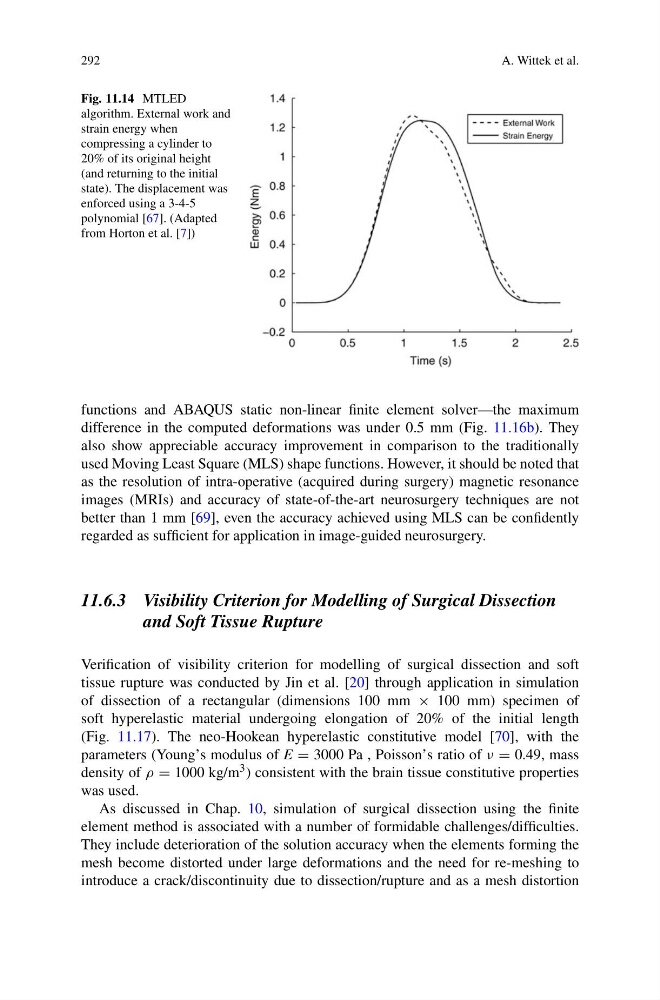
Fig. 11.14 MTLED
algorithm. External work and
strain energy when
compressing a cylinder to
20% of its original height
(and returning to the initial
state). The displacement was
enforced using a 3-4-5
polynomial [67]. (Adapted
from Horton et al. [7])
functions and ABAQUS static non-linear finite element solver—the maximum
difference in the computed deformations was under 0.5 mm (Fig. 11.16b). They
also show appreciable accuracy improvement in comparison to the traditionally
used Moving Least Square (MLS) shape functions. However, it should be noted that
as the resolution of intra-operative (acquired during surgery) magnetic resonance
images (MRIs) and accuracy of state-of-the-art neurosurgery techniques are not
better than 1 mm [69], even the accuracy achieved using MLS can be confidently
regarded as sufficient for application in image-guided neurosurgery.
11.6.3 Visibility Criterion for Modelling of Surgical Dissection
and Soft Tissue Rupture
Verification of visibility criterion for modelling of surgical dissection and soft
tissue rupture was conducted by Jin et al. [20] through application in simulation
of dissection of a rectangular (dimensions 100 mm × 100 mm) specimen of
soft hyperelastic material undergoing elongation of 20% of the initial length
(Fig. 11.17). The neo-Hookean hyperelastic constitutive model [70], with the
parameters (Young’s modulus of E = 3000 Pa , Poisson’s ratio of ν = 0.49, mass
density of ρ = 1000 kg/m 3 ) consistent with the brain tissue constitutive properties
was used.
As discussed in Chap. 10, simulation of surgical dissection using the finite
element method is associated with a number of formidable challenges/difficulties.
They include deterioration of the solution accuracy when the elements forming the
mesh become distorted under large deformations and the need for re-meshing to
introduce a crack/discontinuity due to dissection/rupture and as a mesh distortion
A. Wittek et al.
Fig. 11.14 MTLED
algorithm. External work and
strain energy when
compressing a cylinder to
20% of its original height
(and returning to the initial
state). The displacement was
enforced using a 3-4-5
polynomial [67]. (Adapted
from Horton et al. [7])
functions and ABAQUS static non-linear finite element solver—the maximum
difference in the computed deformations was under 0.5 mm (Fig. 11.16b). They
also show appreciable accuracy improvement in comparison to the traditionally
used Moving Least Square (MLS) shape functions. However, it should be noted that
as the resolution of intra-operative (acquired during surgery) magnetic resonance
images (MRIs) and accuracy of state-of-the-art neurosurgery techniques are not
better than 1 mm [69], even the accuracy achieved using MLS can be confidently
regarded as sufficient for application in image-guided neurosurgery.
11.6.3 Visibility Criterion for Modelling of Surgical Dissection
and Soft Tissue Rupture
Verification of visibility criterion for modelling of surgical dissection and soft
tissue rupture was conducted by Jin et al. [20] through application in simulation
of dissection of a rectangular (dimensions 100 mm × 100 mm) specimen of
soft hyperelastic material undergoing elongation of 20% of the initial length
(Fig. 11.17). The neo-Hookean hyperelastic constitutive model [70], with the
parameters (Young’s modulus of E = 3000 Pa , Poisson’s ratio of ν = 0.49, mass
density of ρ = 1000 kg/m 3 ) consistent with the brain tissue constitutive properties
was used.
As discussed in Chap. 10, simulation of surgical dissection using the finite
element method is associated with a number of formidable challenges/difficulties.
They include deterioration of the solution accuracy when the elements forming the
mesh become distorted under large deformations and the need for re-meshing to
introduce a crack/discontinuity due to dissection/rupture and as a mesh distortion