

11 Meshless Algorithms for Computational Biomechanics of the Brain
281
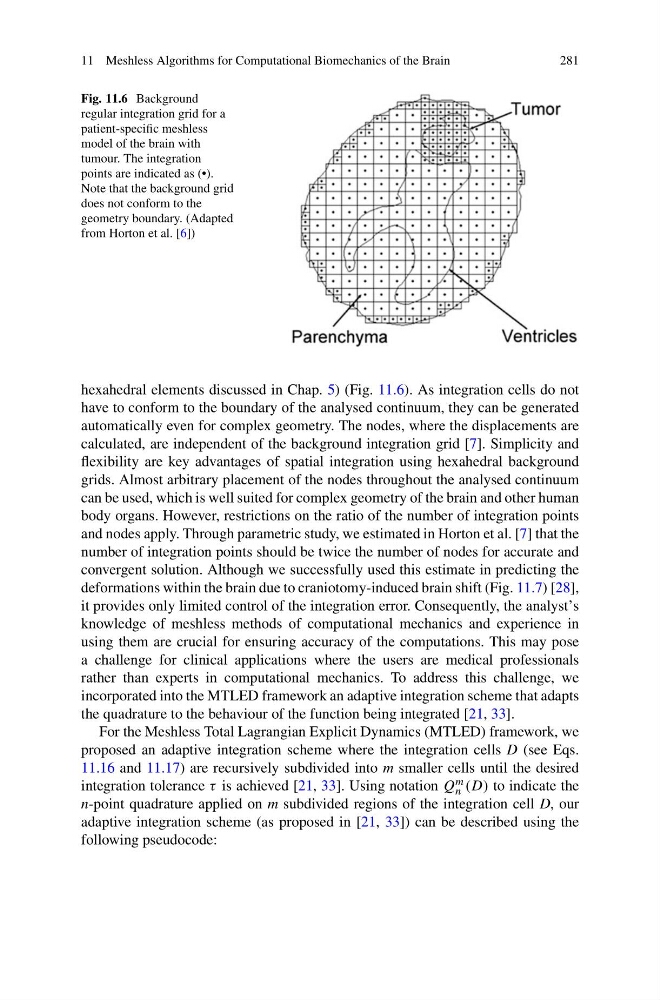
Fig. 11.6 Background
regular integration grid for a
patient-specific meshless
model of the brain with
tumour. The integration
points are indicated as (•).
Note that the background grid
does not conform to the
geometry boundary. (Adapted
from Horton et al. [6])
hexahedral elements discussed in Chap. 5) (Fig. 11.6). As integration cells do not
have to conform to the boundary of the analysed continuum, they can be generated
automatically even for complex geometry. The nodes, where the displacements are
calculated, are independent of the background integration grid [7]. Simplicity and
flexibility are key advantages of spatial integration using hexahedral background
grids. Almost arbitrary placement of the nodes throughout the analysed continuum
can be used, which is well suited for complex geometry of the brain and other human
body organs. However, restrictions on the ratio of the number of integration points
and nodes apply. Through parametric study, we estimated in Horton et al. [7] that the
number of integration points should be twice the number of nodes for accurate and
convergent solution. Although we successfully used this estimate in predicting the
deformations within the brain due to craniotomy-induced brain shift (Fig. 11.7) [28],
it provides only limited control of the integration error. Consequently, the analyst’s
knowledge of meshless methods of computational mechanics and experience in
using them are crucial for ensuring accuracy of the computations. This may pose
a challenge for clinical applications where the users are medical professionals
rather than experts in computational mechanics. To address this challenge, we
incorporated into the MTLED framework an adaptive integration scheme that adapts
the quadrature to the behaviour of the function being integrated [21, 33].
For the Meshless Total Lagrangian Explicit Dynamics (MTLED) framework, we
proposed an adaptive integration scheme where the integration cells D (see Eqs.
11.16 and 11.17) are recursively subdivided into m smaller cells until the desired
integration tolerance τ is achieved [21, 33]. Using notation Q m
n (D) to indicate the
n-point quadrature applied on m subdivided regions of the integration cell D, our
adaptive integration scheme (as proposed in [21, 33]) can be described using the
following pseudocode:
281
Fig. 11.6 Background
regular integration grid for a
patient-specific meshless
model of the brain with
tumour. The integration
points are indicated as (•).
Note that the background grid
does not conform to the
geometry boundary. (Adapted
from Horton et al. [6])
hexahedral elements discussed in Chap. 5) (Fig. 11.6). As integration cells do not
have to conform to the boundary of the analysed continuum, they can be generated
automatically even for complex geometry. The nodes, where the displacements are
calculated, are independent of the background integration grid [7]. Simplicity and
flexibility are key advantages of spatial integration using hexahedral background
grids. Almost arbitrary placement of the nodes throughout the analysed continuum
can be used, which is well suited for complex geometry of the brain and other human
body organs. However, restrictions on the ratio of the number of integration points
and nodes apply. Through parametric study, we estimated in Horton et al. [7] that the
number of integration points should be twice the number of nodes for accurate and
convergent solution. Although we successfully used this estimate in predicting the
deformations within the brain due to craniotomy-induced brain shift (Fig. 11.7) [28],
it provides only limited control of the integration error. Consequently, the analyst’s
knowledge of meshless methods of computational mechanics and experience in
using them are crucial for ensuring accuracy of the computations. This may pose
a challenge for clinical applications where the users are medical professionals
rather than experts in computational mechanics. To address this challenge, we
incorporated into the MTLED framework an adaptive integration scheme that adapts
the quadrature to the behaviour of the function being integrated [21, 33].
For the Meshless Total Lagrangian Explicit Dynamics (MTLED) framework, we
proposed an adaptive integration scheme where the integration cells D (see Eqs.
11.16 and 11.17) are recursively subdivided into m smaller cells until the desired
integration tolerance τ is achieved [21, 33]. Using notation Q m
n (D) to indicate the
n-point quadrature applied on m subdivided regions of the integration cell D, our
adaptive integration scheme (as proposed in [21, 33]) can be described using the
following pseudocode: