

274
A. Wittek et al.
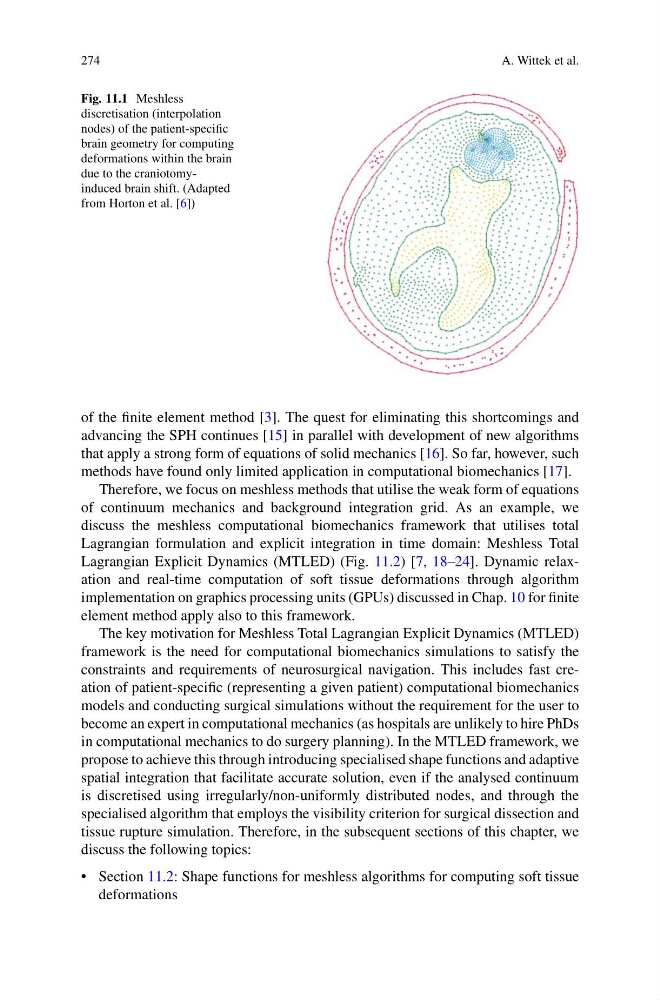
Fig. 11.1 Meshless
discretisation (interpolation
nodes) of the patient-specific
brain geometry for computing
deformations within the brain
due to the craniotomyinduced brain shift. (Adapted
from Horton et al. [6])
of the finite element method [3]. The quest for eliminating this shortcomings and
advancing the SPH continues [15] in parallel with development of new algorithms
that apply a strong form of equations of solid mechanics [16]. So far, however, such
methods have found only limited application in computational biomechanics [17].
Therefore, we focus on meshless methods that utilise the weak form of equations
of continuum mechanics and background integration grid. As an example, we
discuss the meshless computational biomechanics framework that utilises total
Lagrangian formulation and explicit integration in time domain: Meshless Total
Lagrangian Explicit Dynamics (MTLED) (Fig. 11.2) [7, 18–24]. Dynamic relaxation and real-time computation of soft tissue deformations through algorithm
implementation on graphics processing units (GPUs) discussed in Chap. 10 for finite
element method apply also to this framework.
The key motivation for Meshless Total Lagrangian Explicit Dynamics (MTLED)
framework is the need for computational biomechanics simulations to satisfy the
constraints and requirements of neurosurgical navigation. This includes fast creation of patient-specific (representing a given patient) computational biomechanics
models and conducting surgical simulations without the requirement for the user to
become an expert in computational mechanics (as hospitals are unlikely to hire PhDs
in computational mechanics to do surgery planning). In the MTLED framework, we
propose to achieve this through introducing specialised shape functions and adaptive
spatial integration that facilitate accurate solution, even if the analysed continuum
is discretised using irregularly/non-uniformly distributed nodes, and through the
specialised algorithm that employs the visibility criterion for surgical dissection and
tissue rupture simulation. Therefore, in the subsequent sections of this chapter, we
discuss the following topics:
• Section 11.2: Shape functions for meshless algorithms for computing soft tissue
deformations
A. Wittek et al.
Fig. 11.1 Meshless
discretisation (interpolation
nodes) of the patient-specific
brain geometry for computing
deformations within the brain
due to the craniotomyinduced brain shift. (Adapted
from Horton et al. [6])
of the finite element method [3]. The quest for eliminating this shortcomings and
advancing the SPH continues [15] in parallel with development of new algorithms
that apply a strong form of equations of solid mechanics [16]. So far, however, such
methods have found only limited application in computational biomechanics [17].
Therefore, we focus on meshless methods that utilise the weak form of equations
of continuum mechanics and background integration grid. As an example, we
discuss the meshless computational biomechanics framework that utilises total
Lagrangian formulation and explicit integration in time domain: Meshless Total
Lagrangian Explicit Dynamics (MTLED) (Fig. 11.2) [7, 18–24]. Dynamic relaxation and real-time computation of soft tissue deformations through algorithm
implementation on graphics processing units (GPUs) discussed in Chap. 10 for finite
element method apply also to this framework.
The key motivation for Meshless Total Lagrangian Explicit Dynamics (MTLED)
framework is the need for computational biomechanics simulations to satisfy the
constraints and requirements of neurosurgical navigation. This includes fast creation of patient-specific (representing a given patient) computational biomechanics
models and conducting surgical simulations without the requirement for the user to
become an expert in computational mechanics (as hospitals are unlikely to hire PhDs
in computational mechanics to do surgery planning). In the MTLED framework, we
propose to achieve this through introducing specialised shape functions and adaptive
spatial integration that facilitate accurate solution, even if the analysed continuum
is discretised using irregularly/non-uniformly distributed nodes, and through the
specialised algorithm that employs the visibility criterion for surgical dissection and
tissue rupture simulation. Therefore, in the subsequent sections of this chapter, we
discuss the following topics:
• Section 11.2: Shape functions for meshless algorithms for computing soft tissue
deformations