

10 Finite Element Algorithms for Computational Biomechanics of the Brain
253
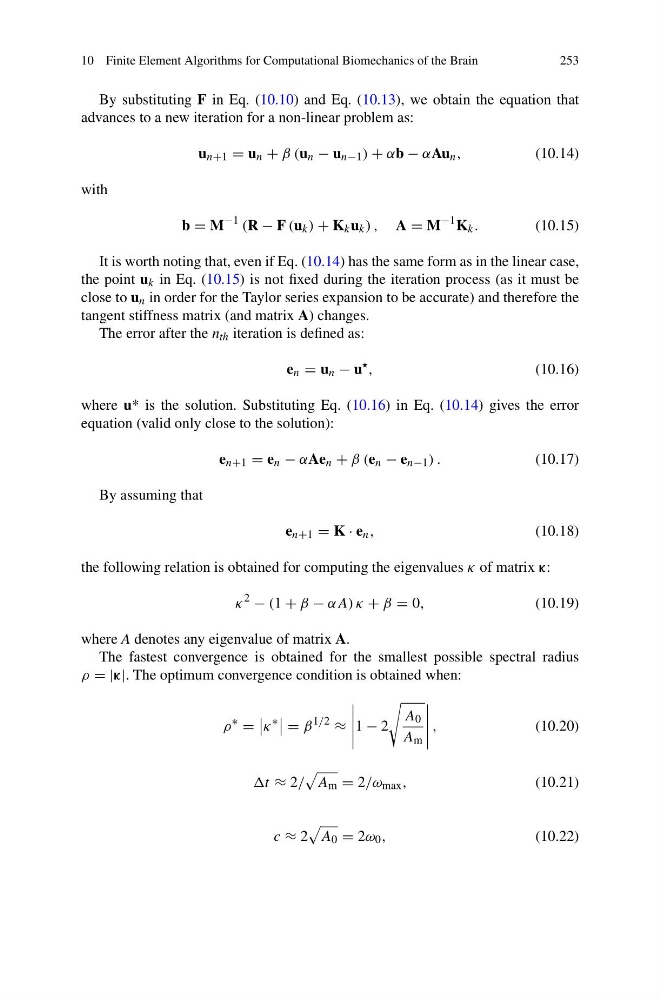
By substituting F in Eq. (10.10) and Eq. (10.13), we obtain the equation that
advances to a new iteration for a non-linear problem as:
u n+1 = u n + β (u n − u n−1 ) + αb − αAu n ,
(10.14)
with
b = M
−1 (R − F (u k ) + K k u k ) , A = M
−1 K k .
(10.15)
It is worth noting that, even if Eq. (10.14) has the same form as in the linear case,
the point u k in Eq. (10.15) is not fixed during the iteration process (as it must be
close to u n in order for the Taylor series expansion to be accurate) and therefore the
tangent stiffness matrix (and matrix A) changes.
The error after the n th iteration is defined as:
e n = u n − u
,
(10.16)
where u* is the solution. Substituting Eq. (10.16) in Eq. (10.14) gives the error
equation (valid only close to the solution):
e n+1 = e n − αAe n + β (e n − e n−1 ) .
(10.17)
By assuming that
e n+1 = K · e n ,
(10.18)
the following relation is obtained for computing the eigenvalues κ of matrix κ:
κ
2
− (1 + β − αA) κ + β = 0,
(10.19)
where A denotes any eigenvalue of matrix A.
The fastest convergence is obtained for the smallest possible spectral radius
ρ = |κ|. The optimum convergence condition is obtained when:
ρ
∗
=
κ
∗
= β
1/2
≈
1 − 2
A 0
A m
,
(10.20)
t ≈ 2/
A m = 2/ω max ,
(10.21)
c ≈ 2
A 0 = 2ω 0 ,
(10.22)
253
By substituting F in Eq. (10.10) and Eq. (10.13), we obtain the equation that
advances to a new iteration for a non-linear problem as:
u n+1 = u n + β (u n − u n−1 ) + αb − αAu n ,
(10.14)
with
b = M
−1 (R − F (u k ) + K k u k ) , A = M
−1 K k .
(10.15)
It is worth noting that, even if Eq. (10.14) has the same form as in the linear case,
the point u k in Eq. (10.15) is not fixed during the iteration process (as it must be
close to u n in order for the Taylor series expansion to be accurate) and therefore the
tangent stiffness matrix (and matrix A) changes.
The error after the n th iteration is defined as:
e n = u n − u
,
(10.16)
where u* is the solution. Substituting Eq. (10.16) in Eq. (10.14) gives the error
equation (valid only close to the solution):
e n+1 = e n − αAe n + β (e n − e n−1 ) .
(10.17)
By assuming that
e n+1 = K · e n ,
(10.18)
the following relation is obtained for computing the eigenvalues κ of matrix κ:
κ
2
− (1 + β − αA) κ + β = 0,
(10.19)
where A denotes any eigenvalue of matrix A.
The fastest convergence is obtained for the smallest possible spectral radius
ρ = |κ|. The optimum convergence condition is obtained when:
ρ
∗
=
κ
∗
= β
1/2
≈
1 − 2
A 0
A m
,
(10.20)
t ≈ 2/
A m = 2/ω max ,
(10.21)
c ≈ 2
A 0 = 2ω 0 ,
(10.22)