

252
A. Wittek et al.
obtain convergence can be quite large, the computation cost of each iteration is very
low, making it a very efficient solution method for non-linear problems.
10.4.1 Dynamic Relaxation Algorithm
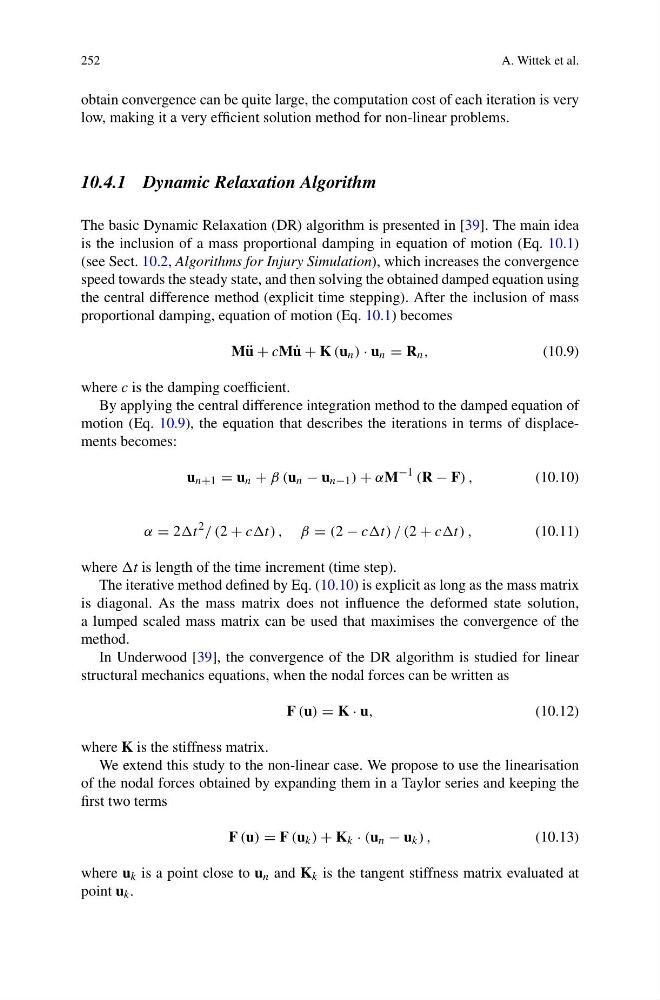
The basic Dynamic Relaxation (DR) algorithm is presented in [39]. The main idea
is the inclusion of a mass proportional damping in equation of motion (Eq. 10.1)
(see Sect. 10.2, Algorithms for Injury Simulation), which increases the convergence
speed towards the steady state, and then solving the obtained damped equation using
the central difference method (explicit time stepping). After the inclusion of mass
proportional damping, equation of motion (Eq. 10.1) becomes
M ¨
u + cM ˙
u + K (u n ) · u n = R n ,
(10.9)
where c is the damping coefficient.
By applying the central difference integration method to the damped equation of
motion (Eq. 10.9), the equation that describes the iterations in terms of displacements becomes:
u n+1 = u n + β (u n − u n−1 ) + αM
−1 (R − F) ,
(10.10)
α = 2t
2 / (2 + cct) , β = (2 − cct) / (2 + cct) ,
(10.11)
where t is length of the time increment (time step).
The iterative method defined by Eq. (10.10) is explicit as long as the mass matrix
is diagonal. As the mass matrix does not influence the deformed state solution,
a lumped scaled mass matrix can be used that maximises the convergence of the
method.
In Underwood [39], the convergence of the DR algorithm is studied for linear
structural mechanics equations, when the nodal forces can be written as
F (u) = K · u,
(10.12)
where K is the stiffness matrix.
We extend this study to the non-linear case. We propose to use the linearisation
of the nodal forces obtained by expanding them in a Taylor series and keeping the
first two terms
F (u) = F (u k ) + K k · (u n − u k ) ,
(10.13)
where u k is a point close to u n and K k is the tangent stiffness matrix evaluated at
point u k .
A. Wittek et al.
obtain convergence can be quite large, the computation cost of each iteration is very
low, making it a very efficient solution method for non-linear problems.
10.4.1 Dynamic Relaxation Algorithm
The basic Dynamic Relaxation (DR) algorithm is presented in [39]. The main idea
is the inclusion of a mass proportional damping in equation of motion (Eq. 10.1)
(see Sect. 10.2, Algorithms for Injury Simulation), which increases the convergence
speed towards the steady state, and then solving the obtained damped equation using
the central difference method (explicit time stepping). After the inclusion of mass
proportional damping, equation of motion (Eq. 10.1) becomes
M ¨
u + cM ˙
u + K (u n ) · u n = R n ,
(10.9)
where c is the damping coefficient.
By applying the central difference integration method to the damped equation of
motion (Eq. 10.9), the equation that describes the iterations in terms of displacements becomes:
u n+1 = u n + β (u n − u n−1 ) + αM
−1 (R − F) ,
(10.10)
α = 2t
2 / (2 + cct) , β = (2 − cct) / (2 + cct) ,
(10.11)
where t is length of the time increment (time step).
The iterative method defined by Eq. (10.10) is explicit as long as the mass matrix
is diagonal. As the mass matrix does not influence the deformed state solution,
a lumped scaled mass matrix can be used that maximises the convergence of the
method.
In Underwood [39], the convergence of the DR algorithm is studied for linear
structural mechanics equations, when the nodal forces can be written as
F (u) = K · u,
(10.12)
where K is the stiffness matrix.
We extend this study to the non-linear case. We propose to use the linearisation
of the nodal forces obtained by expanding them in a Taylor series and keeping the
first two terms
F (u) = F (u k ) + K k · (u n − u k ) ,
(10.13)
where u k is a point close to u n and K k is the tangent stiffness matrix evaluated at
point u k .