

244
A. Wittek et al.
Due to its simplicity and low computational costs, the target application areas for
this method included simulation software for virtual reality training systems for
minimally invasive surgery [11] and surgical planning [12]. However, the behaviour
of the mass-spring models strongly depends on the topology of the spring network.
Furthermore, the spring parameters are difficult to identify and express in terms of
soft tissue constitutive parameters (such as Young’s modulus and Poisson’s ratio)
used in continuum mechanics [13]. Therefore, in recent years, more interest has
been given to finite element method [4] that utilises the principles of continuum
mechanics and does not suffer from the limitations of the mass-spring method.
Traditionally real-time computations for biomechanics for medicine relied on
linear finite element algorithms that assume infinitesimally small deformations [13–
19]. However, this assumption is not satisfied in surgical procedures where large
deformations of the organ undergoing surgery occur. Examples include the brain
deformations due to craniotomy (referred to in the literature as brain shift [20])
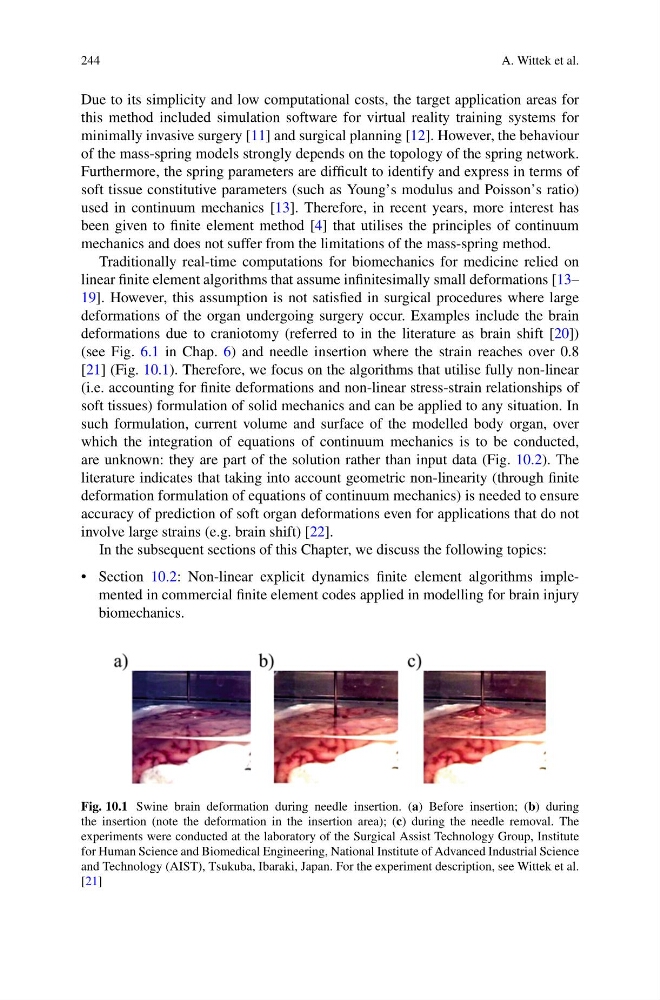
(see Fig. 6.1 in Chap. 6) and needle insertion where the strain reaches over 0.8
[21] (Fig. 10.1). Therefore, we focus on the algorithms that utilise fully non-linear
(i.e. accounting for finite deformations and non-linear stress-strain relationships of
soft tissues) formulation of solid mechanics and can be applied to any situation. In
such formulation, current volume and surface of the modelled body organ, over
which the integration of equations of continuum mechanics is to be conducted,
are unknown: they are part of the solution rather than input data (Fig. 10.2). The
literature indicates that taking into account geometric non-linearity (through finite
deformation formulation of equations of continuum mechanics) is needed to ensure
accuracy of prediction of soft organ deformations even for applications that do not
involve large strains (e.g. brain shift) [22].
In the subsequent sections of this Chapter, we discuss the following topics:
• Section 10.2: Non-linear explicit dynamics finite element algorithms implemented in commercial finite element codes applied in modelling for brain injury
biomechanics.
Fig. 10.1 Swine brain deformation during needle insertion. (a) Before insertion; (b) during
the insertion (note the deformation in the insertion area); (c) during the needle removal. The
experiments were conducted at the laboratory of the Surgical Assist Technology Group, Institute
for Human Science and Biomedical Engineering, National Institute of Advanced Industrial Science
and Technology (AIST), Tsukuba, Ibaraki, Japan. For the experiment description, see Wittek et al.
[21]
A. Wittek et al.
Due to its simplicity and low computational costs, the target application areas for
this method included simulation software for virtual reality training systems for
minimally invasive surgery [11] and surgical planning [12]. However, the behaviour
of the mass-spring models strongly depends on the topology of the spring network.
Furthermore, the spring parameters are difficult to identify and express in terms of
soft tissue constitutive parameters (such as Young’s modulus and Poisson’s ratio)
used in continuum mechanics [13]. Therefore, in recent years, more interest has
been given to finite element method [4] that utilises the principles of continuum
mechanics and does not suffer from the limitations of the mass-spring method.
Traditionally real-time computations for biomechanics for medicine relied on
linear finite element algorithms that assume infinitesimally small deformations [13–
19]. However, this assumption is not satisfied in surgical procedures where large
deformations of the organ undergoing surgery occur. Examples include the brain
deformations due to craniotomy (referred to in the literature as brain shift [20])
(see Fig. 6.1 in Chap. 6) and needle insertion where the strain reaches over 0.8
[21] (Fig. 10.1). Therefore, we focus on the algorithms that utilise fully non-linear
(i.e. accounting for finite deformations and non-linear stress-strain relationships of
soft tissues) formulation of solid mechanics and can be applied to any situation. In
such formulation, current volume and surface of the modelled body organ, over
which the integration of equations of continuum mechanics is to be conducted,
are unknown: they are part of the solution rather than input data (Fig. 10.2). The
literature indicates that taking into account geometric non-linearity (through finite
deformation formulation of equations of continuum mechanics) is needed to ensure
accuracy of prediction of soft organ deformations even for applications that do not
involve large strains (e.g. brain shift) [22].
In the subsequent sections of this Chapter, we discuss the following topics:
• Section 10.2: Non-linear explicit dynamics finite element algorithms implemented in commercial finite element codes applied in modelling for brain injury
biomechanics.
Fig. 10.1 Swine brain deformation during needle insertion. (a) Before insertion; (b) during
the insertion (note the deformation in the insertion area); (c) during the needle removal. The
experiments were conducted at the laboratory of the Surgical Assist Technology Group, Institute
for Human Science and Biomedical Engineering, National Institute of Advanced Industrial Science
and Technology (AIST), Tsukuba, Ibaraki, Japan. For the experiment description, see Wittek et al.
[21]