

6 Biomechanical Modelling of the Brain for Neurosurgical Simulation. . .
157
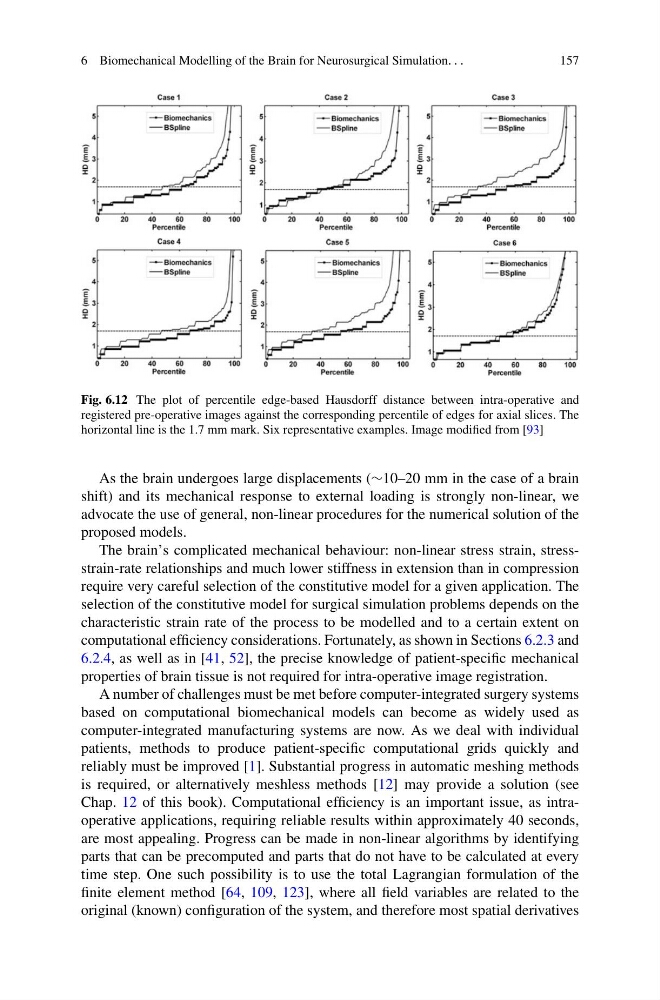
Fig. 6.12 The plot of percentile edge-based Hausdorff distance between intra-operative and
registered pre-operative images against the corresponding percentile of edges for axial slices. The
horizontal line is the 1.7 mm mark. Six representative examples. Image modified from [93]
As the brain undergoes large displacements (∼10–20 mm in the case of a brain
shift) and its mechanical response to external loading is strongly non-linear, we
advocate the use of general, non-linear procedures for the numerical solution of the
proposed models.
The brain’s complicated mechanical behaviour: non-linear stress strain, stressstrain-rate relationships and much lower stiffness in extension than in compression
require very careful selection of the constitutive model for a given application. The
selection of the constitutive model for surgical simulation problems depends on the
characteristic strain rate of the process to be modelled and to a certain extent on
computational efficiency considerations. Fortunately, as shown in Sections 6.2.3 and
6.2.4, as well as in [41, 52], the precise knowledge of patient-specific mechanical
properties of brain tissue is not required for intra-operative image registration.
A number of challenges must be met before computer-integrated surgery systems
based on computational biomechanical models can become as widely used as
computer-integrated manufacturing systems are now. As we deal with individual
patients, methods to produce patient-specific computational grids quickly and
reliably must be improved [1]. Substantial progress in automatic meshing methods
is required, or alternatively meshless methods [12] may provide a solution (see
Chap. 12 of this book). Computational efficiency is an important issue, as intraoperative applications, requiring reliable results within approximately 40 seconds,
are most appealing. Progress can be made in non-linear algorithms by identifying
parts that can be precomputed and parts that do not have to be calculated at every
time step. One such possibility is to use the total Lagrangian formulation of the
finite element method [64, 109, 123], where all field variables are related to the
original (known) configuration of the system, and therefore most spatial derivatives
157
Fig. 6.12 The plot of percentile edge-based Hausdorff distance between intra-operative and
registered pre-operative images against the corresponding percentile of edges for axial slices. The
horizontal line is the 1.7 mm mark. Six representative examples. Image modified from [93]
As the brain undergoes large displacements (∼10–20 mm in the case of a brain
shift) and its mechanical response to external loading is strongly non-linear, we
advocate the use of general, non-linear procedures for the numerical solution of the
proposed models.
The brain’s complicated mechanical behaviour: non-linear stress strain, stressstrain-rate relationships and much lower stiffness in extension than in compression
require very careful selection of the constitutive model for a given application. The
selection of the constitutive model for surgical simulation problems depends on the
characteristic strain rate of the process to be modelled and to a certain extent on
computational efficiency considerations. Fortunately, as shown in Sections 6.2.3 and
6.2.4, as well as in [41, 52], the precise knowledge of patient-specific mechanical
properties of brain tissue is not required for intra-operative image registration.
A number of challenges must be met before computer-integrated surgery systems
based on computational biomechanical models can become as widely used as
computer-integrated manufacturing systems are now. As we deal with individual
patients, methods to produce patient-specific computational grids quickly and
reliably must be improved [1]. Substantial progress in automatic meshing methods
is required, or alternatively meshless methods [12] may provide a solution (see
Chap. 12 of this book). Computational efficiency is an important issue, as intraoperative applications, requiring reliable results within approximately 40 seconds,
are most appealing. Progress can be made in non-linear algorithms by identifying
parts that can be precomputed and parts that do not have to be calculated at every
time step. One such possibility is to use the total Lagrangian formulation of the
finite element method [64, 109, 123], where all field variables are related to the
original (known) configuration of the system, and therefore most spatial derivatives