

140
K. Miller et al.
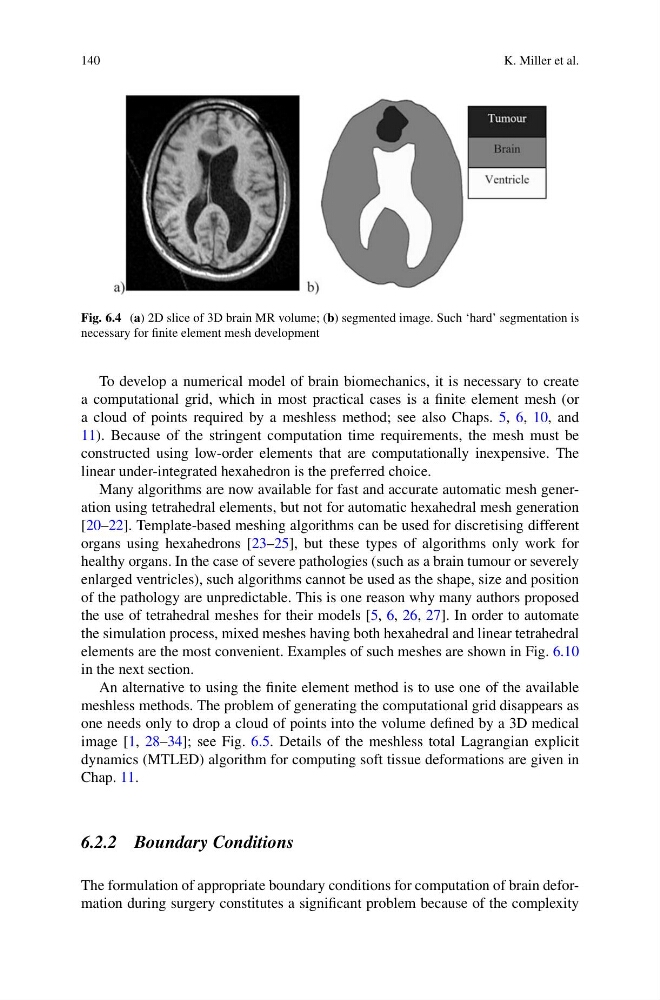
Fig. 6.4 (a) 2D slice of 3D brain MR volume; (b) segmented image. Such ‘hard’ segmentation is
necessary for finite element mesh development
To develop a numerical model of brain biomechanics, it is necessary to create
a computational grid, which in most practical cases is a finite element mesh (or
a cloud of points required by a meshless method; see also Chaps. 5, 6, 10, and
11). Because of the stringent computation time requirements, the mesh must be
constructed using low-order elements that are computationally inexpensive. The
linear under-integrated hexahedron is the preferred choice.
Many algorithms are now available for fast and accurate automatic mesh generation using tetrahedral elements, but not for automatic hexahedral mesh generation
[20–22]. Template-based meshing algorithms can be used for discretising different
organs using hexahedrons [23–25], but these types of algorithms only work for
healthy organs. In the case of severe pathologies (such as a brain tumour or severely
enlarged ventricles), such algorithms cannot be used as the shape, size and position
of the pathology are unpredictable. This is one reason why many authors proposed
the use of tetrahedral meshes for their models [5, 6, 26, 27]. In order to automate
the simulation process, mixed meshes having both hexahedral and linear tetrahedral
elements are the most convenient. Examples of such meshes are shown in Fig. 6.10
in the next section.
An alternative to using the finite element method is to use one of the available
meshless methods. The problem of generating the computational grid disappears as
one needs only to drop a cloud of points into the volume defined by a 3D medical
image [1, 28–34]; see Fig. 6.5. Details of the meshless total Lagrangian explicit
dynamics (MTLED) algorithm for computing soft tissue deformations are given in
Chap. 11.
6.2.2 Boundary Conditions
The formulation of appropriate boundary conditions for computation of brain deformation during surgery constitutes a significant problem because of the complexity
K. Miller et al.
Fig. 6.4 (a) 2D slice of 3D brain MR volume; (b) segmented image. Such ‘hard’ segmentation is
necessary for finite element mesh development
To develop a numerical model of brain biomechanics, it is necessary to create
a computational grid, which in most practical cases is a finite element mesh (or
a cloud of points required by a meshless method; see also Chaps. 5, 6, 10, and
11). Because of the stringent computation time requirements, the mesh must be
constructed using low-order elements that are computationally inexpensive. The
linear under-integrated hexahedron is the preferred choice.
Many algorithms are now available for fast and accurate automatic mesh generation using tetrahedral elements, but not for automatic hexahedral mesh generation
[20–22]. Template-based meshing algorithms can be used for discretising different
organs using hexahedrons [23–25], but these types of algorithms only work for
healthy organs. In the case of severe pathologies (such as a brain tumour or severely
enlarged ventricles), such algorithms cannot be used as the shape, size and position
of the pathology are unpredictable. This is one reason why many authors proposed
the use of tetrahedral meshes for their models [5, 6, 26, 27]. In order to automate
the simulation process, mixed meshes having both hexahedral and linear tetrahedral
elements are the most convenient. Examples of such meshes are shown in Fig. 6.10
in the next section.
An alternative to using the finite element method is to use one of the available
meshless methods. The problem of generating the computational grid disappears as
one needs only to drop a cloud of points into the volume defined by a 3D medical
image [1, 28–34]; see Fig. 6.5. Details of the meshless total Lagrangian explicit
dynamics (MTLED) algorithm for computing soft tissue deformations are given in
Chap. 11.
6.2.2 Boundary Conditions
The formulation of appropriate boundary conditions for computation of brain deformation during surgery constitutes a significant problem because of the complexity