

6 Biomechanical Modelling of the Brain for Neurosurgical Simulation. . .
137
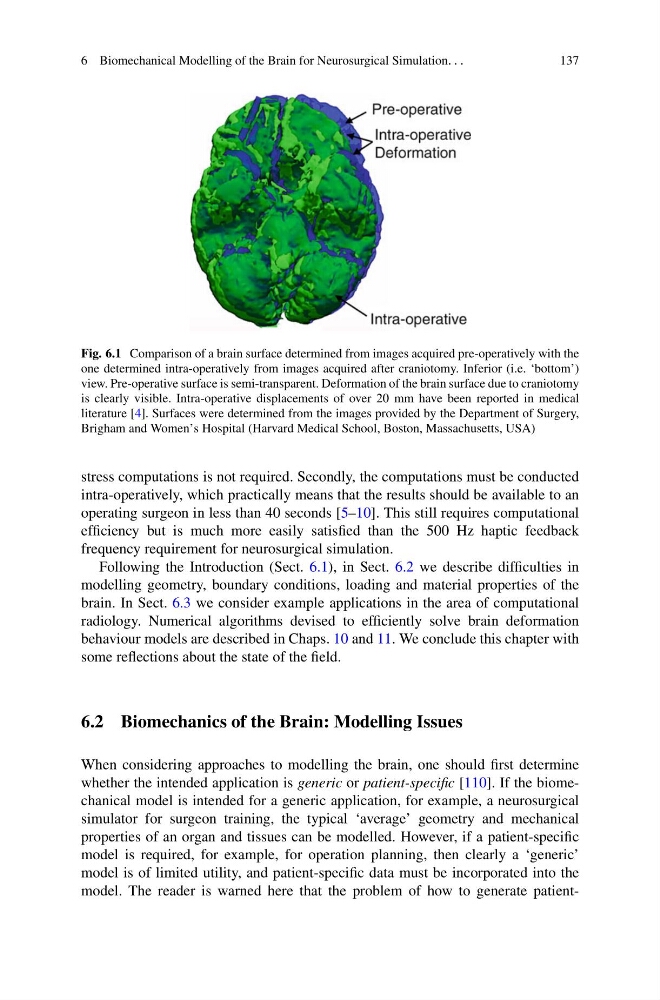
Fig. 6.1 Comparison of a brain surface determined from images acquired pre-operatively with the
one determined intra-operatively from images acquired after craniotomy. Inferior (i.e. ‘bottom’)
view. Pre-operative surface is semi-transparent. Deformation of the brain surface due to craniotomy
is clearly visible. Intra-operative displacements of over 20 mm have been reported in medical
literature [4]. Surfaces were determined from the images provided by the Department of Surgery,
Brigham and Women’s Hospital (Harvard Medical School, Boston, Massachusetts, USA)
stress computations is not required. Secondly, the computations must be conducted
intra-operatively, which practically means that the results should be available to an
operating surgeon in less than 40 seconds [5–10]. This still requires computational
efficiency but is much more easily satisfied than the 500 Hz haptic feedback
frequency requirement for neurosurgical simulation.
Following the Introduction (Sect. 6.1), in Sect. 6.2 we describe difficulties in
modelling geometry, boundary conditions, loading and material properties of the
brain. In Sect. 6.3 we consider example applications in the area of computational
radiology. Numerical algorithms devised to efficiently solve brain deformation
behaviour models are described in Chaps. 10 and 11. We conclude this chapter with
some reflections about the state of the field.
6.2 Biomechanics of the Brain: Modelling Issues
When considering approaches to modelling the brain, one should first determine
whether the intended application is generic or patient-specific [110]. If the biomechanical model is intended for a generic application, for example, a neurosurgical
simulator for surgeon training, the typical ‘average’ geometry and mechanical
properties of an organ and tissues can be modelled. However, if a patient-specific
model is required, for example, for operation planning, then clearly a ‘generic’
model is of limited utility, and patient-specific data must be incorporated into the
model. The reader is warned here that the problem of how to generate patient-
137
Fig. 6.1 Comparison of a brain surface determined from images acquired pre-operatively with the
one determined intra-operatively from images acquired after craniotomy. Inferior (i.e. ‘bottom’)
view. Pre-operative surface is semi-transparent. Deformation of the brain surface due to craniotomy
is clearly visible. Intra-operative displacements of over 20 mm have been reported in medical
literature [4]. Surfaces were determined from the images provided by the Department of Surgery,
Brigham and Women’s Hospital (Harvard Medical School, Boston, Massachusetts, USA)
stress computations is not required. Secondly, the computations must be conducted
intra-operatively, which practically means that the results should be available to an
operating surgeon in less than 40 seconds [5–10]. This still requires computational
efficiency but is much more easily satisfied than the 500 Hz haptic feedback
frequency requirement for neurosurgical simulation.
Following the Introduction (Sect. 6.1), in Sect. 6.2 we describe difficulties in
modelling geometry, boundary conditions, loading and material properties of the
brain. In Sect. 6.3 we consider example applications in the area of computational
radiology. Numerical algorithms devised to efficiently solve brain deformation
behaviour models are described in Chaps. 10 and 11. We conclude this chapter with
some reflections about the state of the field.
6.2 Biomechanics of the Brain: Modelling Issues
When considering approaches to modelling the brain, one should first determine
whether the intended application is generic or patient-specific [110]. If the biomechanical model is intended for a generic application, for example, a neurosurgical
simulator for surgeon training, the typical ‘average’ geometry and mechanical
properties of an organ and tissues can be modelled. However, if a patient-specific
model is required, for example, for operation planning, then clearly a ‘generic’
model is of limited utility, and patient-specific data must be incorporated into the
model. The reader is warned here that the problem of how to generate patient-