

86
ture. Bouzon et al. (2016) researched reverse logistics development in Brazil. The
authors identified 36 barriers, which were classified into seven categories: (i) technology and infrastructure, (ii) governance and supply chain process, (iii) economic,
(iv) knowledge, (v) policy, (vi) market and competitors and (vii) management.
Similarly, Prakash, Barua and Pandya (2015) found 28 barriers to implementation of
reverse logistics in Indian electronics industry, which was categorized in (i) strategic,
(ii) economic, (iii) policy, (iv) infrastructural and (vi) market related. Among the barriers cited by these authors, we can highlight lack of coordination/collaboration, customer perception about reverse logistics, lack of specific policies and incentives, lack
of infrastructure and knowledge and lack of systems to monitor returns.
Besides, the study of the United Nations Environment Programme (2009) cites
barriers to the transfer of technology of sustainable E-waste recycling in South
Africa, Morocco, Colombia, Mexico and Brazil, which are (i) lack of specific regulation on E-waste, (ii) low technological potential and (iii) lack of investments and
business models. In Brazil, the Policy of Waste Management was enacted to regulate
waste management in both public and private areas. This law establishes the criteria
for the reverse logistics of E-waste and other categories of hazardous waste, i.e.
herbicides, lubricant oil, lamps, batteries, tyres and products’ packages. Related to
the technology barrier, the collecting and recycling processes are concentrated in
components and materials with high added value (as circuit boards and stainless
steel), but other components are undervalued. Consequently, they are discarded in
improper places. The recycling of E-waste does not seem to be a high priority in the
cited countries; besides that, an additional fee for the E-waste recycling sounds very
unpopular.
Yacob et al. (2012) identified barriers to reverse logistics practices in Malaysian
micro and small enterprises, and, according to the authors, the absence of a minimum
infrastructure, such as storage locations of the returned products, transport network
for collection or points of reception and a structure for product recovery, among
others, compromises the implementation and execution of reverse logistics. It is
important to note that establishing the adequate infrastructure to collect final
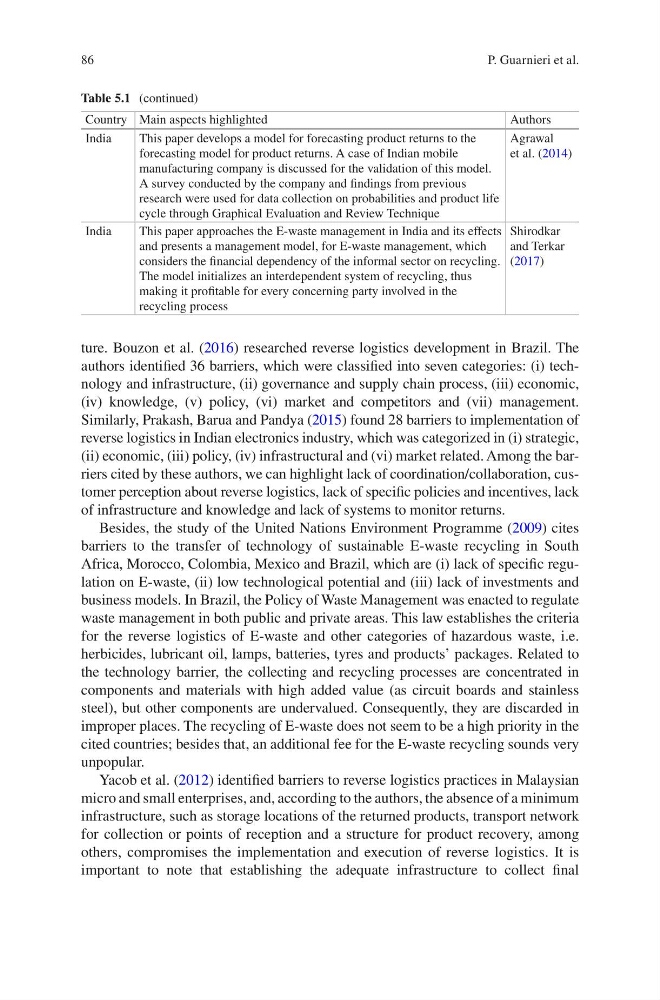
Table 5.1 (continued)
Country Main aspects highlighted
Authors
India
This paper develops a model for forecasting product returns to the
forecasting model for product returns. A case of Indian mobile
manufacturing company is discussed for the validation of this model.
A survey conducted by the company and findings from previous
research were used for data collection on probabilities and product life
cycle through Graphical Evaluation and Review Technique
Agrawal
et al. (2014)
India
This paper approaches the E-waste management in India and its effects
and presents a management model, for E-waste management, which
considers the financial dependency of the informal sector on recycling.
The model initializes an interdependent system of recycling, thus
making it profitable for every concerning party involved in the
recycling process
Shirodkar
and Terkar
(2017)
P. Guarnieri et al.
ture. Bouzon et al. (2016) researched reverse logistics development in Brazil. The
authors identified 36 barriers, which were classified into seven categories: (i) technology and infrastructure, (ii) governance and supply chain process, (iii) economic,
(iv) knowledge, (v) policy, (vi) market and competitors and (vii) management.
Similarly, Prakash, Barua and Pandya (2015) found 28 barriers to implementation of
reverse logistics in Indian electronics industry, which was categorized in (i) strategic,
(ii) economic, (iii) policy, (iv) infrastructural and (vi) market related. Among the barriers cited by these authors, we can highlight lack of coordination/collaboration, customer perception about reverse logistics, lack of specific policies and incentives, lack
of infrastructure and knowledge and lack of systems to monitor returns.
Besides, the study of the United Nations Environment Programme (2009) cites
barriers to the transfer of technology of sustainable E-waste recycling in South
Africa, Morocco, Colombia, Mexico and Brazil, which are (i) lack of specific regulation on E-waste, (ii) low technological potential and (iii) lack of investments and
business models. In Brazil, the Policy of Waste Management was enacted to regulate
waste management in both public and private areas. This law establishes the criteria
for the reverse logistics of E-waste and other categories of hazardous waste, i.e.
herbicides, lubricant oil, lamps, batteries, tyres and products’ packages. Related to
the technology barrier, the collecting and recycling processes are concentrated in
components and materials with high added value (as circuit boards and stainless
steel), but other components are undervalued. Consequently, they are discarded in
improper places. The recycling of E-waste does not seem to be a high priority in the
cited countries; besides that, an additional fee for the E-waste recycling sounds very
unpopular.
Yacob et al. (2012) identified barriers to reverse logistics practices in Malaysian
micro and small enterprises, and, according to the authors, the absence of a minimum
infrastructure, such as storage locations of the returned products, transport network
for collection or points of reception and a structure for product recovery, among
others, compromises the implementation and execution of reverse logistics. It is
important to note that establishing the adequate infrastructure to collect final
Table 5.1 (continued)
Country Main aspects highlighted
Authors
India
This paper develops a model for forecasting product returns to the
forecasting model for product returns. A case of Indian mobile
manufacturing company is discussed for the validation of this model.
A survey conducted by the company and findings from previous
research were used for data collection on probabilities and product life
cycle through Graphical Evaluation and Review Technique
Agrawal
et al. (2014)
India
This paper approaches the E-waste management in India and its effects
and presents a management model, for E-waste management, which
considers the financial dependency of the informal sector on recycling.
The model initializes an interdependent system of recycling, thus
making it profitable for every concerning party involved in the
recycling process
Shirodkar
and Terkar
(2017)
P. Guarnieri et al.