

85
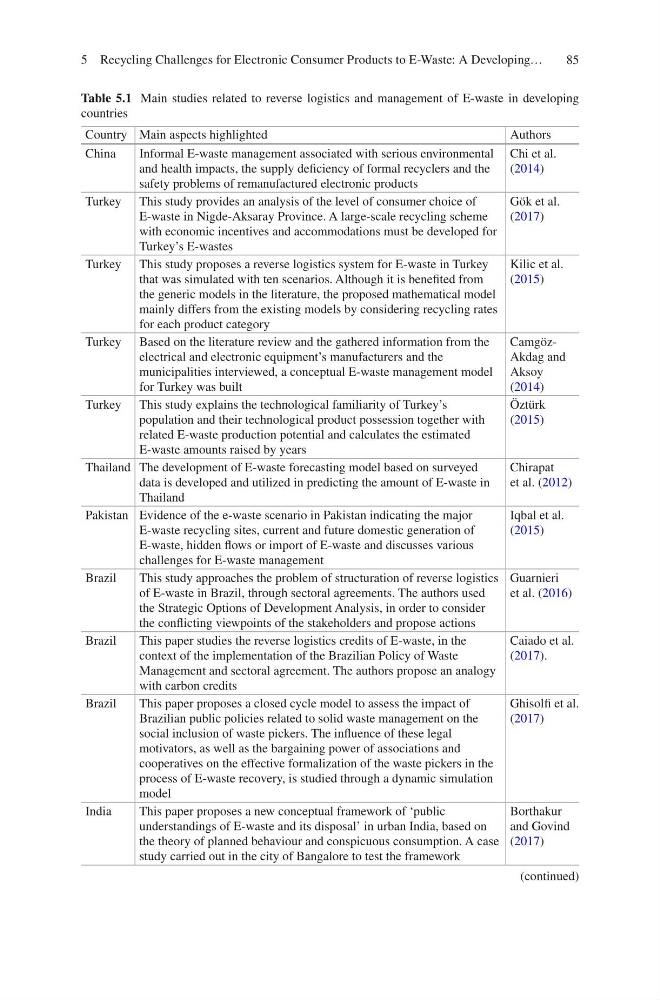
Table 5.1 Main studies related to reverse logistics and management of E-waste in developing
countries
Country Main aspects highlighted
Authors
China
Informal E-waste management associated with serious environmental
and health impacts, the supply deficiency of formal recyclers and the
safety problems of remanufactured electronic products
Chi et al.
(2014)
Turkey This study provides an analysis of the level of consumer choice of
E-waste in Nigde-Aksaray Province. A large-scale recycling scheme
with economic incentives and accommodations must be developed for
Turkey’s E-wastes
Gök et al.
(2017)
Turkey This study proposes a reverse logistics system for E-waste in Turkey
that was simulated with ten scenarios. Although it is benefited from
the generic models in the literature, the proposed mathematical model
mainly differs from the existing models by considering recycling rates
for each product category
Kilic et al.
(2015)
Turkey Based on the literature review and the gathered information from the
electrical and electronic equipment’s manufacturers and the
municipalities interviewed, a conceptual E-waste management model
for Turkey was built
CamgözAkdag and
Aksoy
(2014)
Turkey This study explains the technological familiarity of Turkey’s
population and their technological product possession together with
related E-waste production potential and calculates the estimated
E-waste amounts raised by years
Öztürk
(2015)
Thailand The development of E-waste forecasting model based on surveyed
data is developed and utilized in predicting the amount of E-waste in
Thailand
Chirapat
et al. (2012)
Pakistan Evidence of the e-waste scenario in Pakistan indicating the major
E-waste recycling sites, current and future domestic generation of
E-waste, hidden flows or import of E-waste and discusses various
challenges for E-waste management
Iqbal et al.
(2015)
Brazil
This study approaches the problem of structuration of reverse logistics
of E-waste in Brazil, through sectoral agreements. The authors used
the Strategic Options of Development Analysis, in order to consider
the conflicting viewpoints of the stakeholders and propose actions
Guarnieri
et al. (2016)
Brazil
This paper studies the reverse logistics credits of E-waste, in the
context of the implementation of the Brazilian Policy of Waste
Management and sectoral agreement. The authors propose an analogy
with carbon credits
Caiado et al.
(2017).
Brazil
This paper proposes a closed cycle model to assess the impact of
Brazilian public policies related to solid waste management on the
social inclusion of waste pickers. The influence of these legal
motivators, as well as the bargaining power of associations and
cooperatives on the effective formalization of the waste pickers in the
process of E-waste recovery, is studied through a dynamic simulation
model
Ghisolfi et al.
(2017)
India
This paper proposes a new conceptual framework of ‘public
understandings of E-waste and its disposal’ in urban India, based on
the theory of planned behaviour and conspicuous consumption. A case
study carried out in the city of Bangalore to test the framework
Borthakur
and Govind
(2017)
(continued)
5 Recycling Challenges for Electronic Consumer Products to E-Waste: A Developing…
Table 5.1 Main studies related to reverse logistics and management of E-waste in developing
countries
Country Main aspects highlighted
Authors
China
Informal E-waste management associated with serious environmental
and health impacts, the supply deficiency of formal recyclers and the
safety problems of remanufactured electronic products
Chi et al.
(2014)
Turkey This study provides an analysis of the level of consumer choice of
E-waste in Nigde-Aksaray Province. A large-scale recycling scheme
with economic incentives and accommodations must be developed for
Turkey’s E-wastes
Gök et al.
(2017)
Turkey This study proposes a reverse logistics system for E-waste in Turkey
that was simulated with ten scenarios. Although it is benefited from
the generic models in the literature, the proposed mathematical model
mainly differs from the existing models by considering recycling rates
for each product category
Kilic et al.
(2015)
Turkey Based on the literature review and the gathered information from the
electrical and electronic equipment’s manufacturers and the
municipalities interviewed, a conceptual E-waste management model
for Turkey was built
CamgözAkdag and
Aksoy
(2014)
Turkey This study explains the technological familiarity of Turkey’s
population and their technological product possession together with
related E-waste production potential and calculates the estimated
E-waste amounts raised by years
Öztürk
(2015)
Thailand The development of E-waste forecasting model based on surveyed
data is developed and utilized in predicting the amount of E-waste in
Thailand
Chirapat
et al. (2012)
Pakistan Evidence of the e-waste scenario in Pakistan indicating the major
E-waste recycling sites, current and future domestic generation of
E-waste, hidden flows or import of E-waste and discusses various
challenges for E-waste management
Iqbal et al.
(2015)
Brazil
This study approaches the problem of structuration of reverse logistics
of E-waste in Brazil, through sectoral agreements. The authors used
the Strategic Options of Development Analysis, in order to consider
the conflicting viewpoints of the stakeholders and propose actions
Guarnieri
et al. (2016)
Brazil
This paper studies the reverse logistics credits of E-waste, in the
context of the implementation of the Brazilian Policy of Waste
Management and sectoral agreement. The authors propose an analogy
with carbon credits
Caiado et al.
(2017).
Brazil
This paper proposes a closed cycle model to assess the impact of
Brazilian public policies related to solid waste management on the
social inclusion of waste pickers. The influence of these legal
motivators, as well as the bargaining power of associations and
cooperatives on the effective formalization of the waste pickers in the
process of E-waste recovery, is studied through a dynamic simulation
model
Ghisolfi et al.
(2017)
India
This paper proposes a new conceptual framework of ‘public
understandings of E-waste and its disposal’ in urban India, based on
the theory of planned behaviour and conspicuous consumption. A case
study carried out in the city of Bangalore to test the framework
Borthakur
and Govind
(2017)
(continued)
5 Recycling Challenges for Electronic Consumer Products to E-Waste: A Developing…