

21
removal of hazardous substances from the waste equipment and then sorting materials to be processed (European Commission 2012). A design of a disassembly plant
must take into consideration the most waste stream of waste electrical and electronic
equipment generated in the area covered by collection and should include estimated
volume from households and other non-household sources (Capraz et al. 2015).
The productivity of a recycling plant depends on the disassembling strategy.
Manual disassembly is less productive, but many elements and assemblies can be
easily identified by workers conducting this process (Chung and Peng 2005; Capraz
et al. 2017). Preselecting of the components can acquire homogeneous material
components or valuable parts. Example of such an approach can be a removal of the
counterweights from washing machines. These are concrete parts and after taking
out from a washing machine, they can be stored separately. A transfer of these components into a shredder could possibly affect its operation and breaking. In a similar
way, disassembling a processor from the computer’s mainboard and separating it is
more profitable than shredding complete mainboards, including processors. The
waste stream volume should be adjusted to a recycling plant capacity. Planning the
waste processing lines in a plant must take into consideration, the scrap material
prices depend on global markets, and the labor cost has the main impact on a potential profit from E-waste recycling.
2.2 Waste Electrical and Electronic Equipment Disassembly
Planning
Planning the disassembling of waste electrical and electronic equipment is a
demanding task. Such equipment has various shapes, masses, material compositions, and techniques of joining elements. Therefore, it is difficult to automate completely this process. The best case occurs when the equipment belongs to the same
category and group, e.g., refrigerators, television sets, washing machines, etc. The
Legislation
requirements
Waste stream
volume
Productivity of
disassembling
plant
Cost and
revenues
of recycling
process
End of life
products
(WEEE)
Environmental
issues
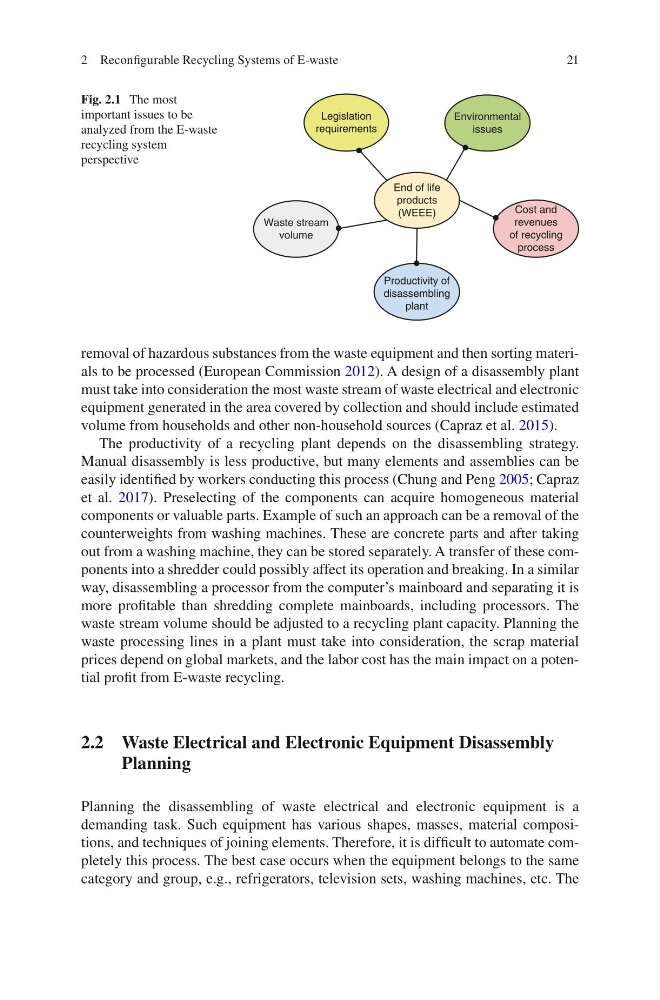
Fig. 2.1 The most
important issues to be
analyzed from the E-waste
recycling system
perspective
2 Reconfigurable Recycling Systems of E-waste
removal of hazardous substances from the waste equipment and then sorting materials to be processed (European Commission 2012). A design of a disassembly plant
must take into consideration the most waste stream of waste electrical and electronic
equipment generated in the area covered by collection and should include estimated
volume from households and other non-household sources (Capraz et al. 2015).
The productivity of a recycling plant depends on the disassembling strategy.
Manual disassembly is less productive, but many elements and assemblies can be
easily identified by workers conducting this process (Chung and Peng 2005; Capraz
et al. 2017). Preselecting of the components can acquire homogeneous material
components or valuable parts. Example of such an approach can be a removal of the
counterweights from washing machines. These are concrete parts and after taking
out from a washing machine, they can be stored separately. A transfer of these components into a shredder could possibly affect its operation and breaking. In a similar
way, disassembling a processor from the computer’s mainboard and separating it is
more profitable than shredding complete mainboards, including processors. The
waste stream volume should be adjusted to a recycling plant capacity. Planning the
waste processing lines in a plant must take into consideration, the scrap material
prices depend on global markets, and the labor cost has the main impact on a potential profit from E-waste recycling.
2.2 Waste Electrical and Electronic Equipment Disassembly
Planning
Planning the disassembling of waste electrical and electronic equipment is a
demanding task. Such equipment has various shapes, masses, material compositions, and techniques of joining elements. Therefore, it is difficult to automate completely this process. The best case occurs when the equipment belongs to the same
category and group, e.g., refrigerators, television sets, washing machines, etc. The
Legislation
requirements
Waste stream
volume
Productivity of
disassembling
plant
Cost and
revenues
of recycling
process
End of life
products
(WEEE)
Environmental
issues
Fig. 2.1 The most
important issues to be
analyzed from the E-waste
recycling system
perspective
2 Reconfigurable Recycling Systems of E-waste