

227
A comparable study by Ha et al. (2009) in recycling sites such as Guiyu in China
and Bangalore in India speculated that heavy metals and their associated pollutants
cause severe damage to the environment and human health. This is due to a high
penetration rate of heavy metals in soil and then to plants where it bio-accumulates
and further transported to trophic level. They found an elevated level of heavy metals like Pb, Bi, Cu, Zn, Bi, In and Sn in the soil near recycling workshops. Hair
samples of workers have increased the level of Cd, Ag, Cu, Sb and Bi. As compared
to control, ten times higher level of polybrominated diphenyl ethers was found in
the serum of workers at recycling workshops (Sjödin et al. 1999). Also, the children
and neonates have elevated levels of Cr, Ni, Cd and polybrominated diphenyl ethers
than controls (Guo et al. 2010; Wu et al. 2010). A parallel study by Asante et al.
(2012) at Agbogbloshie, Accra and Ghana found relatively high traces of heavy
metals in the urine of workers. These studies indicated that E-waste disposal has a
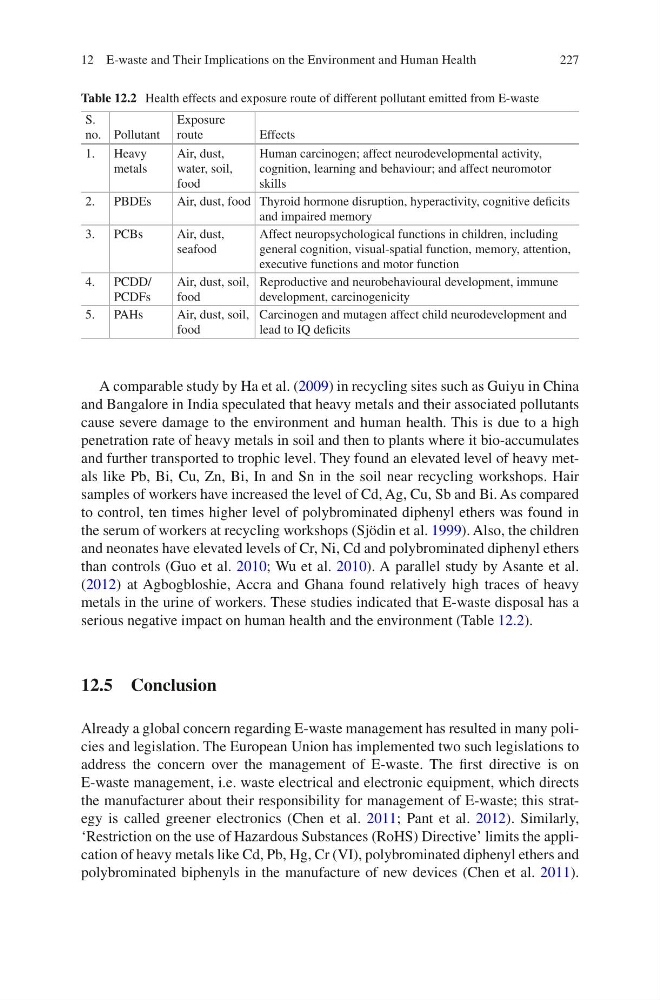
serious negative impact on human health and the environment (Table 12.2).
12.5 Conclusion
Already a global concern regarding E-waste management has resulted in many policies and legislation. The European Union has implemented two such legislations to
address the concern over the management of E-waste. The first directive is on
E-waste management, i.e. waste electrical and electronic equipment, which directs
the manufacturer about their responsibility for management of E-waste; this strategy is called greener electronics (Chen et al. 2011; Pant et al. 2012). Similarly,
‘Restriction on the use of Hazardous Substances (RoHS) Directive’ limits the application of heavy metals like Cd, Pb, Hg, Cr (VI), polybrominated diphenyl ethers and
polybrominated biphenyls in the manufacture of new devices (Chen et al. 2011).
Table 12.2 Health effects and exposure route of different pollutant emitted from E-waste
S.
no. Pollutant
Exposure
route
Effects
1. Heavy
metals
Air, dust,
water, soil,
food
Human carcinogen; affect neurodevelopmental activity,
cognition, learning and behaviour; and affect neuromotor
skills
2. PBDEs
Air, dust, food Thyroid hormone disruption, hyperactivity, cognitive deficits
and impaired memory
3. PCBs
Air, dust,
seafood
Affect neuropsychological functions in children, including
general cognition, visual-spatial function, memory, attention,
executive functions and motor function
4. PCDD/
PCDFs
Air, dust, soil,
food
Reproductive and neurobehavioural development, immune
development, carcinogenicity
5. PAHs
Air, dust, soil,
food
Carcinogen and mutagen affect child neurodevelopment and
lead to IQ deficits
12 E-waste and Their Implications on the Environment and Human Health
A comparable study by Ha et al. (2009) in recycling sites such as Guiyu in China
and Bangalore in India speculated that heavy metals and their associated pollutants
cause severe damage to the environment and human health. This is due to a high
penetration rate of heavy metals in soil and then to plants where it bio-accumulates
and further transported to trophic level. They found an elevated level of heavy metals like Pb, Bi, Cu, Zn, Bi, In and Sn in the soil near recycling workshops. Hair
samples of workers have increased the level of Cd, Ag, Cu, Sb and Bi. As compared
to control, ten times higher level of polybrominated diphenyl ethers was found in
the serum of workers at recycling workshops (Sjödin et al. 1999). Also, the children
and neonates have elevated levels of Cr, Ni, Cd and polybrominated diphenyl ethers
than controls (Guo et al. 2010; Wu et al. 2010). A parallel study by Asante et al.
(2012) at Agbogbloshie, Accra and Ghana found relatively high traces of heavy
metals in the urine of workers. These studies indicated that E-waste disposal has a
serious negative impact on human health and the environment (Table 12.2).
12.5 Conclusion
Already a global concern regarding E-waste management has resulted in many policies and legislation. The European Union has implemented two such legislations to
address the concern over the management of E-waste. The first directive is on
E-waste management, i.e. waste electrical and electronic equipment, which directs
the manufacturer about their responsibility for management of E-waste; this strategy is called greener electronics (Chen et al. 2011; Pant et al. 2012). Similarly,
‘Restriction on the use of Hazardous Substances (RoHS) Directive’ limits the application of heavy metals like Cd, Pb, Hg, Cr (VI), polybrominated diphenyl ethers and
polybrominated biphenyls in the manufacture of new devices (Chen et al. 2011).
Table 12.2 Health effects and exposure route of different pollutant emitted from E-waste
S.
no. Pollutant
Exposure
route
Effects
1. Heavy
metals
Air, dust,
water, soil,
food
Human carcinogen; affect neurodevelopmental activity,
cognition, learning and behaviour; and affect neuromotor
skills
2. PBDEs
Air, dust, food Thyroid hormone disruption, hyperactivity, cognitive deficits
and impaired memory
3. PCBs
Air, dust,
seafood
Affect neuropsychological functions in children, including
general cognition, visual-spatial function, memory, attention,
executive functions and motor function
4. PCDD/
PCDFs
Air, dust, soil,
food
Reproductive and neurobehavioural development, immune
development, carcinogenicity
5. PAHs
Air, dust, soil,
food
Carcinogen and mutagen affect child neurodevelopment and
lead to IQ deficits
12 E-waste and Their Implications on the Environment and Human Health