

165
Osram (2009) divided LED bulbs into three main parts: base, bulb, and filling.
These parts were also divided into subparts (Table 9.2).
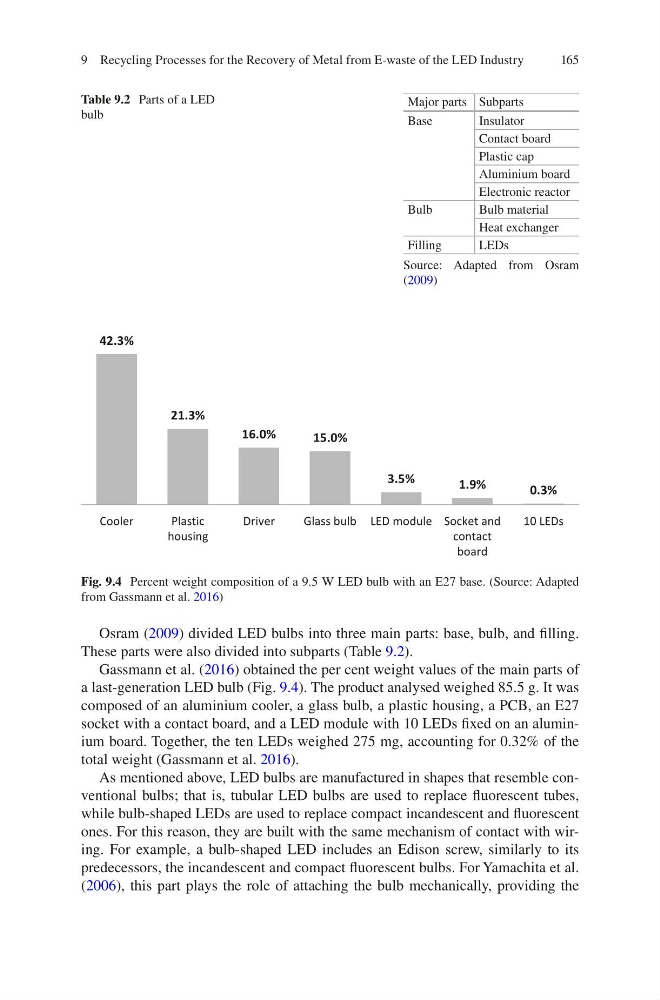
Gassmann et al. (2016) obtained the per cent weight values of the main parts of
a last-generation LED bulb (Fig. 9.4). The product analysed weighed 85.5 g. It was
composed of an aluminium cooler, a glass bulb, a plastic housing, a PCB, an E27
socket with a contact board, and a LED module with 10 LEDs fixed on an aluminium board. Together, the ten LEDs weighed 275 mg, accounting for 0.32% of the
total weight (Gassmann et al. 2016).
As mentioned above, LED bulbs are manufactured in shapes that resemble conventional bulbs; that is, tubular LED bulbs are used to replace fluorescent tubes,
while bulb-shaped LEDs are used to replace compact incandescent and fluorescent
ones. For this reason, they are built with the same mechanism of contact with wiring. For example, a bulb-shaped LED includes an Edison screw, similarly to its
predecessors, the incandescent and compact fluorescent bulbs. For Yamachita et al.
(2006), this part plays the role of attaching the bulb mechanically, providing the
Table 9.2 Parts of a LED
bulb
Major parts Subparts
Base
Insulator
Contact board
Plastic cap
Aluminium board
Electronic reactor
Bulb
Bulb material
Heat exchanger
Filling
LEDs
Source: Adapted from Osram
(2009)
42.3%
21.3%
16.0%
15.0%
3.5%
1.9%
0.3%
Cooler
Plastic
housing
Driver
Glass bulb LED module Socket and
contact
board
10 LEDs
Fig. 9.4 Percent weight composition of a 9.5 W LED bulb with an E27 base. (Source: Adapted
from Gassmann et al. 2016)
9 Recycling Processes for the Recovery of Metal from E-waste of the LED Industry
Osram (2009) divided LED bulbs into three main parts: base, bulb, and filling.
These parts were also divided into subparts (Table 9.2).
Gassmann et al. (2016) obtained the per cent weight values of the main parts of
a last-generation LED bulb (Fig. 9.4). The product analysed weighed 85.5 g. It was
composed of an aluminium cooler, a glass bulb, a plastic housing, a PCB, an E27
socket with a contact board, and a LED module with 10 LEDs fixed on an aluminium board. Together, the ten LEDs weighed 275 mg, accounting for 0.32% of the
total weight (Gassmann et al. 2016).
As mentioned above, LED bulbs are manufactured in shapes that resemble conventional bulbs; that is, tubular LED bulbs are used to replace fluorescent tubes,
while bulb-shaped LEDs are used to replace compact incandescent and fluorescent
ones. For this reason, they are built with the same mechanism of contact with wiring. For example, a bulb-shaped LED includes an Edison screw, similarly to its
predecessors, the incandescent and compact fluorescent bulbs. For Yamachita et al.
(2006), this part plays the role of attaching the bulb mechanically, providing the
Table 9.2 Parts of a LED
bulb
Major parts Subparts
Base
Insulator
Contact board
Plastic cap
Aluminium board
Electronic reactor
Bulb
Bulb material
Heat exchanger
Filling
LEDs
Source: Adapted from Osram
(2009)
42.3%
21.3%
16.0%
15.0%
3.5%
1.9%
0.3%
Cooler
Plastic
housing
Driver
Glass bulb LED module Socket and
contact
board
10 LEDs
Fig. 9.4 Percent weight composition of a 9.5 W LED bulb with an E27 base. (Source: Adapted
from Gassmann et al. 2016)
9 Recycling Processes for the Recovery of Metal from E-waste of the LED Industry