

163
designed in a variety of ways, two important advantages that are not afforded by other
lighting technologies (Ascurra 2013; Jang et al. 2014; Gassmann et al. 2016).
Since 2007, LED bulbs are available in the market, and currently it is possible to
choose between several models of different shapes and socket types. The market
offers not only LED bulbs that may be used to replace conventional ones but also
several fixture types with their own inbuilt LED module. This wide diversity of
products makes it difficult to quantify and qualify the materials characteristically
used in LED lighting devices (Gassmann et al. 2016).
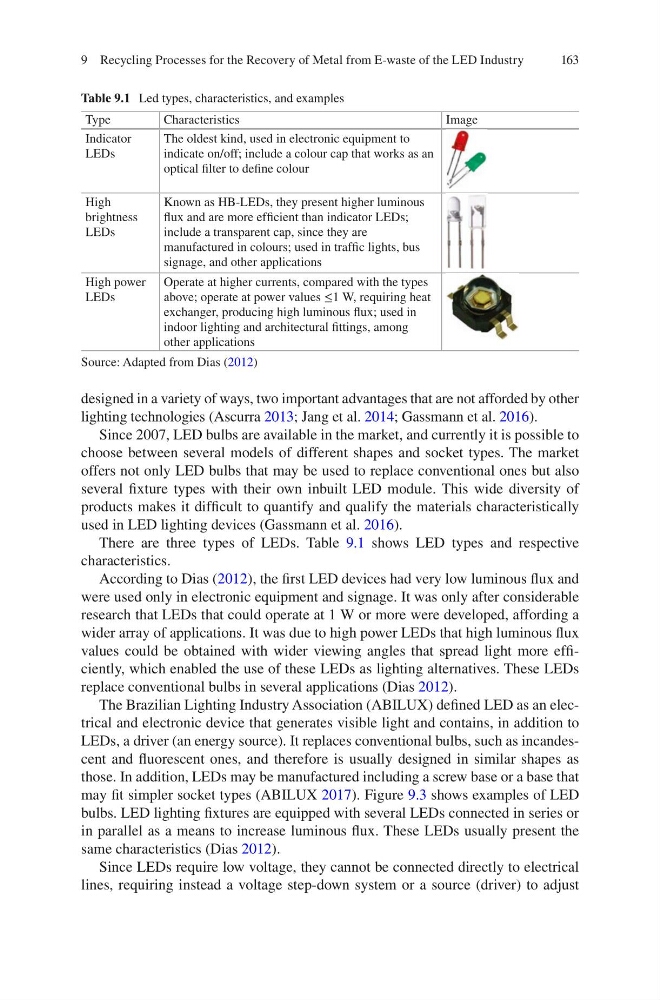
There are three types of LEDs. Table 9.1 shows LED types and respective
characteristics.
According to Dias (2012), the first LED devices had very low luminous flux and
were used only in electronic equipment and signage. It was only after considerable
research that LEDs that could operate at 1 W or more were developed, affording a
wider array of applications. It was due to high power LEDs that high luminous flux
values could be obtained with wider viewing angles that spread light more efficiently, which enabled the use of these LEDs as lighting alternatives. These LEDs
replace conventional bulbs in several applications (Dias 2012).
The Brazilian Lighting Industry Association (ABILUX) defined LED as an electrical and electronic device that generates visible light and contains, in addition to
LEDs, a driver (an energy source). It replaces conventional bulbs, such as incandescent and fluorescent ones, and therefore is usually designed in similar shapes as
those. In addition, LEDs may be manufactured including a screw base or a base that
may fit simpler socket types (ABILUX 2017). Figure 9.3 shows examples of LED
bulbs. LED lighting fixtures are equipped with several LEDs connected in series or
in parallel as a means to increase luminous flux. These LEDs usually present the
same characteristics (Dias 2012).
Since LEDs require low voltage, they cannot be connected directly to electrical
lines, requiring instead a voltage step-down system or a source (driver) to adjust
Table 9.1 Led types, characteristics, and examples
Type
Characteristics
Image
Indicator
LEDs
The oldest kind, used in electronic equipment to
indicate on/off; include a colour cap that works as an
optical filter to define colour
High
brightness
LEDs
Known as HB-LEDs, they present higher luminous
flux and are more efficient than indicator LEDs;
include a transparent cap, since they are
manufactured in colours; used in traffic lights, bus
signage, and other applications
High power
LEDs
Operate at higher currents, compared with the types
above; operate at power values ≤1 W, requiring heat
exchanger, producing high luminous flux; used in
indoor lighting and architectural fittings, among
other applications
Source: Adapted from Dias (2012)
9 Recycling Processes for the Recovery of Metal from E-waste of the LED Industry
designed in a variety of ways, two important advantages that are not afforded by other
lighting technologies (Ascurra 2013; Jang et al. 2014; Gassmann et al. 2016).
Since 2007, LED bulbs are available in the market, and currently it is possible to
choose between several models of different shapes and socket types. The market
offers not only LED bulbs that may be used to replace conventional ones but also
several fixture types with their own inbuilt LED module. This wide diversity of
products makes it difficult to quantify and qualify the materials characteristically
used in LED lighting devices (Gassmann et al. 2016).
There are three types of LEDs. Table 9.1 shows LED types and respective
characteristics.
According to Dias (2012), the first LED devices had very low luminous flux and
were used only in electronic equipment and signage. It was only after considerable
research that LEDs that could operate at 1 W or more were developed, affording a
wider array of applications. It was due to high power LEDs that high luminous flux
values could be obtained with wider viewing angles that spread light more efficiently, which enabled the use of these LEDs as lighting alternatives. These LEDs
replace conventional bulbs in several applications (Dias 2012).
The Brazilian Lighting Industry Association (ABILUX) defined LED as an electrical and electronic device that generates visible light and contains, in addition to
LEDs, a driver (an energy source). It replaces conventional bulbs, such as incandescent and fluorescent ones, and therefore is usually designed in similar shapes as
those. In addition, LEDs may be manufactured including a screw base or a base that
may fit simpler socket types (ABILUX 2017). Figure 9.3 shows examples of LED
bulbs. LED lighting fixtures are equipped with several LEDs connected in series or
in parallel as a means to increase luminous flux. These LEDs usually present the
same characteristics (Dias 2012).
Since LEDs require low voltage, they cannot be connected directly to electrical
lines, requiring instead a voltage step-down system or a source (driver) to adjust
Table 9.1 Led types, characteristics, and examples
Type
Characteristics
Image
Indicator
LEDs
The oldest kind, used in electronic equipment to
indicate on/off; include a colour cap that works as an
optical filter to define colour
High
brightness
LEDs
Known as HB-LEDs, they present higher luminous
flux and are more efficient than indicator LEDs;
include a transparent cap, since they are
manufactured in colours; used in traffic lights, bus
signage, and other applications
High power
LEDs
Operate at higher currents, compared with the types
above; operate at power values ≤1 W, requiring heat
exchanger, producing high luminous flux; used in
indoor lighting and architectural fittings, among
other applications
Source: Adapted from Dias (2012)
9 Recycling Processes for the Recovery of Metal from E-waste of the LED Industry