

162
In 1907, the researcher Henry Joseph Round described an interesting phenomenon, in which a small voltage run across a silicon carbide (SiC) crystal-induced the
emission of yellow light. The first LED that emitted visible light (red) using the
technology called gallium arsenide phosphide (GaAsP) was developed by a
researcher at General Electric named Nick Holonnayak Jr. in 1962. In 1993, the
researcher Dr. Shuji Nakamura introduced the first blue high brightness LED,
enabling the development of the white LED. The first LED bulbs produced on large
scale were introduced in exhibitions in the United States of America and Europe in
1997 and 1998 (Gois 2008). The technology evolved rapidly, at impressive growth
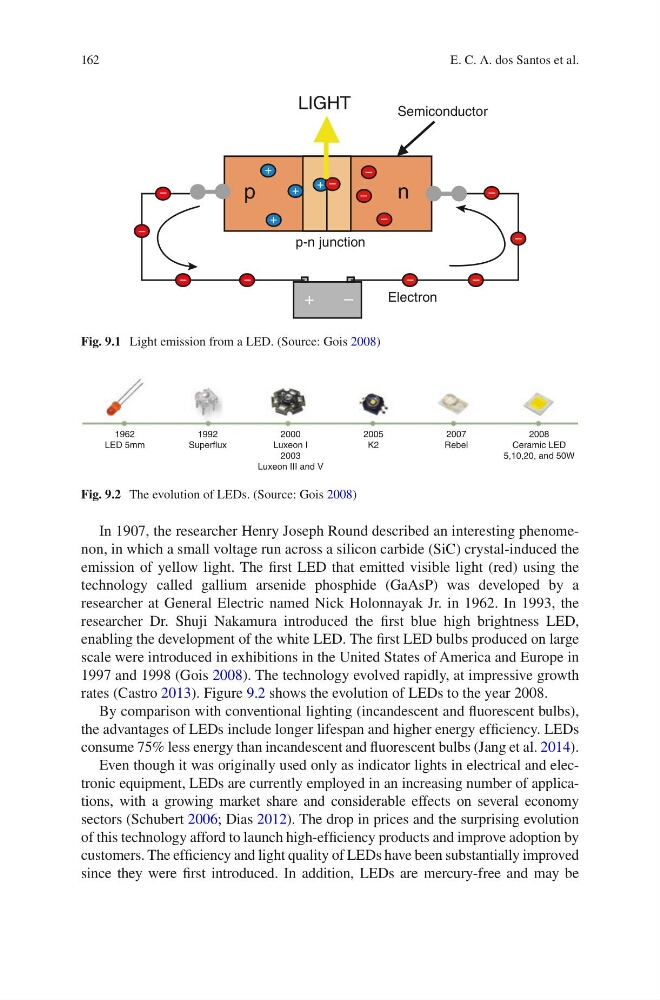
rates (Castro 2013). Figure 9.2 shows the evolution of LEDs to the year 2008.
By comparison with conventional lighting (incandescent and fluorescent bulbs),
the advantages of LEDs include longer lifespan and higher energy efficiency. LEDs
consume 75% less energy than incandescent and fluorescent bulbs (Jang et al. 2014).
Even though it was originally used only as indicator lights in electrical and electronic equipment, LEDs are currently employed in an increasing number of applications, with a growing market share and considerable effects on several economy
sectors (Schubert 2006; Dias 2012). The drop in prices and the surprising evolution
of this technology afford to launch high-efficiency products and improve adoption by
customers. The efficiency and light quality of LEDs have been substantially improved
since they were first introduced. In addition, LEDs are mercury-free and may be
LIGHT
p
n
Semiconductor
Electron
p-n junction
+
+
–
+
+
+
–
–
–
–
–
–
–
–
–
–
–
–
Fig. 9.1 Light emission from a LED. (Source: Gois 2008)
1962
LED 5mm
1992
Superflux
2000
Luxeon I
2003
Luxeon III and V
2005
K2
2007
Rebel
2008
Ceramic LED
5,10,20, and 50W
Fig. 9.2 The evolution of LEDs. (Source: Gois 2008)
E. C. A. dos Santos et al.
In 1907, the researcher Henry Joseph Round described an interesting phenomenon, in which a small voltage run across a silicon carbide (SiC) crystal-induced the
emission of yellow light. The first LED that emitted visible light (red) using the
technology called gallium arsenide phosphide (GaAsP) was developed by a
researcher at General Electric named Nick Holonnayak Jr. in 1962. In 1993, the
researcher Dr. Shuji Nakamura introduced the first blue high brightness LED,
enabling the development of the white LED. The first LED bulbs produced on large
scale were introduced in exhibitions in the United States of America and Europe in
1997 and 1998 (Gois 2008). The technology evolved rapidly, at impressive growth
rates (Castro 2013). Figure 9.2 shows the evolution of LEDs to the year 2008.
By comparison with conventional lighting (incandescent and fluorescent bulbs),
the advantages of LEDs include longer lifespan and higher energy efficiency. LEDs
consume 75% less energy than incandescent and fluorescent bulbs (Jang et al. 2014).
Even though it was originally used only as indicator lights in electrical and electronic equipment, LEDs are currently employed in an increasing number of applications, with a growing market share and considerable effects on several economy
sectors (Schubert 2006; Dias 2012). The drop in prices and the surprising evolution
of this technology afford to launch high-efficiency products and improve adoption by
customers. The efficiency and light quality of LEDs have been substantially improved
since they were first introduced. In addition, LEDs are mercury-free and may be
LIGHT
p
n
Semiconductor
Electron
p-n junction
+
+
–
+
+
+
–
–
–
–
–
–
–
–
–
–
–
–
Fig. 9.1 Light emission from a LED. (Source: Gois 2008)
1962
LED 5mm
1992
Superflux
2000
Luxeon I
2003
Luxeon III and V
2005
K2
2007
Rebel
2008
Ceramic LED
5,10,20, and 50W
Fig. 9.2 The evolution of LEDs. (Source: Gois 2008)
E. C. A. dos Santos et al.