

89
Ongondo et al. (2011), some specificities about E-waste management can be
identified in different countries. Other characteristics are common between some
countries, which allow allocating them in groups.
In developed countries, E-waste is mainly managed by private companies in
association with the municipality, and the role of waste pickers is virtually null
(Xavier and Carvalho 2014). In the Indian context, Ardi and Leisten (2016) explain
the cause of the informal sector growth in E-waste management system. Except for
Russia and Brazil, the other developing countries seem to present a pattern of
behaviour regarding E-waste management that allows classification according to the
respective continents.
5.4.1.1 American Countries
Brazil
Considering that the Brazilian electronics segment generates between 2% and 4% of
the waste of its operations, unfortunately, estimations based on the Brazilian formal
labour market indicate that no more than 1% of E-waste produced has an adequate
environmental treatment (FEAM 2013).
E-waste recycling in Brazil exists countrywide, mainly in the southeast region
(São Paulo State), which has several companies specialized in material fractions
that have a high aggregated value (printed wiring boards, stainless steel, coppercontaining components) (United Nations Environment Programme 2009). After
processing the disassembling of the parts, the companies sell it to countries as
Belgic and Japan, to recycle the noble metals.
In Brazil, like as in other developing countries, the waste pickers participate in
reverse logistics of E-waste (Guarnieri and Cerqueira-Streit 2015; Ferri et al. 2015).
They act in the collection and in the recovery of recyclable material (Franco and
Lange 2011; Guarnieri et al. 2016). Another particularity in developing countries is
the presence of the scrap dealers, which can be considered a middleman in the
process. They act in the equipment recovery stage, disassembling the material
received by technical assistance and reconditioning centres, then selling the parts to
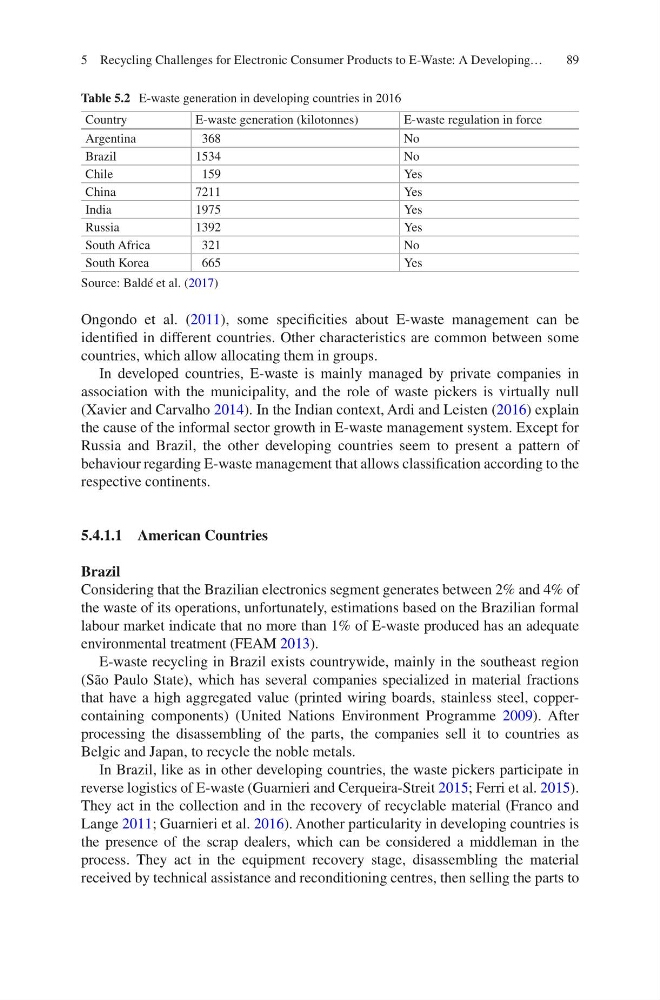
Table 5.2 E-waste generation in developing countries in 2016
Country
E-waste generation (kilotonnes)
E-waste regulation in force
Argentina
368
No
Brazil
1534
No
Chile
159
Yes
China
7211
Yes
India
1975
Yes
Russia
1392
Yes
South Africa
321
No
South Korea
665
Yes
Source: Baldé et al. (2017)
5 Recycling Challenges for Electronic Consumer Products to E-Waste: A Developing…
Ongondo et al. (2011), some specificities about E-waste management can be
identified in different countries. Other characteristics are common between some
countries, which allow allocating them in groups.
In developed countries, E-waste is mainly managed by private companies in
association with the municipality, and the role of waste pickers is virtually null
(Xavier and Carvalho 2014). In the Indian context, Ardi and Leisten (2016) explain
the cause of the informal sector growth in E-waste management system. Except for
Russia and Brazil, the other developing countries seem to present a pattern of
behaviour regarding E-waste management that allows classification according to the
respective continents.
5.4.1.1 American Countries
Brazil
Considering that the Brazilian electronics segment generates between 2% and 4% of
the waste of its operations, unfortunately, estimations based on the Brazilian formal
labour market indicate that no more than 1% of E-waste produced has an adequate
environmental treatment (FEAM 2013).
E-waste recycling in Brazil exists countrywide, mainly in the southeast region
(São Paulo State), which has several companies specialized in material fractions
that have a high aggregated value (printed wiring boards, stainless steel, coppercontaining components) (United Nations Environment Programme 2009). After
processing the disassembling of the parts, the companies sell it to countries as
Belgic and Japan, to recycle the noble metals.
In Brazil, like as in other developing countries, the waste pickers participate in
reverse logistics of E-waste (Guarnieri and Cerqueira-Streit 2015; Ferri et al. 2015).
They act in the collection and in the recovery of recyclable material (Franco and
Lange 2011; Guarnieri et al. 2016). Another particularity in developing countries is
the presence of the scrap dealers, which can be considered a middleman in the
process. They act in the equipment recovery stage, disassembling the material
received by technical assistance and reconditioning centres, then selling the parts to
Table 5.2 E-waste generation in developing countries in 2016
Country
E-waste generation (kilotonnes)
E-waste regulation in force
Argentina
368
No
Brazil
1534
No
Chile
159
Yes
China
7211
Yes
India
1975
Yes
Russia
1392
Yes
South Africa
321
No
South Korea
665
Yes
Source: Baldé et al. (2017)
5 Recycling Challenges for Electronic Consumer Products to E-Waste: A Developing…