

78
4 Mathematical Models of the Interaction of Laser Radiation with Turbid Media
From this system, one can find the reflection coefficient in the principal approximation for the reflected field.
Now, we will pass to the derivation of the formulas for the reflection of a Gaussian
beam. This problem will be solved by expansion of counter propagating waves in
terms of plane waves in the region of medium 1, their reflection by layer 2, and
reverse transformation with a subsequent Huygens–Fresnel integral transformation
to obtain the field in the initial section.
4.4 Reflection of a Gaussian Beam from a Layer
with a Slowly Varying Thickness
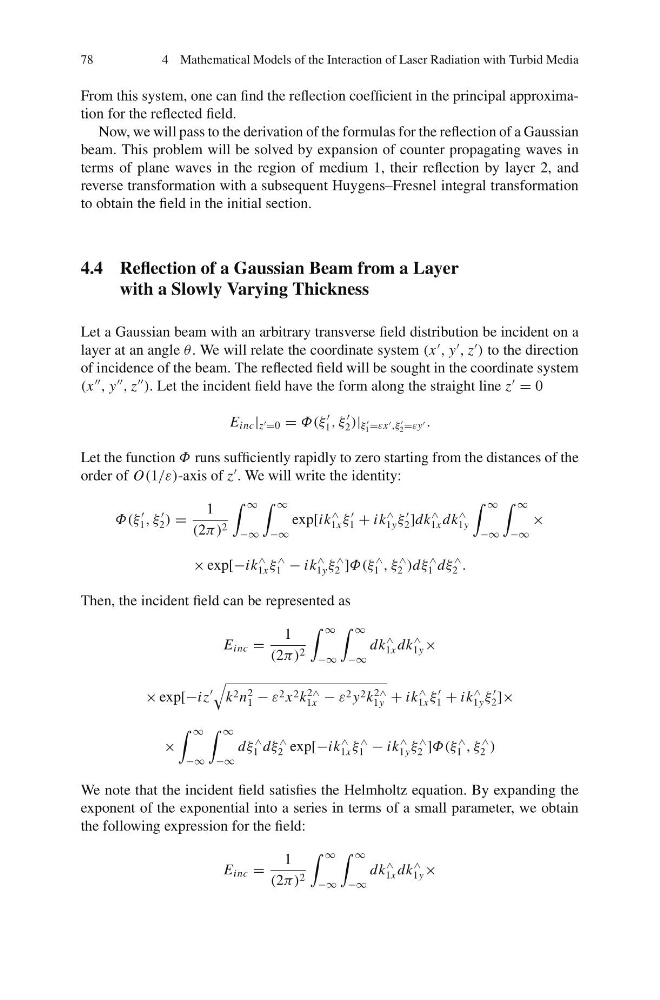
Let a Gaussian beam with an arbitrary transverse field distribution be incident on a
layer at an angle θ . We will relate the coordinate system (x
, y
, z
) to the direction
of incidence of the beam. The reflected field will be sought in the coordinate system
(x
, y
, z
). Let the incident field have the form along the straight line z
= 0
E inc | z =0 = Φ(ξ
1 , ξ
2 )| ξ
1 =εx ,ξ
2 =εy .
Let the function Φ runs sufficiently rapidly to zero starting from the distances of the
order of O(1/ε)-axis of z
. We will write the identity:
Φ(ξ
1 , ξ
2 ) =
1
(2π) 2
∞
−∞
∞
−∞
exp[ik
∧
1x ξ
1 + ik
∧
1y ξ
2 ]dk
∧
1x dk
∧
1y
∞
−∞
∞
−∞
×
× exp[−ik
∧
1x ξ
∧
1 − ik
∧
1y ξ
∧
2 ]Φ(ξ
∧
1 , ξ
∧
2 )dξ
∧
1 dξ
∧
2 .
Then, the incident field can be represented as
E inc =
1
(2π) 2
∞
−∞
∞
−∞
dk
∧
1x dk
∧
1y ×
× exp[−i z
k 2 n
2
1 − ε 2 x 2 k
2∧
1x − ε 2 y 2 k
2∧
1y + ik
∧
1x ξ
1 + ik
∧
1y ξ
2 ]×
×
∞
−∞
∞
−∞
dξ
∧
1 dξ
∧
2 exp[−ik
∧
1x ξ
∧
1 − ik
∧
1y ξ
∧
2 ]Φ(ξ
∧
1 , ξ
∧
2 )
We note that the incident field satisfies the Helmholtz equation. By expanding the
exponent of the exponential into a series in terms of a small parameter, we obtain
the following expression for the field:
E inc =
1
(2π) 2
∞
−∞
∞
−∞
dk
∧
1x dk
∧
1y ×
4 Mathematical Models of the Interaction of Laser Radiation with Turbid Media
From this system, one can find the reflection coefficient in the principal approximation for the reflected field.
Now, we will pass to the derivation of the formulas for the reflection of a Gaussian
beam. This problem will be solved by expansion of counter propagating waves in
terms of plane waves in the region of medium 1, their reflection by layer 2, and
reverse transformation with a subsequent Huygens–Fresnel integral transformation
to obtain the field in the initial section.
4.4 Reflection of a Gaussian Beam from a Layer
with a Slowly Varying Thickness
Let a Gaussian beam with an arbitrary transverse field distribution be incident on a
layer at an angle θ . We will relate the coordinate system (x
, y
, z
) to the direction
of incidence of the beam. The reflected field will be sought in the coordinate system
(x
, y
, z
). Let the incident field have the form along the straight line z
= 0
E inc | z =0 = Φ(ξ
1 , ξ
2 )| ξ
1 =εx ,ξ
2 =εy .
Let the function Φ runs sufficiently rapidly to zero starting from the distances of the
order of O(1/ε)-axis of z
. We will write the identity:
Φ(ξ
1 , ξ
2 ) =
1
(2π) 2
∞
−∞
∞
−∞
exp[ik
∧
1x ξ
1 + ik
∧
1y ξ
2 ]dk
∧
1x dk
∧
1y
∞
−∞
∞
−∞
×
× exp[−ik
∧
1x ξ
∧
1 − ik
∧
1y ξ
∧
2 ]Φ(ξ
∧
1 , ξ
∧
2 )dξ
∧
1 dξ
∧
2 .
Then, the incident field can be represented as
E inc =
1
(2π) 2
∞
−∞
∞
−∞
dk
∧
1x dk
∧
1y ×
× exp[−i z
k 2 n
2
1 − ε 2 x 2 k
2∧
1x − ε 2 y 2 k
2∧
1y + ik
∧
1x ξ
1 + ik
∧
1y ξ
2 ]×
×
∞
−∞
∞
−∞
dξ
∧
1 dξ
∧
2 exp[−ik
∧
1x ξ
∧
1 − ik
∧
1y ξ
∧
2 ]Φ(ξ
∧
1 , ξ
∧
2 )
We note that the incident field satisfies the Helmholtz equation. By expanding the
exponent of the exponential into a series in terms of a small parameter, we obtain
the following expression for the field:
E inc =
1
(2π) 2
∞
−∞
∞
−∞
dk
∧
1x dk
∧
1y ×