

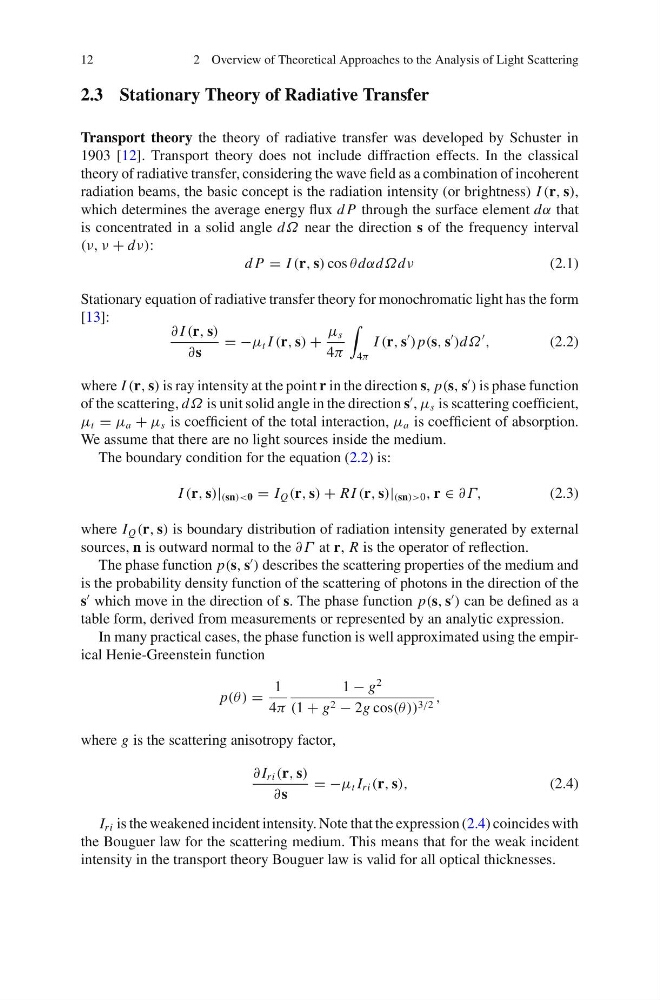
12
2 Overview of Theoretical Approaches to the Analysis of Light Scattering
2.3 Stationary Theory of Radiative Transfer
Transport theory the theory of radiative transfer was developed by Schuster in
1903 [12]. Transport theory does not include diffraction effects. In the classical
theory of radiative transfer, considering the wave field as a combination of incoherent
radiation beams, the basic concept is the radiation intensity (or brightness) I (r, s),
which determines the average energy flux d P through the surface element dα that
is concentrated in a solid angle dΩ near the direction s of the frequency interval
(ν, ν + dν):
d P = I (r, s) cos θ dαdΩdν
(2.1)
Stationary equation of radiative transfer theory for monochromatic light has the form
[13]:
∂ I (r, s)
∂s
= −μ t I (r, s) +
μ s
4π
4π
I (r, s
) p(s, s
)dΩ
,
(2.2)
where I (r, s) is ray intensity at the point r in the direction s, p(s, s
) is phase function
of the scattering, dΩ is unit solid angle in the direction s
, μ s is scattering coefficient,
μ t = μ a + μ s is coefficient of the total interaction, μ a is coefficient of absorption.
We assume that there are no light sources inside the medium.
The boundary condition for the equation (2.2) is:
I (r, s)| (sn)<0 = I Q (r, s) + R I (r, s)| (sn)>0 , r ∈ ∂Γ,
(2.3)
where I Q (r, s) is boundary distribution of radiation intensity generated by external
sources, n is outward normal to the ∂Γ at r, R is the operator of reflection.
The phase function p(s, s
) describes the scattering properties of the medium and
is the probability density function of the scattering of photons in the direction of the
s
which move in the direction of s. The phase function p(s, s
) can be defined as a
table form, derived from measurements or represented by an analytic expression.
In many practical cases, the phase function is well approximated using the empirical Henie-Greenstein function
p(θ ) =
1
4π
1 − g
2
(1 + g 2 − 2g cos(θ )) 3/2 ,
where g is the scattering anisotropy factor,
∂ I ri (r, s)
∂s
= −μ t I ri (r, s),
(2.4)
I ri is the weakened incident intensity. Note that the expression (2.4) coincides with
the Bouguer law for the scattering medium. This means that for the weak incident
intensity in the transport theory Bouguer law is valid for all optical thicknesses.
2 Overview of Theoretical Approaches to the Analysis of Light Scattering
2.3 Stationary Theory of Radiative Transfer
Transport theory the theory of radiative transfer was developed by Schuster in
1903 [12]. Transport theory does not include diffraction effects. In the classical
theory of radiative transfer, considering the wave field as a combination of incoherent
radiation beams, the basic concept is the radiation intensity (or brightness) I (r, s),
which determines the average energy flux d P through the surface element dα that
is concentrated in a solid angle dΩ near the direction s of the frequency interval
(ν, ν + dν):
d P = I (r, s) cos θ dαdΩdν
(2.1)
Stationary equation of radiative transfer theory for monochromatic light has the form
[13]:
∂ I (r, s)
∂s
= −μ t I (r, s) +
μ s
4π
4π
I (r, s
) p(s, s
)dΩ
,
(2.2)
where I (r, s) is ray intensity at the point r in the direction s, p(s, s
) is phase function
of the scattering, dΩ is unit solid angle in the direction s
, μ s is scattering coefficient,
μ t = μ a + μ s is coefficient of the total interaction, μ a is coefficient of absorption.
We assume that there are no light sources inside the medium.
The boundary condition for the equation (2.2) is:
I (r, s)| (sn)<0 = I Q (r, s) + R I (r, s)| (sn)>0 , r ∈ ∂Γ,
(2.3)
where I Q (r, s) is boundary distribution of radiation intensity generated by external
sources, n is outward normal to the ∂Γ at r, R is the operator of reflection.
The phase function p(s, s
) describes the scattering properties of the medium and
is the probability density function of the scattering of photons in the direction of the
s
which move in the direction of s. The phase function p(s, s
) can be defined as a
table form, derived from measurements or represented by an analytic expression.
In many practical cases, the phase function is well approximated using the empirical Henie-Greenstein function
p(θ ) =
1
4π
1 − g
2
(1 + g 2 − 2g cos(θ )) 3/2 ,
where g is the scattering anisotropy factor,
∂ I ri (r, s)
∂s
= −μ t I ri (r, s),
(2.4)
I ri is the weakened incident intensity. Note that the expression (2.4) coincides with
the Bouguer law for the scattering medium. This means that for the weak incident
intensity in the transport theory Bouguer law is valid for all optical thicknesses.