

10.2 Scattering of a Plane Wave from a Rough Surface
163
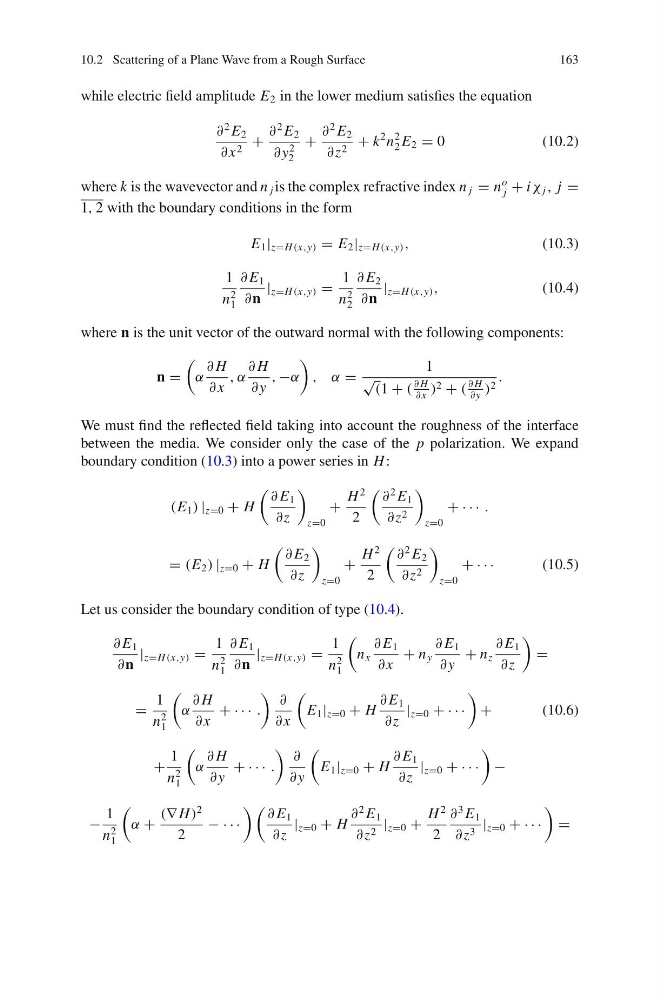
while electric field amplitude E 2 in the lower medium satisfies the equation
∂
2 E 2
∂ x 2 +
∂
2 E 2
∂ y
2
2
+
∂
2 E 2
∂z 2 + k
2 n
2
2 E 2 = 0
(10.2)
where k is the wavevector and n j is the complex refractive index n j = n
o
j + iχ j , j =
1, 2 with the boundary conditions in the form
E 1 | z=H (x,y) = E 2 | z=H (x,y) ,
(10.3)
1
n
2
1
∂ E 1
∂n
| z=H (x,y) =
1
n
2
2
∂ E 2
∂n
| z=H (x,y) ,
(10.4)
where n is the unit vector of the outward normal with the following components:
n =
α
∂ H
∂ x
, α
∂ H
∂ y
, −α
, α =
1
√
(1 + (
∂ H
∂ x
) 2 + (
∂ H
∂ y
) 2 .
We must find the reflected field taking into account the roughness of the interface
between the media. We consider only the case of the p polarization. We expand
boundary condition (10.3) into a power series in H :
(E 1 ) | z=0 + H
∂ E 1
∂z
z=0
+
H
2
2
∂
2 E 1
∂z 2
z=0
+ · · · .
= (E 2 ) | z=0 + H
∂ E 2
∂z
z=0
+
H
2
2
∂
2 E 2
∂z 2
z=0
+ · · ·
(10.5)
Let us consider the boundary condition of type (10.4).
∂ E 1
∂n
| z=H (x,y) =
1
n
2
1
∂ E 1
∂n
| z=H (x,y) =
1
n
2
1
n x
∂ E 1
∂ x
+ n y
∂ E 1
∂ y
+ n z
∂ E 1
∂z
=
=
1
n
2
1
α
∂ H
∂ x
+ · · · .
∂
∂ x
E 1 | z=0 + H
∂ E 1
∂z
| z=0 + · · ·
+
(10.6)
+
1
n
2
1
α
∂ H
∂ y
+ · · · .
∂
∂ y
E 1 | z=0 + H
∂ E 1
∂z
| z=0 + · · ·
−
−
1
n
2
1
α +
(∇ H )
2
2
− · · ·
∂ E 1
∂z
| z=0 + H
∂
2 E 1
∂z 2 | z=0 +
H
2
2
∂
3 E 1
∂z 3 | z=0 + · · ·
=
163
while electric field amplitude E 2 in the lower medium satisfies the equation
∂
2 E 2
∂ x 2 +
∂
2 E 2
∂ y
2
2
+
∂
2 E 2
∂z 2 + k
2 n
2
2 E 2 = 0
(10.2)
where k is the wavevector and n j is the complex refractive index n j = n
o
j + iχ j , j =
1, 2 with the boundary conditions in the form
E 1 | z=H (x,y) = E 2 | z=H (x,y) ,
(10.3)
1
n
2
1
∂ E 1
∂n
| z=H (x,y) =
1
n
2
2
∂ E 2
∂n
| z=H (x,y) ,
(10.4)
where n is the unit vector of the outward normal with the following components:
n =
α
∂ H
∂ x
, α
∂ H
∂ y
, −α
, α =
1
√
(1 + (
∂ H
∂ x
) 2 + (
∂ H
∂ y
) 2 .
We must find the reflected field taking into account the roughness of the interface
between the media. We consider only the case of the p polarization. We expand
boundary condition (10.3) into a power series in H :
(E 1 ) | z=0 + H
∂ E 1
∂z
z=0
+
H
2
2
∂
2 E 1
∂z 2
z=0
+ · · · .
= (E 2 ) | z=0 + H
∂ E 2
∂z
z=0
+
H
2
2
∂
2 E 2
∂z 2
z=0
+ · · ·
(10.5)
Let us consider the boundary condition of type (10.4).
∂ E 1
∂n
| z=H (x,y) =
1
n
2
1
∂ E 1
∂n
| z=H (x,y) =
1
n
2
1
n x
∂ E 1
∂ x
+ n y
∂ E 1
∂ y
+ n z
∂ E 1
∂z
=
=
1
n
2
1
α
∂ H
∂ x
+ · · · .
∂
∂ x
E 1 | z=0 + H
∂ E 1
∂z
| z=0 + · · ·
+
(10.6)
+
1
n
2
1
α
∂ H
∂ y
+ · · · .
∂
∂ y
E 1 | z=0 + H
∂ E 1
∂z
| z=0 + · · ·
−
−
1
n
2
1
α +
(∇ H )
2
2
− · · ·
∂ E 1
∂z
| z=0 + H
∂
2 E 1
∂z 2 | z=0 +
H
2
2
∂
3 E 1
∂z 3 | z=0 + · · ·
=