

162
10 Study of the Optical Characteristics of Thin Layer of the Biological Sample
of counterpropagating waves in plane waves in the region of medium 1 and their
reflection from layer 2 using inverse transformation followed by HuygensFresnel
integral transformation to obtain the field in the initial reference cross section after
the circumvention of the resonator (see Chap. 4). At the third stage, the effect of
roughness on the spectral characteristics of the biological sample being simulated
was investigated.
Chapter is based on the results of the [1, 2].
10.2 Scattering of a Plane Wave from a Rough Surface
As noted above, the surfaces of real bodies (in particular, in biology) are not always
perfectly smooth to a certain extent; for this reason, reflection and refraction of
waves from such surfaces are accompanied by phenomena which are not observed
in the case of perfectly smooth interfaces. The form of scattering from a rough
surface is determined by the set of the following factor: the degree of smoothness
is determined by the relation between the wavelength of incident radiation and the
geometrical parameters of the surface; the polarization of the primary wave as well
as the reflecting and refracting properties of the substance also play a significant role.
Rigorous methods for solving problems in the case of a rough surface do not exist.
The problem can be solved only approximately under certain constraints imposed
on the size and shape of roughness. The scattered field is calculated using the method
of small perturbations and the Kirchhoff method. In this study, we are using the small
perturbation method for calculating the scattered field.
To apply the small perturbation method correctly, we assume that roughness of
the surface under investigation is small and gently sloping on the wavelength scale
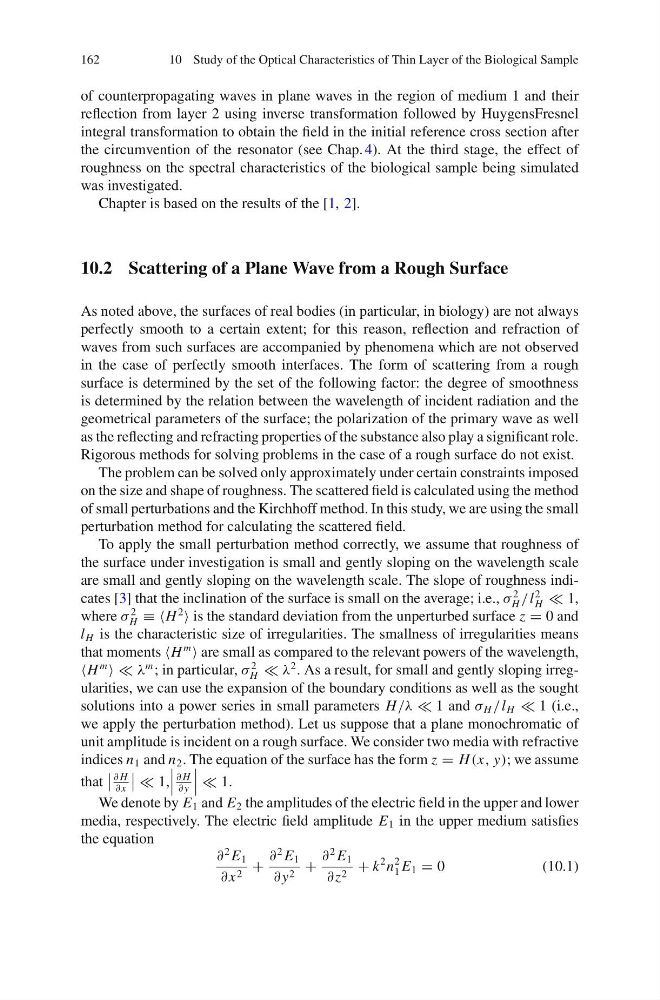
are small and gently sloping on the wavelength scale. The slope of roughness indicates [3] that the inclination of the surface is small on the average; i.e., σ
2
H /l
2
H 1,
where σ
2
H ≡ ≡H
2
is the standard deviation from the unperturbed surface z = 0 and
l H is the characteristic size of irregularities. The smallness of irregularities means
that moments H
m
are small as compared to the relevant powers of the wavelength,
H
m
λ
m ; in particular, σ
2
H λ
2 . As a result, for small and gently sloping irregularities, we can use the expansion of the boundary conditions as well as the sought
solutions into a power series in small parameters H/λ 1 and σ H /l H 1 (i.e.,
we apply the perturbation method). Let us suppose that a plane monochromatic of
unit amplitude is incident on a rough surface. We consider two media with refractive
indices n 1 and n 2 . The equation of the surface has the form z = H (x, y); we assume
that
∂ H
∂ x
1,
∂ H
∂ y
1.
We denote by E 1 and E 2 the amplitudes of the electric field in the upper and lower
media, respectively. The electric field amplitude E 1 in the upper medium satisfies
the equation
∂
2 E 1
∂ x 2 +
∂
2 E 1
∂ y 2 +
∂
2 E 1
∂z 2 + k
2 n
2
1 E 1 = 0
(10.1)
10 Study of the Optical Characteristics of Thin Layer of the Biological Sample
of counterpropagating waves in plane waves in the region of medium 1 and their
reflection from layer 2 using inverse transformation followed by HuygensFresnel
integral transformation to obtain the field in the initial reference cross section after
the circumvention of the resonator (see Chap. 4). At the third stage, the effect of
roughness on the spectral characteristics of the biological sample being simulated
was investigated.
Chapter is based on the results of the [1, 2].
10.2 Scattering of a Plane Wave from a Rough Surface
As noted above, the surfaces of real bodies (in particular, in biology) are not always
perfectly smooth to a certain extent; for this reason, reflection and refraction of
waves from such surfaces are accompanied by phenomena which are not observed
in the case of perfectly smooth interfaces. The form of scattering from a rough
surface is determined by the set of the following factor: the degree of smoothness
is determined by the relation between the wavelength of incident radiation and the
geometrical parameters of the surface; the polarization of the primary wave as well
as the reflecting and refracting properties of the substance also play a significant role.
Rigorous methods for solving problems in the case of a rough surface do not exist.
The problem can be solved only approximately under certain constraints imposed
on the size and shape of roughness. The scattered field is calculated using the method
of small perturbations and the Kirchhoff method. In this study, we are using the small
perturbation method for calculating the scattered field.
To apply the small perturbation method correctly, we assume that roughness of
the surface under investigation is small and gently sloping on the wavelength scale
are small and gently sloping on the wavelength scale. The slope of roughness indicates [3] that the inclination of the surface is small on the average; i.e., σ
2
H /l
2
H 1,
where σ
2
H ≡ ≡H
2
is the standard deviation from the unperturbed surface z = 0 and
l H is the characteristic size of irregularities. The smallness of irregularities means
that moments H
m
are small as compared to the relevant powers of the wavelength,
H
m
λ
m ; in particular, σ
2
H λ
2 . As a result, for small and gently sloping irregularities, we can use the expansion of the boundary conditions as well as the sought
solutions into a power series in small parameters H/λ 1 and σ H /l H 1 (i.e.,
we apply the perturbation method). Let us suppose that a plane monochromatic of
unit amplitude is incident on a rough surface. We consider two media with refractive
indices n 1 and n 2 . The equation of the surface has the form z = H (x, y); we assume
that
∂ H
∂ x
1,
∂ H
∂ y
1.
We denote by E 1 and E 2 the amplitudes of the electric field in the upper and lower
media, respectively. The electric field amplitude E 1 in the upper medium satisfies
the equation
∂
2 E 1
∂ x 2 +
∂
2 E 1
∂ y 2 +
∂
2 E 1
∂z 2 + k
2 n
2
1 E 1 = 0
(10.1)