

148
8 Theoretical Determination the Function of Size Distribution for Blood Cells
this system leads to reflection coefficient A and similar system of equations can
be derived for reflected field of layers: the epidermis, the upper layer of the derms
(E skin ), The expression for the reflection of a Gaussian beam with an arbitrary cross
section is defined analogously to the method described in Chap. 4.
Determine the intensity:
I blood (θ, λ) = |E (blood) ⊥ |
2
+ |E (blood) |
2
,
where
E (blood) ⊥ = cos(θ )E z blood + sin(θ )E x blood ,
E (blood) = sin(θ )E z blood − cos(θ )E x blood ,
where E x and E z are given by the following expressions
∂ E z
∂ y
−
∂ E y
∂z
= −iωμ 0 μ j H x ,
∂ E x
∂z
−
∂ E z
∂ x
= −iωμ 0 μ j H y ,
(8.6)
∂ E y
∂ x
−
∂ E x
∂ y
= −iωμ 0 μ j H z ,
∂ H z
∂ y
−
∂ H y
∂z
= iωε 0 ε j E x ,
(8.7)
∂ H x
∂z
−
∂ H z
∂ x
= iωε 0 ε j E y ,
∂ H y
∂ x
−
∂ H x
∂ y
= iωε 0 ε j E z .
(8.8)
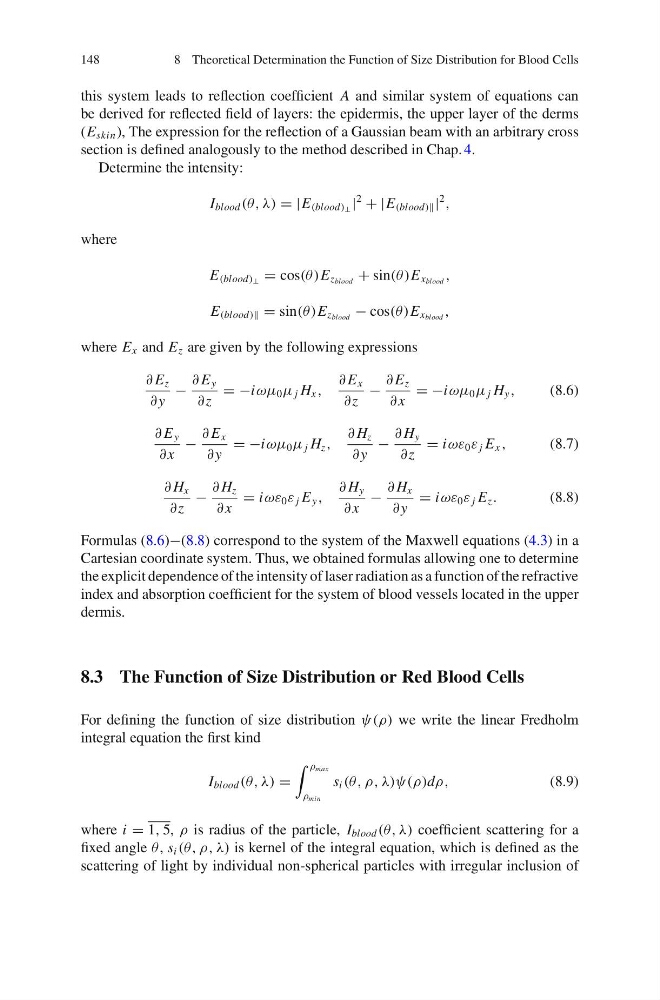
Formulas (8.6)−(8.8) correspond to the system of the Maxwell equations (4.3) in a
Cartesian coordinate system. Thus, we obtained formulas allowing one to determine
the explicit dependence of the intensity of laser radiation as a function of the refractive
index and absorption coefficient for the system of blood vessels located in the upper
dermis.
8.3 The Function of Size Distribution or Red Blood Cells
For defining the function of size distribution ψ(ρ) we write the linear Fredholm
integral equation the first kind
I blood (θ, λ) =
ρ max
ρ min
s i (θ, ρ, λ)ψ(ρ)dρ,
(8.9)
where i = 1, 5, ρ is radius of the particle, I blood (θ, λ) coefficient scattering for a
fixed angle θ , s i (θ, ρ, λ) is kernel of the integral equation, which is defined as the
scattering of light by individual non-spherical particles with irregular inclusion of
8 Theoretical Determination the Function of Size Distribution for Blood Cells
this system leads to reflection coefficient A and similar system of equations can
be derived for reflected field of layers: the epidermis, the upper layer of the derms
(E skin ), The expression for the reflection of a Gaussian beam with an arbitrary cross
section is defined analogously to the method described in Chap. 4.
Determine the intensity:
I blood (θ, λ) = |E (blood) ⊥ |
2
+ |E (blood) |
2
,
where
E (blood) ⊥ = cos(θ )E z blood + sin(θ )E x blood ,
E (blood) = sin(θ )E z blood − cos(θ )E x blood ,
where E x and E z are given by the following expressions
∂ E z
∂ y
−
∂ E y
∂z
= −iωμ 0 μ j H x ,
∂ E x
∂z
−
∂ E z
∂ x
= −iωμ 0 μ j H y ,
(8.6)
∂ E y
∂ x
−
∂ E x
∂ y
= −iωμ 0 μ j H z ,
∂ H z
∂ y
−
∂ H y
∂z
= iωε 0 ε j E x ,
(8.7)
∂ H x
∂z
−
∂ H z
∂ x
= iωε 0 ε j E y ,
∂ H y
∂ x
−
∂ H x
∂ y
= iωε 0 ε j E z .
(8.8)
Formulas (8.6)−(8.8) correspond to the system of the Maxwell equations (4.3) in a
Cartesian coordinate system. Thus, we obtained formulas allowing one to determine
the explicit dependence of the intensity of laser radiation as a function of the refractive
index and absorption coefficient for the system of blood vessels located in the upper
dermis.
8.3 The Function of Size Distribution or Red Blood Cells
For defining the function of size distribution ψ(ρ) we write the linear Fredholm
integral equation the first kind
I blood (θ, λ) =
ρ max
ρ min
s i (θ, ρ, λ)ψ(ρ)dρ,
(8.9)
where i = 1, 5, ρ is radius of the particle, I blood (θ, λ) coefficient scattering for a
fixed angle θ , s i (θ, ρ, λ) is kernel of the integral equation, which is defined as the
scattering of light by individual non-spherical particles with irregular inclusion of