

100
5 Study of the Optical Characteristics of a Biotissue …
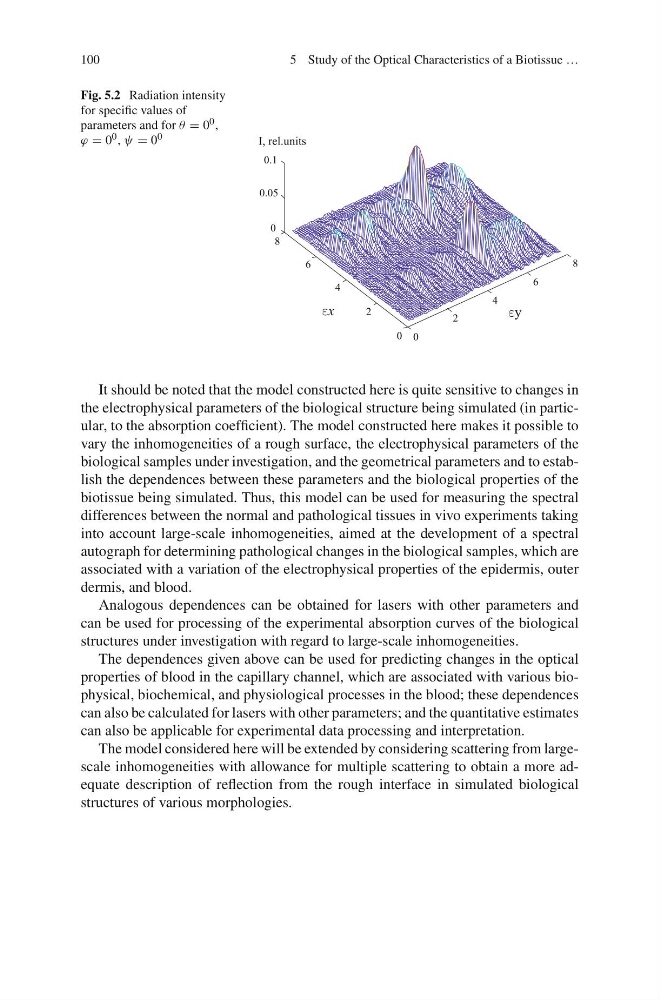
Fig. 5.2 Radiation intensity
for specific values of
parameters and for θ = 0 0 ,
ϕ = 0 0 , ψ = 0 0
0
2
4
6
8
0
2
4
6
8
0
0.05
0.1
x
y
It should be noted that the model constructed here is quite sensitive to changes in
the electrophysical parameters of the biological structure being simulated (in particular, to the absorption coefficient). The model constructed here makes it possible to
vary the inhomogeneities of a rough surface, the electrophysical parameters of the
biological samples under investigation, and the geometrical parameters and to establish the dependences between these parameters and the biological properties of the
biotissue being simulated. Thus, this model can be used for measuring the spectral
differences between the normal and pathological tissues in vivo experiments taking
into account large-scale inhomogeneities, aimed at the development of a spectral
autograph for determining pathological changes in the biological samples, which are
associated with a variation of the electrophysical properties of the epidermis, outer
dermis, and blood.
Analogous dependences can be obtained for lasers with other parameters and
can be used for processing of the experimental absorption curves of the biological
structures under investigation with regard to large-scale inhomogeneities.
The dependences given above can be used for predicting changes in the optical
properties of blood in the capillary channel, which are associated with various biophysical, biochemical, and physiological processes in the blood; these dependences
can also be calculated for lasers with other parameters; and the quantitative estimates
can also be applicable for experimental data processing and interpretation.
The model considered here will be extended by considering scattering from largescale inhomogeneities with allowance for multiple scattering to obtain a more adequate description of reflection from the rough interface in simulated biological
structures of various morphologies.
5 Study of the Optical Characteristics of a Biotissue …
Fig. 5.2 Radiation intensity
for specific values of
parameters and for θ = 0 0 ,
ϕ = 0 0 , ψ = 0 0
0
2
4
6
8
0
2
4
6
8
0
0.05
0.1
x
y
It should be noted that the model constructed here is quite sensitive to changes in
the electrophysical parameters of the biological structure being simulated (in particular, to the absorption coefficient). The model constructed here makes it possible to
vary the inhomogeneities of a rough surface, the electrophysical parameters of the
biological samples under investigation, and the geometrical parameters and to establish the dependences between these parameters and the biological properties of the
biotissue being simulated. Thus, this model can be used for measuring the spectral
differences between the normal and pathological tissues in vivo experiments taking
into account large-scale inhomogeneities, aimed at the development of a spectral
autograph for determining pathological changes in the biological samples, which are
associated with a variation of the electrophysical properties of the epidermis, outer
dermis, and blood.
Analogous dependences can be obtained for lasers with other parameters and
can be used for processing of the experimental absorption curves of the biological
structures under investigation with regard to large-scale inhomogeneities.
The dependences given above can be used for predicting changes in the optical
properties of blood in the capillary channel, which are associated with various biophysical, biochemical, and physiological processes in the blood; these dependences
can also be calculated for lasers with other parameters; and the quantitative estimates
can also be applicable for experimental data processing and interpretation.
The model considered here will be extended by considering scattering from largescale inhomogeneities with allowance for multiple scattering to obtain a more adequate description of reflection from the rough interface in simulated biological
structures of various morphologies.