

5.5 Numerical Calculations for a Model Medium and Conclusions
99
5.5 Numerical Calculations for a Model Medium
and Conclusions
Let us consider the optical system being simulated. The system consists of three
domains with different refractive indices (epidermis, the outer layer of the dermis,
and a blood vessel). The system has the following parameters. Refractive indices
of the layers are n
◦
2 = 1.33, n
◦
3 = 1.35, n
◦
4 = 1.35 and the characteristic thicknesses
of the layers are d 1 = 65 · 10
−6 , d 2 = 565 · 10
−6 , n
◦
1 = 1, χ 1 = 0, χ 2 = χ 3 = χ 4 =
10
−5 , a 1 = −0.0987, b 1 = 0.09920, c 1 = 0.07749, a 2 = 0.007, b 2 = 0.0089, c 2 =
0.0089, wavelength is λ = 0.63 µm (center of the line of a He−Ne laser), q 2 = 1.01,
K 2 = 6, N 2 = 2, M 2 = 3, D 2 = 2.9, σ = 1; i.e., function H 2 (x, y) is normalized to
σ = 1. Note that the values of parameters a i , b i and c i , i = 1, 2 are selected so
that the shape of the surface corresponds best to the shape of the interface with
the corresponding layer in the structure of the normal human dermis. In numerical
calculations, the edge effect was not taken into account.
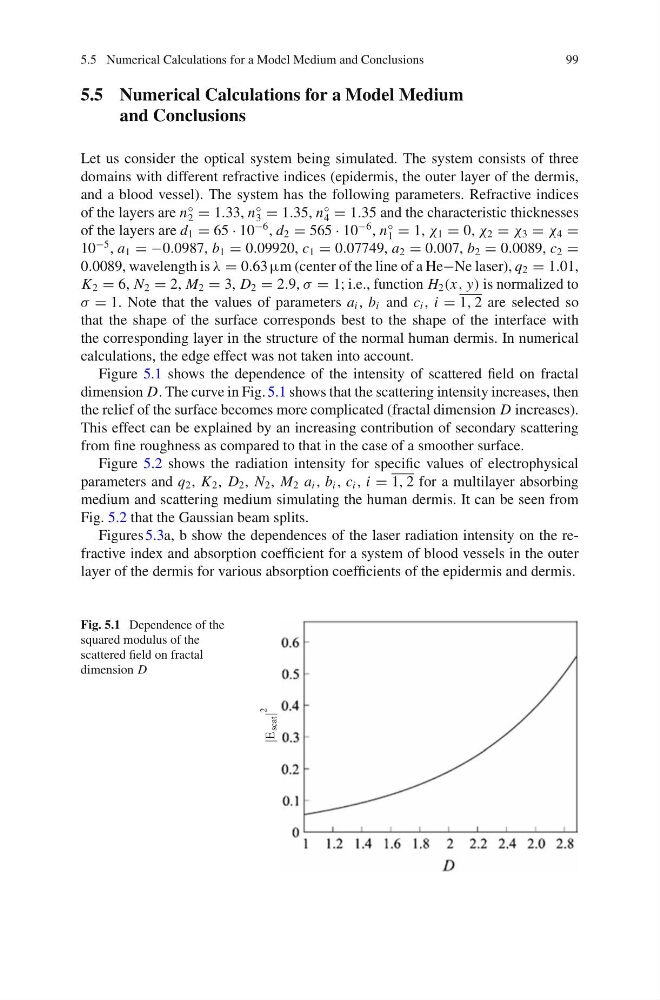
Figure 5.1 shows the dependence of the intensity of scattered field on fractal
dimension D. The curve in Fig. 5.1 shows that the scattering intensity increases, then
the relief of the surface becomes more complicated (fractal dimension D increases).
This effect can be explained by an increasing contribution of secondary scattering
from fine roughness as compared to that in the case of a smoother surface.
Figure 5.2 shows the radiation intensity for specific values of electrophysical
parameters and q 2 , K 2 , D 2 , N 2 , M 2 a i , b i , c i , i = 1, 2 for a multilayer absorbing
medium and scattering medium simulating the human dermis. It can be seen from
Fig. 5.2 that the Gaussian beam splits.
Figures 5.3a, b show the dependences of the laser radiation intensity on the refractive index and absorption coefficient for a system of blood vessels in the outer
layer of the dermis for various absorption coefficients of the epidermis and dermis.
Fig. 5.1 Dependence of the
squared modulus of the
scattered field on fractal
dimension D
scat
2
99
5.5 Numerical Calculations for a Model Medium
and Conclusions
Let us consider the optical system being simulated. The system consists of three
domains with different refractive indices (epidermis, the outer layer of the dermis,
and a blood vessel). The system has the following parameters. Refractive indices
of the layers are n
◦
2 = 1.33, n
◦
3 = 1.35, n
◦
4 = 1.35 and the characteristic thicknesses
of the layers are d 1 = 65 · 10
−6 , d 2 = 565 · 10
−6 , n
◦
1 = 1, χ 1 = 0, χ 2 = χ 3 = χ 4 =
10
−5 , a 1 = −0.0987, b 1 = 0.09920, c 1 = 0.07749, a 2 = 0.007, b 2 = 0.0089, c 2 =
0.0089, wavelength is λ = 0.63 µm (center of the line of a He−Ne laser), q 2 = 1.01,
K 2 = 6, N 2 = 2, M 2 = 3, D 2 = 2.9, σ = 1; i.e., function H 2 (x, y) is normalized to
σ = 1. Note that the values of parameters a i , b i and c i , i = 1, 2 are selected so
that the shape of the surface corresponds best to the shape of the interface with
the corresponding layer in the structure of the normal human dermis. In numerical
calculations, the edge effect was not taken into account.
Figure 5.1 shows the dependence of the intensity of scattered field on fractal
dimension D. The curve in Fig. 5.1 shows that the scattering intensity increases, then
the relief of the surface becomes more complicated (fractal dimension D increases).
This effect can be explained by an increasing contribution of secondary scattering
from fine roughness as compared to that in the case of a smoother surface.
Figure 5.2 shows the radiation intensity for specific values of electrophysical
parameters and q 2 , K 2 , D 2 , N 2 , M 2 a i , b i , c i , i = 1, 2 for a multilayer absorbing
medium and scattering medium simulating the human dermis. It can be seen from
Fig. 5.2 that the Gaussian beam splits.
Figures 5.3a, b show the dependences of the laser radiation intensity on the refractive index and absorption coefficient for a system of blood vessels in the outer
layer of the dermis for various absorption coefficients of the epidermis and dermis.
Fig. 5.1 Dependence of the
squared modulus of the
scattered field on fractal
dimension D
scat
2