

3 EEG Spectral Analysis
39
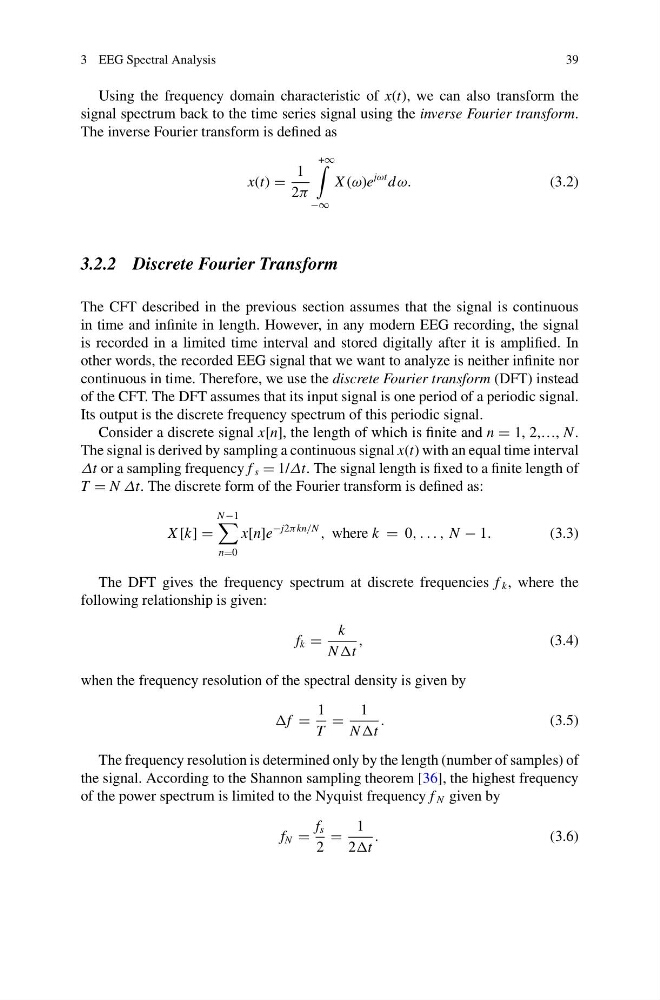
Using the frequency domain characteristic of x(t), we can also transform the
signal spectrum back to the time series signal using the inverse Fourier transform.
The inverse Fourier transform is defined as
x(t)
1
2π
+∞
−∞
X (ω)e
jωt d ω.
(3.2)
3.2.2 Discrete Fourier Transform
The CFT described in the previous section assumes that the signal is continuous
in time and infinite in length. However, in any modern EEG recording, the signal
is recorded in a limited time interval and stored digitally after it is amplified. In
other words, the recorded EEG signal that we want to analyze is neither infinite nor
continuous in time. Therefore, we use the discrete Fourier transform (DFT) instead
of the CFT. The DFT assumes that its input signal is one period of a periodic signal.
Its output is the discrete frequency spectrum of this periodic signal.
Consider a discrete signal x[n], the length of which is finite and n 1, 2,…, N.
The signal is derived by sampling a continuous signal x(t) with an equal time interval
Δt or a sampling frequency f s 1/Δt. The signal length is fixed to a finite length of
T N Δt. The discrete form of the Fourier transform is defined as:
X [k]
N −1
n0
x[n]e
−j2πkn/N
, where k 0, . . . , N − 1.
(3.3)
The DFT gives the frequency spectrum at discrete frequencies f k , where the
following relationship is given:
f k
k
N t
,
(3.4)
when the frequency resolution of the spectral density is given by
f
1
T
1
N t
.
(3.5)
The frequency resolution is determined only by the length (number of samples) of
the signal. According to the Shannon sampling theorem [36], the highest frequency
of the power spectrum is limited to the Nyquist frequency f N given by
f N
f s
2
1
2t
.
(3.6)
39
Using the frequency domain characteristic of x(t), we can also transform the
signal spectrum back to the time series signal using the inverse Fourier transform.
The inverse Fourier transform is defined as
x(t)
1
2π
+∞
−∞
X (ω)e
jωt d ω.
(3.2)
3.2.2 Discrete Fourier Transform
The CFT described in the previous section assumes that the signal is continuous
in time and infinite in length. However, in any modern EEG recording, the signal
is recorded in a limited time interval and stored digitally after it is amplified. In
other words, the recorded EEG signal that we want to analyze is neither infinite nor
continuous in time. Therefore, we use the discrete Fourier transform (DFT) instead
of the CFT. The DFT assumes that its input signal is one period of a periodic signal.
Its output is the discrete frequency spectrum of this periodic signal.
Consider a discrete signal x[n], the length of which is finite and n 1, 2,…, N.
The signal is derived by sampling a continuous signal x(t) with an equal time interval
Δt or a sampling frequency f s 1/Δt. The signal length is fixed to a finite length of
T N Δt. The discrete form of the Fourier transform is defined as:
X [k]
N −1
n0
x[n]e
−j2πkn/N
, where k 0, . . . , N − 1.
(3.3)
The DFT gives the frequency spectrum at discrete frequencies f k , where the
following relationship is given:
f k
k
N t
,
(3.4)
when the frequency resolution of the spectral density is given by
f
1
T
1
N t
.
(3.5)
The frequency resolution is determined only by the length (number of samples) of
the signal. According to the Shannon sampling theorem [36], the highest frequency
of the power spectrum is limited to the Nyquist frequency f N given by
f N
f s
2
1
2t
.
(3.6)