

10 Computational EEG Analysis for Hyperscanning …
223
⎡
⎢
⎢
⎢
⎢
⎢
⎢
⎣
x
S1
Ch1 (n)
x
S1
Ch2 (n)
. . .
x
SN
Ch M (n)
⎤
⎥
⎥
⎥
⎥
⎥
⎥
⎦
m
i1
A i
⎡
⎢
⎢
⎢
⎢
⎢
⎢
⎣
x
S1
Ch1 (n − i)
x
S1
Ch2 (n − i)
. . .
x
SN
Ch M (n − i)
⎤
⎥
⎥
⎥
⎥
⎥
⎥
⎦
+
⎡
⎢
⎢
⎢
⎢
⎢
⎢
⎣
w
S1
Ch1 (n)
w
S1
Ch2 (n)
. . .
w
SN
Ch M (n)
⎤
⎥
⎥
⎥
⎥
⎥
⎥
⎦
,
(10.8)
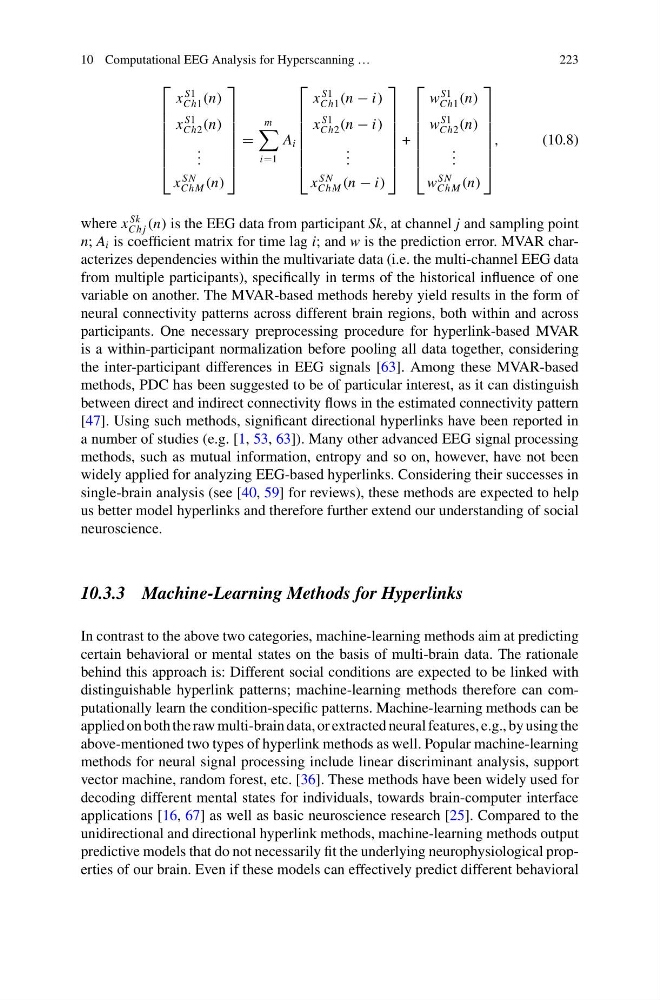
where x
Sk
Ch j (n) is the EEG data from participant Sk, at channel j and sampling point
n; A i is coefficient matrix for time lag i; and w is the prediction error. MVAR characterizes dependencies within the multivariate data (i.e. the multi-channel EEG data
from multiple participants), specifically in terms of the historical influence of one
variable on another. The MVAR-based methods hereby yield results in the form of
neural connectivity patterns across different brain regions, both within and across
participants. One necessary preprocessing procedure for hyperlink-based MVAR
is a within-participant normalization before pooling all data together, considering
the inter-participant differences in EEG signals [63]. Among these MVAR-based
methods, PDC has been suggested to be of particular interest, as it can distinguish
between direct and indirect connectivity flows in the estimated connectivity pattern
[47]. Using such methods, significant directional hyperlinks have been reported in
a number of studies (e.g. [1, 53, 63]). Many other advanced EEG signal processing
methods, such as mutual information, entropy and so on, however, have not been
widely applied for analyzing EEG-based hyperlinks. Considering their successes in
single-brain analysis (see [40, 59] for reviews), these methods are expected to help
us better model hyperlinks and therefore further extend our understanding of social
neuroscience.
10.3.3 Machine-Learning Methods for Hyperlinks
In contrast to the above two categories, machine-learning methods aim at predicting
certain behavioral or mental states on the basis of multi-brain data. The rationale
behind this approach is: Different social conditions are expected to be linked with
distinguishable hyperlink patterns; machine-learning methods therefore can computationally learn the condition-specific patterns. Machine-learning methods can be
applied on both the raw multi-brain data, or extracted neural features, e.g., by using the
above-mentioned two types of hyperlink methods as well. Popular machine-learning
methods for neural signal processing include linear discriminant analysis, support
vector machine, random forest, etc. [36]. These methods have been widely used for
decoding different mental states for individuals, towards brain-computer interface
applications [16, 67] as well as basic neuroscience research [25]. Compared to the
unidirectional and directional hyperlink methods, machine-learning methods output
predictive models that do not necessarily fit the underlying neurophysiological properties of our brain. Even if these models can effectively predict different behavioral
223
⎡
⎢
⎢
⎢
⎢
⎢
⎢
⎣
x
S1
Ch1 (n)
x
S1
Ch2 (n)
. . .
x
SN
Ch M (n)
⎤
⎥
⎥
⎥
⎥
⎥
⎥
⎦
m
i1
A i
⎡
⎢
⎢
⎢
⎢
⎢
⎢
⎣
x
S1
Ch1 (n − i)
x
S1
Ch2 (n − i)
. . .
x
SN
Ch M (n − i)
⎤
⎥
⎥
⎥
⎥
⎥
⎥
⎦
+
⎡
⎢
⎢
⎢
⎢
⎢
⎢
⎣
w
S1
Ch1 (n)
w
S1
Ch2 (n)
. . .
w
SN
Ch M (n)
⎤
⎥
⎥
⎥
⎥
⎥
⎥
⎦
,
(10.8)
where x
Sk
Ch j (n) is the EEG data from participant Sk, at channel j and sampling point
n; A i is coefficient matrix for time lag i; and w is the prediction error. MVAR characterizes dependencies within the multivariate data (i.e. the multi-channel EEG data
from multiple participants), specifically in terms of the historical influence of one
variable on another. The MVAR-based methods hereby yield results in the form of
neural connectivity patterns across different brain regions, both within and across
participants. One necessary preprocessing procedure for hyperlink-based MVAR
is a within-participant normalization before pooling all data together, considering
the inter-participant differences in EEG signals [63]. Among these MVAR-based
methods, PDC has been suggested to be of particular interest, as it can distinguish
between direct and indirect connectivity flows in the estimated connectivity pattern
[47]. Using such methods, significant directional hyperlinks have been reported in
a number of studies (e.g. [1, 53, 63]). Many other advanced EEG signal processing
methods, such as mutual information, entropy and so on, however, have not been
widely applied for analyzing EEG-based hyperlinks. Considering their successes in
single-brain analysis (see [40, 59] for reviews), these methods are expected to help
us better model hyperlinks and therefore further extend our understanding of social
neuroscience.
10.3.3 Machine-Learning Methods for Hyperlinks
In contrast to the above two categories, machine-learning methods aim at predicting
certain behavioral or mental states on the basis of multi-brain data. The rationale
behind this approach is: Different social conditions are expected to be linked with
distinguishable hyperlink patterns; machine-learning methods therefore can computationally learn the condition-specific patterns. Machine-learning methods can be
applied on both the raw multi-brain data, or extracted neural features, e.g., by using the
above-mentioned two types of hyperlink methods as well. Popular machine-learning
methods for neural signal processing include linear discriminant analysis, support
vector machine, random forest, etc. [36]. These methods have been widely used for
decoding different mental states for individuals, towards brain-computer interface
applications [16, 67] as well as basic neuroscience research [25]. Compared to the
unidirectional and directional hyperlink methods, machine-learning methods output
predictive models that do not necessarily fit the underlying neurophysiological properties of our brain. Even if these models can effectively predict different behavioral