

218
D. Zhang
recording of multiple participants is preferred, this kind of hyperlink can be applied
to ‘off-line’ recorded data as well, as long as the data are from participants receiving
identical social stimulations.
Indeed, a number of studies have shown that human brain activities can be highly
reliable under naturalistic stimulus conditions. Originally termed as inter-subject correlation (ISC) and applied for fMRI data, significant hyperlinks were found when a
group of five participants watched half an hour of a popular movie. Results revealed
that hyperlinks existed beyond the primary and secondary visual cortex, including
higher-level visual processing regions, auditory regions, etc. [21]. Follow-up fMRI
studies reported that ISC spatial patterns could be modulated by the content of the
visual stimuli, with unstructured movie clips showing the minimal hyperlink-based
activation and highly structured movie clips eliciting a reliable hyperlink across a
widespread brain network including the parietal and frontal regions as well [22].
Another ISC-based fMRI study reported a bilateral network for speech production,
extending our previous understanding of left lateralized network [57]. The calculated hyperlink could also predict human behaviors, for instance, the powerfulness
of political speeches [51]. The hyperlink in fMRI data is usually calculated using
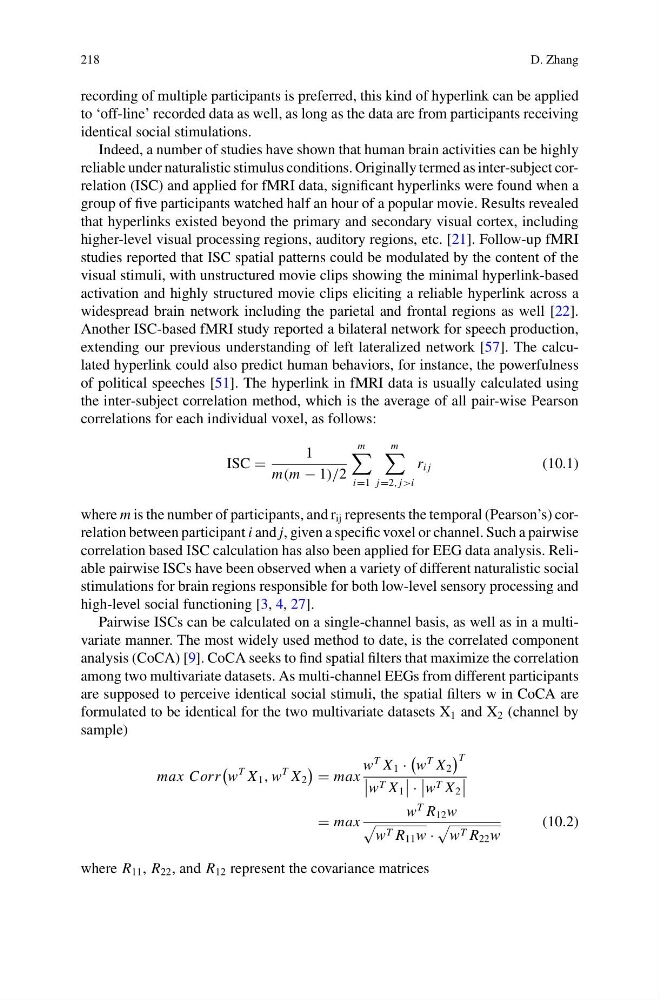
the inter-subject correlation method, which is the average of all pair-wise Pearson
correlations for each individual voxel, as follows:
ISC
1
m(m − 1)/2
m
i1
m
j2, j>i
r i j
(10.1)
where m is the number of participants, and r ij represents the temporal (Pearson’s) correlation between participant i and j, given a specific voxel or channel. Such a pairwise
correlation based ISC calculation has also been applied for EEG data analysis. Reliable pairwise ISCs have been observed when a variety of different naturalistic social
stimulations for brain regions responsible for both low-level sensory processing and
high-level social functioning [3, 4, 27].
Pairwise ISCs can be calculated on a single-channel basis, as well as in a multivariate manner. The most widely used method to date, is the correlated component
analysis (CoCA) [9]. CoCA seeks to find spatial filters that maximize the correlation
among two multivariate datasets. As multi-channel EEGs from different participants
are supposed to perceive identical social stimuli, the spatial filters w in CoCA are
formulated to be identical for the two multivariate datasets X 1 and X 2 (channel by
sample)
max Corr
w
T X 1 , w
T X 2
max
w
T X 1 ·
w
T X 2
T
w T X 1
·
w T X 2
max
w
T R 12 w
w T R 11 w ·
w T R 22 w
(10.2)
where R 11 , R 22 , and R 12 represent the covariance matrices
D. Zhang
recording of multiple participants is preferred, this kind of hyperlink can be applied
to ‘off-line’ recorded data as well, as long as the data are from participants receiving
identical social stimulations.
Indeed, a number of studies have shown that human brain activities can be highly
reliable under naturalistic stimulus conditions. Originally termed as inter-subject correlation (ISC) and applied for fMRI data, significant hyperlinks were found when a
group of five participants watched half an hour of a popular movie. Results revealed
that hyperlinks existed beyond the primary and secondary visual cortex, including
higher-level visual processing regions, auditory regions, etc. [21]. Follow-up fMRI
studies reported that ISC spatial patterns could be modulated by the content of the
visual stimuli, with unstructured movie clips showing the minimal hyperlink-based
activation and highly structured movie clips eliciting a reliable hyperlink across a
widespread brain network including the parietal and frontal regions as well [22].
Another ISC-based fMRI study reported a bilateral network for speech production,
extending our previous understanding of left lateralized network [57]. The calculated hyperlink could also predict human behaviors, for instance, the powerfulness
of political speeches [51]. The hyperlink in fMRI data is usually calculated using
the inter-subject correlation method, which is the average of all pair-wise Pearson
correlations for each individual voxel, as follows:
ISC
1
m(m − 1)/2
m
i1
m
j2, j>i
r i j
(10.1)
where m is the number of participants, and r ij represents the temporal (Pearson’s) correlation between participant i and j, given a specific voxel or channel. Such a pairwise
correlation based ISC calculation has also been applied for EEG data analysis. Reliable pairwise ISCs have been observed when a variety of different naturalistic social
stimulations for brain regions responsible for both low-level sensory processing and
high-level social functioning [3, 4, 27].
Pairwise ISCs can be calculated on a single-channel basis, as well as in a multivariate manner. The most widely used method to date, is the correlated component
analysis (CoCA) [9]. CoCA seeks to find spatial filters that maximize the correlation
among two multivariate datasets. As multi-channel EEGs from different participants
are supposed to perceive identical social stimuli, the spatial filters w in CoCA are
formulated to be identical for the two multivariate datasets X 1 and X 2 (channel by
sample)
max Corr
w
T X 1 , w
T X 2
max
w
T X 1 ·
w
T X 2
T
w T X 1
·
w T X 2
max
w
T R 12 w
w T R 11 w ·
w T R 22 w
(10.2)
where R 11 , R 22 , and R 12 represent the covariance matrices